
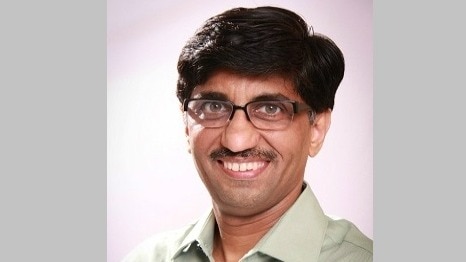
A journey that began as a student at IIT Kanpur led Abhay Karandikar to nearly three decades as a professor at IIT Bombay, where his work in telecommunications and wireless networks helped shape India's contribution to 5G and emerging 6G technologies.There are careers which advance by a straight road, and there are those which take the traveller from the classroom to the workshop, from the workshop to the public office. The career of Professor Abhay Karandikar, an IITian, who served as IIT Kanpur director belongs to the latter kind. He is now a Member of NITI Aayog, appointed in April 2026. Yet much of his working life was spent among students, laboratories, networks, and communications.He received his MTech in Electrical Engineering from IIT Kanpur in 1988 and his PhD there in 1994. His academic training was in communications networks, a field that later grew central to mobile telephony and the internet.FROM IIT KANPUR TO THE FIELD OF TECHNOLOGYIn 1997, Karandikar joined the Electrical Engineering Department of IIT Bombay. There he remained, on lien during later public appointments, for nearly three decades. His duties widened with time. He headed the Computer Centre, led the Electrical Engineering Department, served as the first Professor-in-Charge of the IIT Bombay Research Park, and became Dean of Faculty Affairs.His research dealt with wired and wireless networks, resource allocation, software-defined networking, and extending broadband to places where conventional infrastructure was costly. It was this last question that gave his work a distinct Indian purpose. His group worked on what came to be called “Frugal 5G”, seeking network arrangements suited to affordable rural broadband.The work moved into questions of standards, regulation, and access. Karandikar helped establish the Telecom Standards Development Society, India (TSDSI), the country’s telecom standards body, and served as its founding member and former chairman.His research also contributed to IEEE standards, including IEEE 1930.1 and IEEE 2061, the latter concerning architecture for affordable broadband networks. His team’s work on rural broadband received the Mozilla Open Innovation Challenge prize in 2017.LEADING IIT KANPUR, SHAPING SCIENCE POLICYIn April 2018, he left IIT Bombay temporarily to become Director of IIT Kanpur. He held that office until September 2023.During those five years, the institute expanded academic and research infrastructure, strengthened incubation, and advanced plans for a medical school devoted to medical technology. It pursued new research facilities, faculty expansion, industry partnerships, and international collaborations.IIT Kanpur records that its incubation efforts were consolidated under the Foundation for Innovation and Research in Science and Technology.On 3 October 2023, Karandikar entered the Union Government as Secretary of the Department of Science and Technology. His tenure coincided with the operationalisation of the Anusandhan National Research Foundation and the National Quantum Mission.The Department also advanced a 1 lakh crore Research, Development and Innovation Fund intended to support research in the private sector and deep-tech start-ups. Other programmes covered clean energy, green hydrogen, advanced materials, geospatial technologies, manufacturing and research infrastructure, and technology incubation.The transition from professor to policy-maker was not an abrupt change of profession.Telecommunications had carried Karandikar from research into standards and regulation; the directorship took him into institutional administration; the Science and Technology Department brought him into national research policy. In May 2026, he moved again, this time to NITI Aayog.There he brings engineering training, an academic’s acquaintance with research, and administrative experience across universities and government.NITI Aayog lists his present interests as telecommunications, wireless networking, electronics and semiconductors, artificial intelligence, and quantum communication. The road from IIT Kanpur to IIT Bombay, from the institute directorship to the Department of Science and Technology, and then to NITI Aayog, is less a change of subject than a widening of the same inquiry: how knowledge in the laboratory may enter the life of the country.- EndsPublished By: Rishab ChauhanPublished On: Sep 23, 2026 19:12 IST
From IIT Kanpur student to IIT Bombay professor: The scientist behind India's 5G and 6G
Full Article
Original Source
Read the full article at Indiatoday →KhanList aggregates and links to publicly available news content. We do not host full articles from third-party sources. Always verify important information with original sources.