
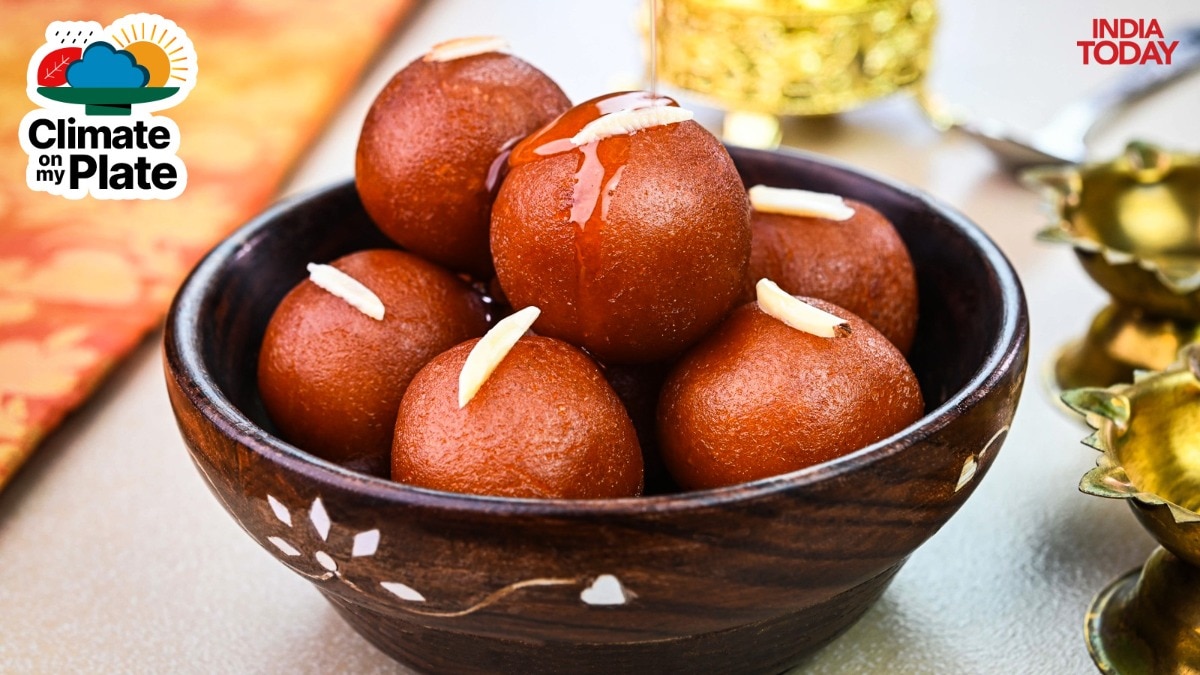
This week, India Today Science's Climate On My Plate points the spotlight on India's beloved delicacies, and how a warming planet is harming the ingredients used to craft traditional sweets.A bowl full of gulab jamun is seen sitting on a table. (Photo: Getty)For millions of Indians, a box of mithai is an integral part of almost every celebration. A festival, wedding, or a birthday feels incomplete without a gulab jamun, jalebi, ladoo or kaju katli. The list, as most know, is expansive.But behind that box that symbolises an occasion worth celebrating, or a guilty treat, is part of a lesser-known food chain that remains vulnerable to a warming planet.Sugarcane, wheat, chickpea, sesame and cashew, all ingredients that go into some of India’s most-loved sweets, are now exposed to rising temperatures, changing rainfall, drought and extreme weather. A person takes a piece from a variety of Indian sweets decorated on a plate. (Photo: Getty) In other words, a warming, unpredictable climate could affect how these ingredients are grown, how much they cost and, eventually, what ends up in India’s sweet boxes. CAN SUGAR BE SAVED?Take almost any traditional sweet and there is a good chance sugar is involved.Gulab jamun, rasgulla, jalebi, peda and countless varieties of ladoo depend directly or indirectly on sugar, meaning they all rely on sugarcane. Similarly, jaggery, another staple sweetener, is also largely produced from sugarcane.But India’s sugar market is feeling the pressure of tighter supplies. Several pieces of gulab jamun are seen kept in a bowl. (Photo: Getty) Sugar prices rose in early August, reaching a record high as supplies tightened ahead of the country’s festival season, according to traders and industry officials cited by news agency Reuters.Poor rainfall in key sugar-producing states such as Maharashtra and Karnataka has also raised concerns about sugar output.The connection between weather and sugar supplies is not always straightforward. Sugarcane needs considerable water, and its performance depends not only on how much rain falls but also on when it arrives.Researchers are increasingly looking at varieties and farming practices that can use water more efficiently. People are seen examining which mithai to get at a sweet shop. (Photo: PTI) The Indian Council of Agricultural Research (ICAR) has called for climate-resilient sugarcane varieties with greater water-use and nutrient-use efficiency.So the next time a jalebi is soaked or a gulab jamun disappears into a bowl of sugar syrup, there is a much larger agricultural story behind it.WHAT ABOUT WHEAT, BESAN, CASHEWS AND SESAME?Sugar is only part of the story.Consider jalebi. Its crisp batter is traditionally made using refined wheat flour, or maida. Wheat is particularly vulnerable to high temperatures during critical stages of crop development.A 2024 study by researchers from several ICAR institutions examined how a changing climate is related to wheat yields across India and found that environmental factors play an important role in determining production. Pieces of jalebis are seen on display. (Photo: Getty) Then there is besan, or gram flour, which is the foundation of many ladoos, Mysore pak and other sweets.It comes from chickpeas, whose response to climate change can vary considerably depending on where it is grown.A study examining chickpeas in South Asia and East Africa found that climate change could affect yields substantially, while drought and heat-tolerant varieties could help reduce potential losses.In other words, even the besan in a ladoo is connected to the climate.Then it is the people's favourite, kaju katli.Some of India’s most recognisable sweets depend on ingredients grown far from the wheat and sugarcane fields of northern India.Kaju katli, for instance, begins with cashew. Kaju Katlis are put on display in an appealing pattern. (Photo: Getty) India has a long history of cashew cultivation, particularly along its western and eastern coasts. But the crop is sensitive to changes in rainfall and moisture availability.ICAR's Directorate of Cashew Research has stated that most Indian cashew plantations are rain-fed and provide contingency measures for delayed monsoons, rainfall deficits and drought.Research from Odisha has also highlighted the importance of identifying cashew varieties that can remain productive under changing conditions.A six-year assessment of 25 varieties found significant differences in their yield performance and adaptability.In the cashew’s case, climate stress does not always mean complete crop failure. Sometimes it means smaller harvests, poorer quality or greater production costs. And those changes can often permeate from the farm all the way to the market. Different kinds of sweets are seen at a shop. (Photo: Getty) That is an important distinction.Climate change does not simply mean every crop will suffer whenever temperatures rise as agriculture responds to a complicated combination of temperature, rainfall, timing and extreme events.For farmers, the biggest challenge may therefore be unpredictability.It's for that reason that across India’s agricultural research system, scientists are working on heat and drought-tolerant crop varieties and more efficient water management. A lady is seen arranging sweets to display them for sale. (Photo: Getty) For consumers, the changes may appear through fluctuations in the price of sugar, nuts, flour or other ingredients.Sweets might not disappear, but they do grow, with each passing day, more symbolic of a changing world.Look closely at a box of mithai, and it might tell you the story of India’s farms. It might remind you that climate change is not only altering India’s landscapes and weather, but also damaging traditions that have lasted the test of time, at least so far.#Climateonmyplate- EndsPublished On: Aug 12, 2026 09:00 IST
From gulab jamun to ladoo: Climate change is stealing India's sweets
Full Article
Original Source
Read the full article at Indiatoday →KhanList aggregates and links to publicly available news content. We do not host full articles from third-party sources. Always verify important information with original sources.