
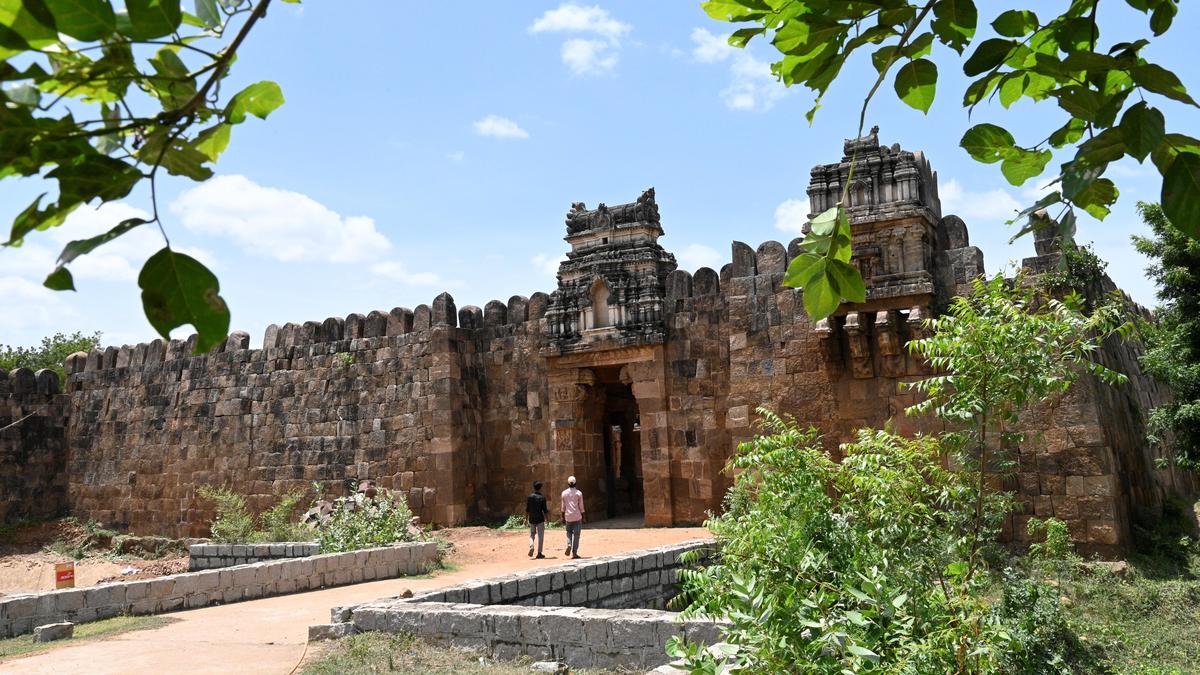
For Sanjeev Borgaonkar and Shaik Wajid, who were part of a tourist troupe from Pune, a visit to Siddhavatam Fort was meant to be another stop on their tour of Andhra Pradesh. Instead, the imposing citadel held their attention long after their families had moved on. Perched on the banks of the Penna River, amid the Palakonda and Veligonda hill ranges, the centuries-old fort continues to draw visitors—even as the heritage site waits to reclaim some of its lost glory.That fascination is shared by many who make their way to the fort, especially on weekends. Even as restoration work taken up by Archaeological Survey of India (ASI) is currently under way, tourists from the neighbouring districts continue to arrive at the fort, undeterred by the lack of snacks and drinking water facilities in the vicinity. “Even the toilets needs enhancement,” says Mr. Borgaonkar.But, the fort’s location has meant more than strategic advantage over the centuries. Siddhavatam Fort, also known as Sidhout Fort, stands as a reminder of the contributions of successive regional rulers and remains a largely unexplored tourist destination in Rayalaseema region. Nestled between the Palakonda (or Lankamalla) and Veligonda hill ranges, it is situated on the left bank of Penna or Pinakini river in Kadapa district of Andhra Pradesh.It’s location also gives Siddhavatam a religious significance. For devotees arriving from the south, the area is considered the gateway to the pilgrimage centre of Srisailam, revered as ‘Dakshin Kashi’. Situated on 30 acres of land, the site is known for its monumental gateways, ornately-carved pillars, and seventeen bastions, besides numerous places of worship.Among these places of worship is Siddheswara or Siddhavateswara temple, believed to date to the 13th century, based on the wall inscription dated 1233 CE and associated with the reign of Rajendra III of the Chola dynasty. That inscription, written in a mix of Tamil and Grantha characters, records the construction of the western Gopuram. It also indicates that the temple was already a fully functional place of worship in the 13th century, before the site was fortified for military purposes.Historical beginningIts initial construction began in 1303 CE under the Matti or Matli kings of the Tuluva dynasty. An older record available with the Archaeological Survey of India (ASI) states that the fort was constructed by Ananta Raja in 1303 CE. The Matli chiefs were a powerful regional family who became prominent during the Vijayanagara Empire and gained political authority in the Siddhavatam Seema (region) by the 16th century. “The era of King Sadasivaraya of Vijayanagara witnessed weddings with the Matli family, thus increasing their political influence far and wide. The most notable ruler in the family was Matli Ananta Raja, a major regional chief and military leader who patronised temples and public works such as tanks and ponds,” explains Sivakumar Challa, founder of the Archaeological Research Group (ARG) and curator of TTD’s SV Museum.The centuries that followed saw the site transformed and strengthened, with the fort taking shape. Major historical evidence of this development is reflected in the 1605 CE inscription found on the eastern wall near the old fort’s entrance, which belongs to Venkatapati Raya II of Vijayanagara. The Telugu inscription, beginning with a Sanskrit verse, records the achievements of Matli Ananta, son of Ellama Raju, and details the political history of Siddhavatam Seema. After Ellama Raju captured the region from Kondaraju Tirupati Raju in battle, Ananta embarked on the task of building the fort and a protective stone wall around the town. Restoration work by the Archaeological Survey of India in progress at the fort. | Photo Credit: K.V. Poornachandra Kumar The Matli kings developed the mud fort into a stone fort, as cited by a study by University of Hyderabad, in view of their wider political connections with the later Vijayanagaraja empire. That strategic advantage has endured over the centuries. Even today, the Tirupati-Kadapa and Kadapa-Badvel-Nellore routes pass through this region.However, this golden era of Vijayanagara alignment was just one chapter in Siddhavatam’s history, as its prized location soon attracted the attention of new ruling dynasties.Despite suffering a loss of territory, the Matli kings still ruled a portion of land during 1644-1645 CE. It was at this time that the region witnessed a larger political struggle among the local Nayaka kings, the Vijayanagara rulers, and the expanding Deccan Sultanates. The Vijayanagara Empire had weakened by the 17th century, and the region’s political authority began to shift slowly towards the Golconda Sultanate.This shift became more pronounced in the decades that followed when the Mughal imperial system started taking over the region, culminating in the fort coming under the Golconda Sultanate. Mir Jumla II, a commander associated with Aurangzeb’s rule, captured Siddhavatam around 1682 CE, along with other territories in the region, marking a major political transition from the sphere of the Vijayanagara-associated Matli chiefs into the Deccan’s Islamic political order.Following the decline of both Golconda and Mughal authority, the fort changed hands once again, coming under the control of the Nawabs of Cuddapah (Kadapa) in the 18th century. Specifically, in 1714 CE, the Kadapa ruler Abdul Nabi Khan captured Siddhavatam and transformed it into a major power centre.However, this shift in power did not end there. Driven by Mysorean expansion, Hyder Ali captured Siddhavatam in 1779–80 CE. His hold over the region was brief, as control soon passed to the Nizams of Hyderabad in the early 1790s, before the British East India Company gained total control by 1800 CE.From a military stronghold that changed among regional rulers, Siddhavatam briefly assumed a very different role under the British. What was a mere military fort under the British became, albeit temporarily, an administrative headquarters of Cuddapah district from 1807 to 1812. However, floods in the Penna river ravaged the region and made life difficult for the administrators, prompting the capital to be shifted back from Siddhavatam to Cuddapah in 1812. For a brief period, the fort had thus served as the district capital.InscriptionsThe fort’s brief stint as administrative capital was only one chapter in its long history. It’s walls, however, continued to preserve traces of the many eras that shaped Siddhavatam. Among the most valuable of these are the inscriptions, as gathered by the ASI, offering a glimpse into its rulers and the historical site.Among the inscriptions found in the fort, an important inscription copied in the year 1915 from the entrance on the eastern wall of the old fort pertains to the Vijayanagara dynasty’s Vira Venkataraya, ruling the Chandragiri Seema, during the Saka 1527, the Viswavasu year. “The text in Sanskrit and Telugu registers that this stone fort was extended by the Matli chief Ananta of the solar race, whose father Ellama Raja conquered Siddhavata after fighting the battle of Utukuru,” says K. Muniratnam Reddy, Director (Epigraphy), ASI, Mysuru. The 17th century inscription found on the walls of the fort in Kadapa district. | Photo Credit: K.V. POORNACHANDRA KUMAR Another inscription on the slab set up at the entrance into the Jumma Masjid, pertaining to Pratapa Deva’s period in Vijayanagara dynasty, seems to register a gift of land, but the slab was seriously damaged. Another slab lying in front of the ruined Siva temple in the fort (Saka 1607, Krodhi, Phalguna) records the obeisance of Gangi-Reddi and others to god Siddhesvara and the goddess Kamakshamma.An inscription on the wall of the Masjid, pertaining to Mughal emperor Aurangzeb’s period (1113H or 1701 AD) shows a Persian verse indicating the building of the mosque and a garden around by Sayyid Muhammad in 1113H during the reign of Aurangzeb. Another one at the lintel of the Masjid’s entrance was an epitaph (1772 AD) from the tomb of some saint, containing Islamic creed and the chronogram of his death, in a Persian verse.The inscriptions on the three tombstones in the masjid’s burial ground record, in Persian, the death of Asghar Ali (1739 AD), the chronogram of the death of Quadir (1700 AD), and the death of a lady named Nargis in 1114 AH (1702 AD). While these inscriptions offer valuable glimpses into the site’s historical and administrative past, its architectural remains bring that history to life in stone.Architectural heritageAt Siddhavatam Fort, visitors can witness a grand blend of South Indian Hindu fortification, the inimitable architectural aesthetics of the Vijayanagara era, and the military adaptations of the Nawabi era. Constructed in phases over the centuries, the fort features a defensive system of colossal walls, a formidable moat, and scores of bastions—all pointing to the dynamic planning of past rulers in response to lurking dangers.To provide an additional layer of reinforcement, the fort’s southern side features a deep trench, an architectural element often associated with a faussebraye defense system. Local legends even claim that crocodiles were bred in this trench to deter enemies from crossing into the fortified area. Complementing these water defenses are seventeen square bastions, which served as elevated observation points across the perimeter.While the citadels and bastions reveal the military and administrative face of the fort, the sculptural grandeur is hard to miss. The architectural ornamentation along the passage, the facade or the watch tower is so nuanced that the place is often taken for a temple, not an office establishment or military barracks. This is again attributed to the modifications that the structure had undergone over a period of time.In the Vijayanagara architectural style, pillars are not just supportive structures, but they form a great platform for narration of mythological episodes, divine themes, and historical events.The image of Gajalakshmi, sculpted on the upper portions of the decorated gateway pillars, forms a major iconographic feature. An ancient motif in Indian art, Gajalakshmi is generally placed at the top of the threshold abutting the portico, as the Indian goddess of wealth is associated with prosperity, opulence, fertility, and auspiciousness.Similarly, the eastern gateway has images of Garuda and Hanuman, the powerful divine attendants of Maha Vishnu, as the guardians of the fort. The sculpture depicting ‘Dasavatharam’ (ten incarnations) of Maha Vishnu. Within the fort, there are temples for Siddhavateswara, Ranganatha, Bala Brahma, and Durga.Collectively, these sculptures of Hindu deities depicted on a military gateway and pillars were meant to derive courage and moral strength, besides symbolising the religious and cultural identity of the rulers. Tourists arriving at the ancient fort in Kadapa district. | Photo Credit: K.V. POORNACHANDRA KUMAR Other key attractions on the premises include the Jumma Masjid, a dilapidated Rani Mahal, and a horse stable. A subterranean passage from the rear portion of the fort leads to the River Penna, which, according to legend, was used by the royal family members, especially women.Tourism potentialBeyond its rich historical and architectural significance, the enduring structures at Siddhavatam Fort have also emerged as a major attraction for visitors. Although the site deserves to be included in the State’s larger heritage tourism, temple tourism, and eco-tourism network, there is not much to boast about.To bridge this gap, the State Ministry of Tourism has introduced ambitious plans to revitalise the area. These initiatives include developing curated temple tours in partnership with local guides, improving road connectivity and signage, installing colourful lighting on the Penna Bridge, and adding benches and resting spots for tourists.Kadapa Collector Sreedhar Cherukuri states that plans are under way to organise fort illumination for night shows, install interactive digital boards detailing the fort’s history—including QR codes for in-depth information—and highlight architectural features such as the Durbar Hall, the Royal Palace ruins, and the subterranean passages. To increase the tourist footfall, the dredge would also be cleaned up to introduce boating (both pedal and rowing).Perhaps the fort’s greatest story today is not what it once was, but what can still be saved. The State’s challenge, therefore, is not merely to document Siddhavatam Fort’s past but to protect what remains.
Beyond the walls of Siddhavatam Fort
Full Article
Original Source
Read the full article at Thehindu →KhanList aggregates and links to publicly available news content. We do not host full articles from third-party sources. Always verify important information with original sources.