
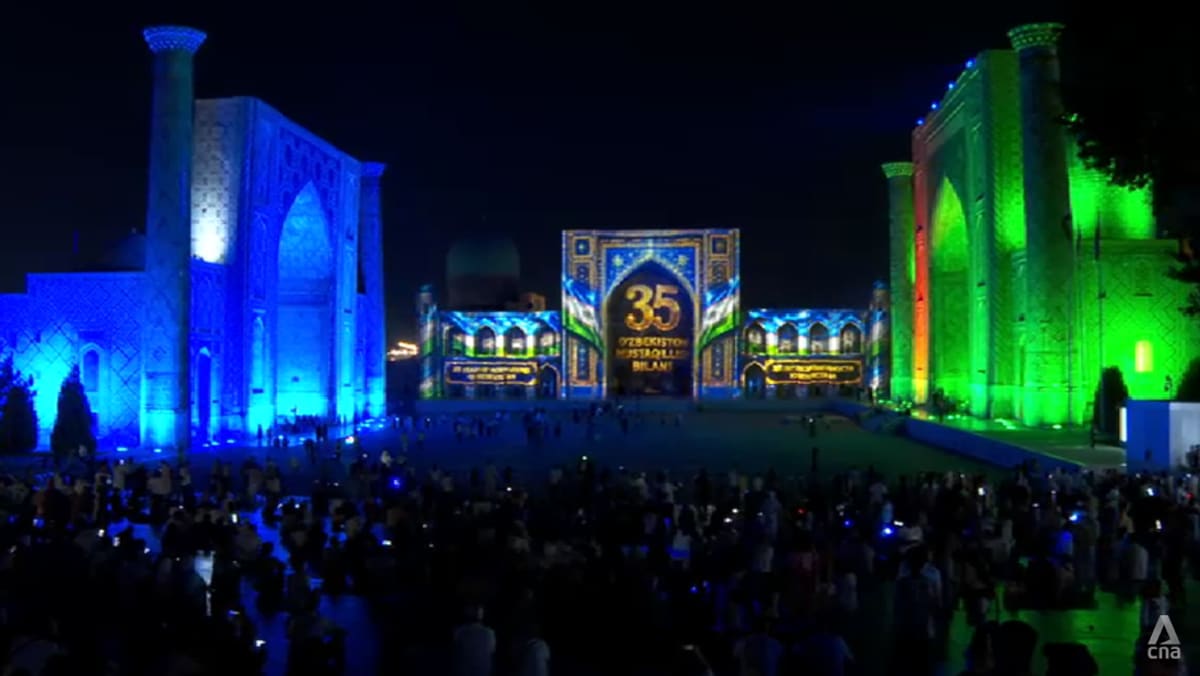
Singapore Singaporeans working in education in Uzbekistan are sharing their expertise – and learning from their hosts – as ties between the two countries deepen. Uzbekistan marks 35 years of independence on Sep 1. The nation's youthful population and growing international links have put a greater focus on developing the skills and talent needed for its future. (Image: CNA) New: You can now listen to articles. This audio is generated by an AI tool. UZBEKISTAN: Growing up in the ancient city of Bukhara, Amirbek Baxshilloyev was surrounded by craftsmanship. He comes from a family of artisans and is an eighth-generation practitioner of goldwork embroidery, a craft closely associated with the historic Silk Road city. But the teenager had ambitions that stretched far beyond his hometown. He attended a Russian-speaking public school and developed an interest in mathematics, and hoped to pursue his studies overseas. In his free time, the 17-year-old helped guide tourists around a mini museum at his family’s workshop – an experience that helped him improve his English. That dream recently became reality when he was accepted into the engineering physics programme at the prestigious Stanford University in California. “I'm proud to represent not just myself, but also an idea of someone from an underprivileged background getting into (such) schools. It inspires a lot of people,” Amirbek told CNA. His long-term ambition is bigger: He hopes to help solve the challenges standing in the way of fusion energy. He credits his achievement in part to Freshman Academy, an education centre in the Uzbek capital Tashkent. Among his mentors is Singaporean Nigel Li, who leads the academy’s research institute. Amirbek Baxshilloyev tells CNA about his journey to Stanford University and his hopes of inspiring other young people to dream big. NURTURING UZBEKISTAN'S YOUNG TALENTMr Li, 27, said many young people in Uzbekistan have enormous ambition but may lack access to the resources and skills needed to pursue it. “(The students here) are hungry for a lot of knowledge and opportunity, but they just don't have the tools,” he said. “We decided to … develop these programmes so that these students have the requisite skills to approach this complex world.” The academy helps students build skills such as critical thinking and writing, while connecting them with opportunities abroad, ranging from undergraduate studies to apprenticeship. Amirbek joined the academy’s Full Support programme, which guides students through the university application process. After securing his place at Stanford, he is now giving back by mentoring and coaching younger participants at the academy.For Mr Li, education is an area where Singapore has something distinctive to contribute as Uzbekistan becomes increasingly outward-looking. “Uzbekistan is hungry for expertise and knowledge and Singapore has a lot to offer,” he said. “While we may not be a manufacturing powerhouse the way China is, or have the capital that the United States has, we have the know-how of nation building. We have expertise in developing educational pedagogies.” Mr Nigel Li, director of Freshman Academy's research institute, tells CNA that Singapore's experience in education and nation-building could benefit Uzbekistan. (Image: CNA) Mr Li moved to Uzbekistan after returning to Singapore earlier this year from Washington, where he had worked and studied, specialising in conflict and arms control. “I wanted to contribute my knowledge differently,” he said. “Rather than trying to mitigate destruction, I wanted to plant the seeds for development and construction of a new generation's ability to build a better world.” What has struck him is the optimism he sees among Uzbekistan's youths. More than half of the country’s population of 38 million is under the age of 30. “Every young person I meet wants to do something – start a business, study abroad, develop their own artificial intelligence language model. We can learn a lot from the hopes and dreams of people here,” he said. As Uzbekistan marks 35 years of independence on Tuesday (Sep 1), the country is looking to shape its next chapter. Its youthful population and growing international links have put a greater focus on developing the skills and talent needed for its future. Mr Li is not the only Singaporean drawn to play a part. MAKING A LIFE IN SAMARKAND About 300km southwest of Tashkent, Singaporean Josiah Ng is contributing in another classroom. The 38-year-old teaches design and communications at the Samarkand International University of Technology. His connection with Uzbekistan began last year, when he travelled there to deliver guest lectures. He made the trip through Resource Exchange International, a non-profit organisation with a Singapore office that sends professionals to developing countries to share their expertise. The initial trip lasted just three weeks, but Uzbekistan left a strong impression on him. Mr Ng later returned – this time with his wife and two sons, aged 10 and six – to make Samarkand their home. Mr Josiah Ng and Ms Tricia Tan say moving to Samarkand with their two sons has helped their family become more resilient. (Image: CNA) “We (wanted to) stay here for a longer term because it's not so much about just giving guest lectures and then leave,” said Mr Ng. “We really resonated deeply with that vision to build people, to build nations. I think what that really means is to walk alongside the locals, to empower them, encourage them, to do much for their community.” Mr Ng sees opportunities for Uzbekistan to develop further in areas such as digitisation and sustainability, where he believes Singapore's experience could be useful. He said the exchange has gone both ways. Six months after relocating, the Ng family is still navigating a new language, culture and unfamiliar systems. Mr Ng's wife, Tricia Tan, who is also a staff member of Resource Exchange International, said local residents have repeatedly stepped in to help. “We have been really in such a privileged position to experience the love from the locals here,” she said. “A lot of them have been journeying with our family in different ways, helping us when language is a barrier or when systems are unfamiliar to us.” For the couple, working through those challenges while immersing themselves in another community has also made their family more resilient. DEEPENING SINGAPORE-UZBEKISTAN TIES The Singaporeans' work in Uzbekistan comes as ties between the two countries deepen. Senior Minister Lee Hsien Loong is on a visit to Uzbekistan from Aug 27 to 31 on his first trip to Central Asia. Delivering a speech to Uzbekistan’s Parliament in Tashkent on Monday (Aug 31). Mr Lee called for deeper cooperation between Singapore and Uzbekistan in various areas.“Singapore has prospered by staying open to the world,” he said.“By deepening ties with Uzbekistan and Central Asia through trade, education exchanges, and technical cooperation in water management and digitalisation, we build new markets, strengthen regional stability, and create opportunities for our people.”Mr Lee said stronger links could also open up opportunities for Singapore businesses and young people, as Uzbekistan strengthens its engagement with the global economy and Southeast Asia. “Our future depends on connections, not closures,” he said. “Through trade missions, student exchanges, and targeted capacity building in governance and fintech, we can help build a resilient, rules based region and at the same time secure new avenues of growth for Singaporeans.”Such exchanges are already taking place on a smaller, more personal scale through Singaporeans such as Mr Ng and Mr Li.For Mr Ng and his family, those links are being forged in classrooms, communities and everyday interactions. He believes both sides stand to gain. “With Singaporeans coming here and interacting with (the locals), that exchange of ideas, learning from one another, would indeed create a very thriving environment, not just for Uzbekistan, but for Singapore as well,” he said.
From classrooms to communities: Young Singaporeans build ties in Uzbekistan
Full Article
Original Source
Read the full article at Channelnewsasia →KhanList aggregates and links to publicly available news content. We do not host full articles from third-party sources. Always verify important information with original sources.