
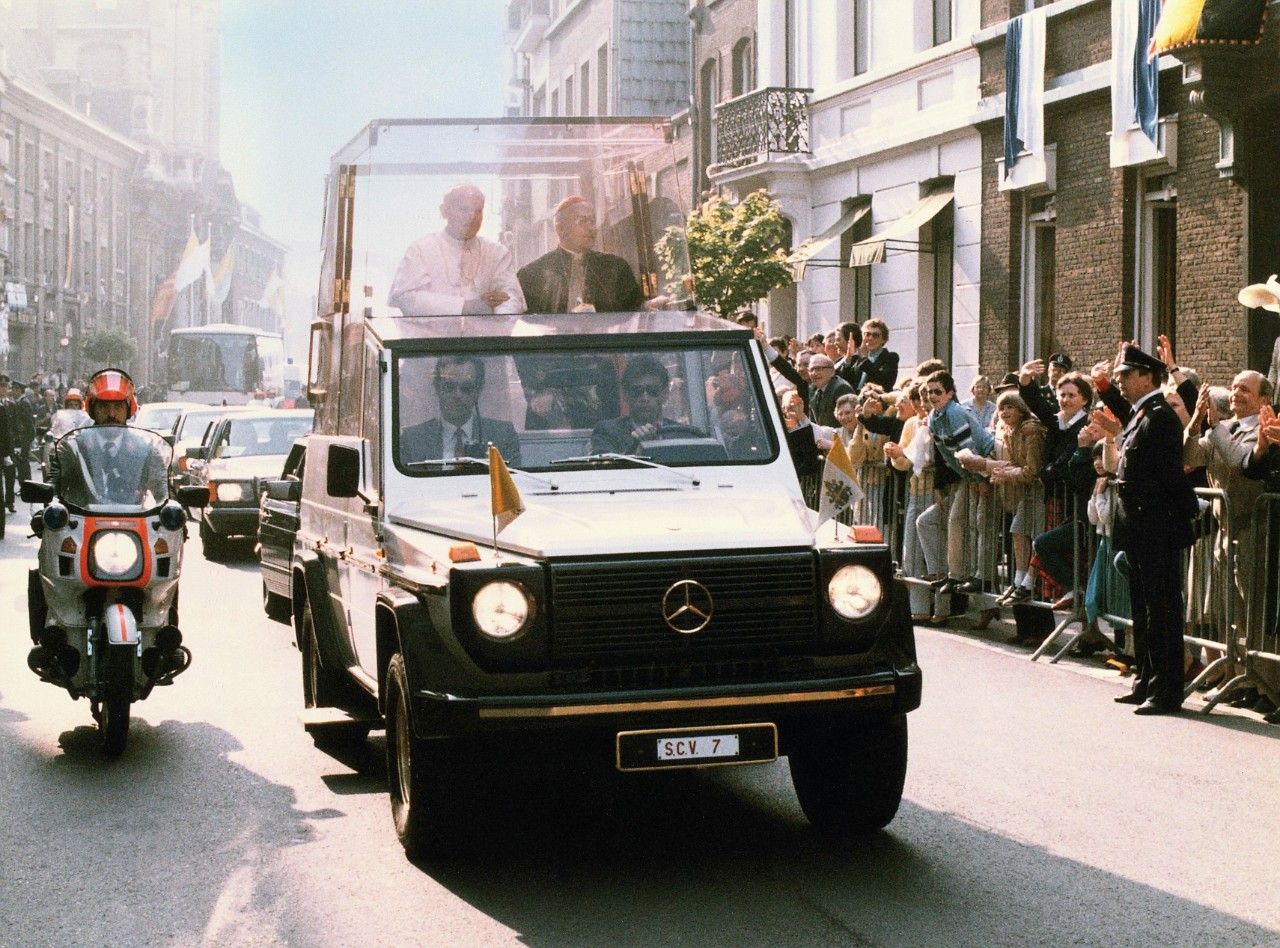
A new exhibition at the Vatican Museums highlights a century of collaboration with Mercedes-Benz, showcasing eight papal vehicles that developed from a “means of transportation into an instrument of encounter,” per Pope Leo XIV October 29, 2026 4:58 p.m. Pope John Paul II on board a Mercedes-Benz 230 G popemobile, 1980 Vatican Museums Once dubbed a “sardine can” by Pope Francis, the popemobile—with its large, domed top and bulletproof glass—is truly the only vehicle of its kind on the road. Now, the story of how the fishbowl-esque automobile came to be is on display at the Vatican for visitors from around the world to see. “A Century of the Popemobile,” an exhibition which opened at the Vatican Museums on Thursday, features eight iterations of popemobiles spanning from 1930 to 2012, all designed by Mercedes-Benz. Versions of the popemobile made by other auto companies, like Land Rover, Fiat and Ferrari are not included in the collection. “Over the decades, the popemobile has evolved from a means of transportation into an instrument of encounter,” Pope Leo XIV told Mercedes-Benz executives in an address ahead of the exhibition’s official opening. “In this way, your work has helped facilitate the Church’s mission of reaching out to people and bringing a message of faith, of hope and of charity to the world.” Mercedes-Benz gifted the first popemobile to to Pope Pius XI in 1930. Vatican Museums The oldest popemobile on display is a 460 Nürburg limousine gifted to Pope Pius XI in 1930. Unlike the hulking, glass popemobiles of today, this first custom-made model featured a black exterior and a red armchair upholstered in a silk brocade. When Pius XI first took the 80-horsepower car for a spin around the Vatican Gardens, he reportedly cried out: “Beautiful car! A masterpiece … A wonder of modern technology!” The 460 Nürburg and its immediate successors, however, tended to reside in the papal garage. “The popemobile didn’t become standard-issue for getting the pontiff through crowds until the late 1970s,” Danny Lewis wrote for Smithsonian magazine in 2015. “Historically, the pope traveled by way of an extravagant sedan chair carried atop the shoulders of a squad of uniformed footmen.” In order to allow the pope to engage with the faithful—and bless babies—from the confines of a car, automakers customized the vehicles to enhance the pope’s visibility and access to the external world. “The so‑called popemobile serves to allow people to see the pope, but also to allow him to see,” Sandro Barbagallo, curator of the Historical Collections Department at the Vatican Museums, tells Francesco Sportelli and Nicole Winfield of the Associated Press (AP). “It serves so that people can greet the pope, but also and above all so that the pope can, along the roads, greet and at the same time bless.” The first model to resemble the iconic modern design comes from 1980, a modified 230 G model with a large, glass dome in the back, allowing for congregants to see the pope as he passed. Popemobiles began incorporating bulletproof glass a year later, after an attempted assassination of Pope John Paul II while he was riding in an open-topped Fiat popemobile. Designing papal automobiles comes with manifold security considerations. “It has to be safely conceived and executed in terms of the current modern risks you face if you are in big crowds,” Marcus Breitschwerdt, executive vice president of Mercedes-Benz and chief executive of Mercedes-Benz Heritage, tells EWTN News’ Ishmael Abiduah. “So we have armored versions; we have the secured glass popemobiles, which are very, very sophisticated.” The exhibit also features a 1960 300D Landaulet with removable side windows built for Pope John XXIII, a 1997 “lungo” Landaulet featuring an electrohydraulic soft top designed for Pope John Paul II and Pope Benedict XVI’s 2012 ML 500, a behemoth with a large, enclosed glass rear, per Agence France-Presse. Did you know? Holy jeep When Pope Francis visited the United States in 2015, he rode around Washington, D.C., New York and Philadelphia in a tricked out Jeep Wrangler with open sides and rear seating. “[The popemobile] was specifically built, designed and prepared for papal use, so much so that just by comparing it, you can see how it transitions from the serial to the unique,” Barbagallo tells the AP. The popemobile has also reflected the distinct preferences of the popes themselves. In 2024, Mercedes-Benz gifted the environmentally minded Pope Francis the first electric car in the popemobile fleet. In fact, Pope Leo XIV referenced this gift, and Pope Francis’ call to make the automotive sector more sustainable, in his address to the Mercedes-Benz executives: “In this spirit, I encourage you to continue placing technological innovation at the service of human dignity, care for creation and the common good.” “A Century of the Popemobile” is on view at the Vatican Museums. You Might Also Like Get the latest stories in your inbox every weekday. More about: Cars Christianity Italy Italy Travel Museums Religion Religious History Technology Transportation
From a Black Limo With a Silken Armchair to a Bulletproof 'Sardine Can,' the Vatican Looks Back at the Evolution of the Popemobile
Full Article
Original Source
Read the full article at Smithsonianmag →KhanList aggregates and links to publicly available news content. We do not host full articles from third-party sources. Always verify important information with original sources.