
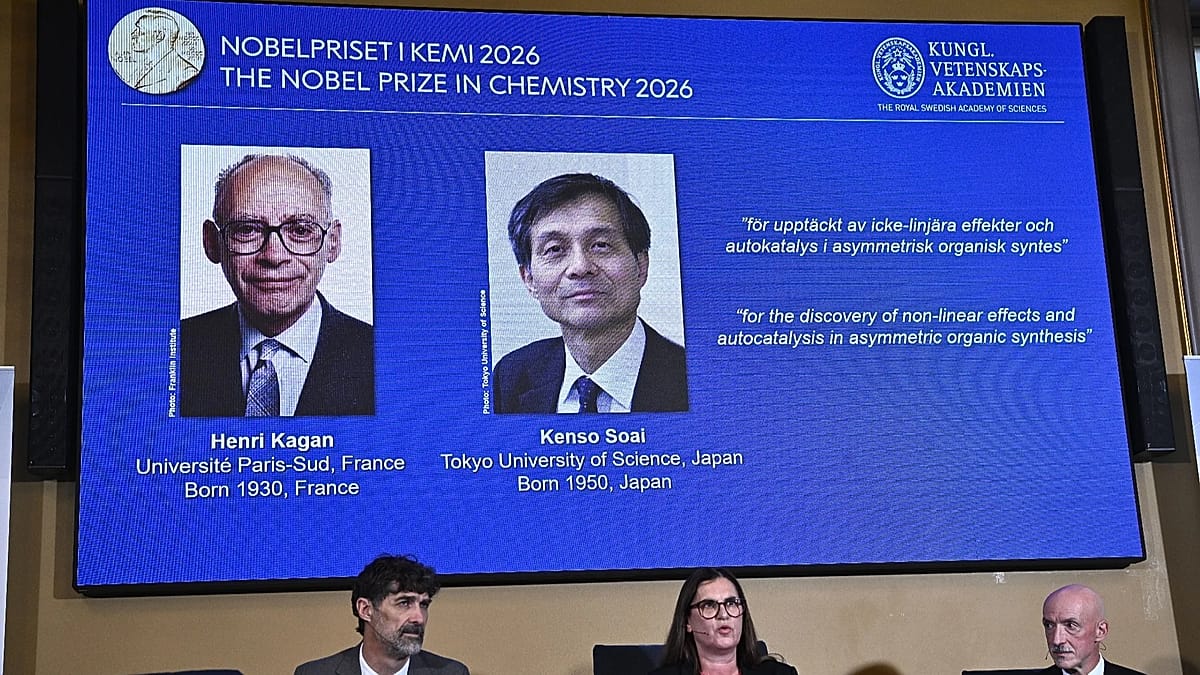
Henri B. Kagan and Kenso Soai have won the Nobel Prize in Chemistry for research into molecules' mirror images, “decisive for chemists who design reactions for the manufacture of pharmaceuticals", the Royal Swedish Academy of Sciences in Stockholm said on Wednesday. ADVERTISEMENT ADVERTISEMENT The French and Japanese researchers were awarded for the discovery ofnon-linear effects and autocatalysis in asymmetric organic synthesis. Many molecules, such as amino acids, have two mirror versions of themselves, but only one version of them is found in living organisms; this is known as chemical asymmetry. This asymmetry creates challenges when developing new pharmaceuticals. Many of the drug molecules occur in two variants that are each other’s non-identical mirror image; one has the therapeutic effect, while the other can cause unnecessary and sometimes harmful side effects, the Committee explained. "Henri Kagan and Kenso Soai have provided a solution to a chemical mystery that is over a century old: how homochirality can emerge spontaneously," said Heiner Linke, chair of the Nobel Committee for Chemistry, in a press release. "The chemical reactions they have developed are spectacular." Kagan is affiliated with Université Paris-Sud in Orsay, France, and Soai with the Tokyo University of Science. “I'm very excited to receive the very nice news about the Nobel Prize,” said Soai after the announcement. “This is one of the most exciting days in my life. I'm really glad to share the prize with Professor Henri Kagan, such a famous organic chemist,” he added. The prize this year is 12 million Swedish kronor (about €1.09 million), whether for an individual, a small group of laureates, or an organisation. The remaining 2026 Nobel Prizes, in literature, peace and economics, will be announced in the coming days. The awards for medicine and physics were announced earlier this week. Following the announcement of Friday’s peace prize, the Nobel Memorial Prize in Economic Sciences will be announced on 12 October. The award ceremony will be held on 10 December, the anniversary of the death in 1896 of Alfred Nobel, the Swedish industrialist and inventor of dynamite who founded the prizes. He died in 1896. Previous Nobel Prizes in Chemistry From 1901 to 2025, 117 Nobel Prizes were awarded in chemistry. Eight of the 198 chemistry winners have been women, including Marie Curie in 1911. Last year’s chemistry award was shared among Susumu Kitagawa from Kyoto University in Japan, Richard Robson from the University of Melbourne in Australia, and Omar M. Yaghi from the University of California, Berkeley, in the United States. They were awarded for creating a new molecular structure used to extract carbon dioxide from the air and separate pollutants from water.
French and Japanese scientists win 2026 Nobel Prize in Chemistry for what could change how medicines are made
Full Article
Original Source
Read the full article at Euronews →KhanList aggregates and links to publicly available news content. We do not host full articles from third-party sources. Always verify important information with original sources.