
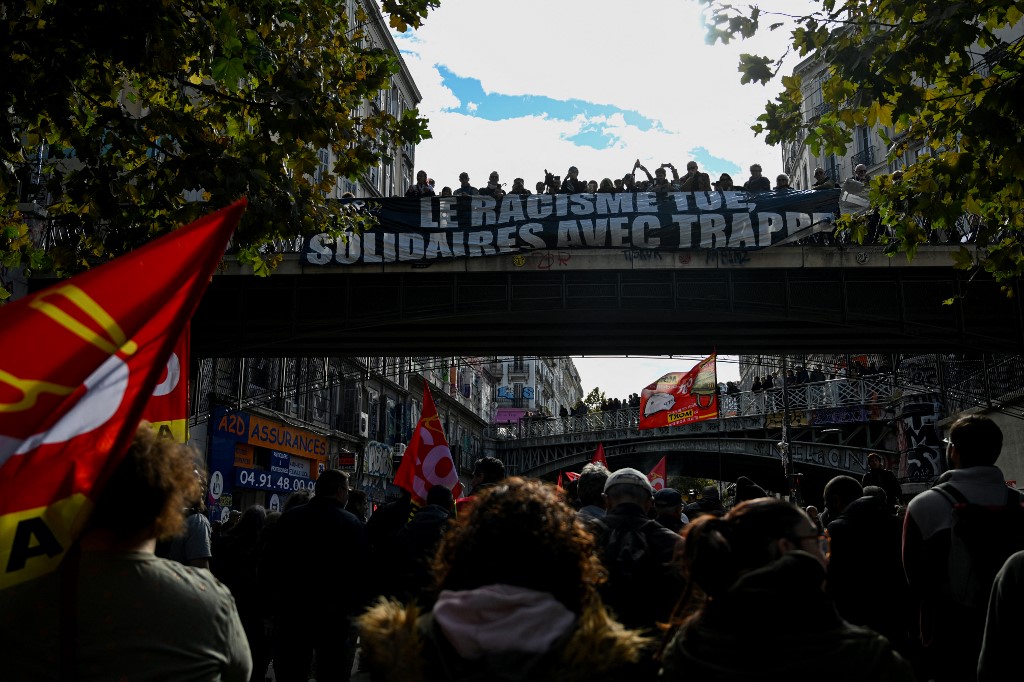
Grief and anger filled the streets of Trappes, north of Paris, on 30 October as thousands paid tribute to the victims of a racist attack committed a week earlier. A 26-year-old Black man, Pengo Bossio Wangi, was killed and seven other people injured, including a 12-year-old girl. Placed in pre-trial detention, the suspect, 39-year-old Kevin Tessier, admitted that he had specifically targeted people whom he described as "Muslim, African or North African". Investigators found in his home a copy of Mein Kampf and self-made stickers referencing the National Rally (RN), the far-right party of 2027 presidential candidate Marine Le Pen. According to Trappes mayor Ali Rabeh, the suspect's "hatred did not come from nowhere. It was planted in his mind through the constant repetition of words and narratives that turned these minorities into targets to be eliminated". Rabeh directly blamed the RN and its president, Jordan Bardella, who described Trappes in 2022 as "a miniature Islamic republic". The mayor also criticised politicians who, "within the republican camp, thought it wise to appease the far right by adopting its language, flirting with its ideas and even enshrining its demands into law". New MEE newsletter: Jerusalem Dispatch Sign up to get the latest insights and analysis on Israel-Palestine, alongside Turkey Unpacked and other MEE newsletters Rabeh further condemned the role of the CNews channel and the "media empire" of conservative businessman Vincent Bollore, calling on independent media to "hold the line" and to "stop giving airtime to convicted racists". One of them is Eric Zemmour, leader of the far-right Reconquete! party and a potential candidate in the 2027 presidential race. Convicted several times for incitement to hatred and discrimination, Zemmour accused "hordes of Arab and African barbarians" of organising looting during recent demonstrations over living standards and conditions in schools and universities. He was not alone. Figures from the National Rally, right-wing presidential candidate Bruno Retailleau, and even the government's spokesperson blamed suburban "thugs" for the unrest. Former Prime Minister Edouard Philippe, also a presidential hopeful, spoke of an "overrepresentation of French people from immigrant backgrounds among the rioters". It was precisely these racialised communities from the banlieues - France’s working‑class, often ethnically diverse suburbs - that Tessier chose to attack. He told police he had targeted them to "avenge looted shopkeepers" and said he had chosen Trappes because, like Bardella, he considered the town "a stronghold of Islamists". ‘The normalisation of far-right discourse’ For Dominique Sopo, president of SOS Racisme, discriminatory rhetoric targeting residents of banlieues helps explain the motives behind the Trappes attack. "The recurring dehumanisation of people perceived as Arab, Black or Muslim, combined with the biased media coverage of the recent demonstrations, plays a direct role in pushing criminals to commit violent acts," he told Middle East Eye. "Portraying part of the population as 'thugs' or an 'existential threat' inevitably legitimises violent behaviour in the minds of certain individuals," he added, warning that other racist attacks could occur in the run-up to the presidential election. ‘The recurring dehumanisation of people perceived as Arab, Black or Muslim, combined with the biased media coverage of the recent demonstrations, plays a direct role in pushing criminals to commit violent acts’ - Dominique Sopo, president of SOS Racisme Since 2022, eight people in France have been killed by far-right activists because of their perceived ethnicity or immigrant background. Among the most recent victims were Djamel Bendjaballah, killed in Dunkirk in 2024 by a member of the ultra-right French Patriotic Brigade (BFP), and Hichem Miraoui, who was murdered in the Var region in 2025 by a neighbour sympathetic to the National Rally because he was Arab. Despite calls from organisations such as SOS Racisme, the BFP has not been formally dissolved. Since the beginning of Emmanuel Macron's presidency, only around 20 far-right identity groups have been banned, despite an estimated 300 operating across the country. In recent weeks, such groups have organised targeted assaults on the sidelines of demonstrations in several French cities, claiming to be "defending businesses". According to Le Monde, some of their attacks on demonstrators took place in full view of riot police. Rather than arresting the perpetrators, officers allegedly restrained the victims and allowed the attackers to leave. In recent days, civil society groups and media outlets have also revealed online exchanges in which individuals threatened to ambush racialised delivery workers, poison halal food in supermarkets and target Muslims during street prayers outside mosques. In Paris on 31 October, graffiti promoting "remigration" - the mass deportation of immigrants - was also discovered on the fronts of several shops. That day, a conference organised by the ultra right on the same theme was ultimately banned by the authorities. The concept of remigration is closely linked to the far-right "Great Replacement" conspiracy theory. France's junior minister for combating discrimination, Aurore Berge, recently sparked controversy by refusing to describe it as racist. For Abdellali Hajjat, a sociology professor at the Free University of Brussels, such positions contribute to "the normalisation of far-right discourse". "When members of the government embrace myths - not theories - such as the 'Great Replacement', 'Brotherism', or 'Islamo-leftism', they legitimise an entire racist and conspiratorial worldview," he told MEE. "Brotherism" or "Entryism", presented as a strategy of political infiltration by the Muslim Brotherhood, was the subject of a Senate bill in May, while "Islamo-leftism" - the alleged convergence of parts of the political left with Islamist interests - has been invoked for years by political actors, including government officials, to discredit critics. Demonstrators stand amid tear gas fired by police during a demonstration of high-school students in Paris, on 13 October 2026, as part of a nationwide high school mobilisation (Lou Benoist/AFP) Hajjat also argues that the current government is "implementing a far-right agenda through the erosion of fundamental rights and freedoms - including the rights to association, protest and expression - and through the brutal repression of political dissent". The French Human Rights League (LDH) regularly describes as "liberty-restricting" the laws and legislative proposals that expand police powers, extend mass surveillance, curb the right to protest or target minorities and civil society organisations in France. Among them is the law on the presumption of self-defence passed by the National Assembly in July. Nicknamed the "licence to kill law" by the LDH, it eases the conditions under which law enforcement officers may claim self-defence. The organisation has also consistently criticised the 2021 so-called anti-separatism law, arguing that it fosters a climate of suspicion directed at Muslims. Meanwhile, Amnesty International has warned about the violent policing of recent demonstrations, including the use of weapons capable of causing permanent injuries. Since the protests began in September, thousands of people have been arrested across France on grounds ranging from public-order offences to damage to public and private property. Eighty-five percent of those taken into custody are minors. Mounting attacks on the left In the aftermath of the violence that erupted during the 17 October demonstrations, Justice Minister Gerald Darmanin called for exceptional legal measures, including treating certain acts as organised crime offences and applying some tools normally associated with anti-terrorism legislation. The minister specifically highlighted the role of the "ultra left" and the "far left" in the violence and looting. ‘Claiming that LFI raises issues such as racism and support for the Palestinian people merely to court Muslim voters is part of this broader effort to discredit the party’ - Jeremy Younes, researcher at media watchdog Acrimed He claimed that presidential candidate Jean-Luc Melenchon and his party France Unbowed (LFI), which was classified as far left in a February ministerial circular, bore "part of the responsibility" for the violence surrounding the demonstrations. Prime Minister Sebastien Lecornu likewise accused LFI of "fuelling anger". The accusation enjoys broad support among Macron's centrist coalition, the traditional right and the far right. Even Socialist Party candidate Raphael Glucksmann, accused by parts of the left of being out of touch with the working classes and an obstacle to left-wing unity, has accused Melenchon of "brutalising public debate". Yet according to French intelligence services, traditional left-wing parties such as LFI and the Communist Party, although present at demonstrations, were not involved in the violence. An investigation by Mediapart further revealed that internal intelligence reports contradicted the government's political narrative. Some officers reportedly said they were pressured to blame LFI for violence that the party did not instigate during the 17 October protests For LFI leaders, who accuse the government of manipulation, these revelations illustrate a broader effort to demonise the party. La France Insoumise (LFI) candidate in France's 2027 presidential election Jean-Luc Melenchon (R) and French-Palestinian MEP Rima Hassan take part in a demonstration over the rising cost of living in Paris on 31 October 2026 (Sameer al-Doumy/AFP) Jeremy Younes, a researcher at media watchdog Acrimed, shares the view that the party of Melenchon - who is currently projected by some polls to face Le Pen in the second round of the election - is the target of a delegitimisation campaign by both the media and the political establishment. "Since its creation in 2016, LFI has faced hostility from journalists and commentators largely because it broke with the neoliberal consensus and adopted anti-racist positions that have led to it being labelled 'Islamo-leftist'," he told MEE. In France, most major private media outlets are owned by a handful of billionaires and large industrial or financial groups opposed to key elements of the party's programme, including proposals for wealth redistribution and the dismantling of private media empires to increase pluralism. Younes describes media coverage of LFI as a constant barrage of attacks, denouncing what he sees as a systematic effort to exclude the movement from the republican mainstream through endless controversy rather than substantive debate about policies and facts. "Claiming that LFI raises issues such as racism and support for the Palestinian people merely to court Muslim voters is part of this broader effort to discredit the party," he said. "The conditions under which the left can express itself are being undermined everywhere." France: Far-right party’s ‘de‑demonisation’ strategy rattled by antisemitism scandal Read More » One media outlet stands out in what critics call "LFI-bashing": CNews. Described by Reporters Without Borders as a far-right opinion channel, the rolling-news station is currently the target of a petition calling for it to lose its broadcasting licence. The petition has gathered close to one million signatures, constitutionally opening the way for a parliamentary review. An online campaign is also encouraging French social media users to reduce the visibility of content promoting far-right narratives. According to Sopo, such initiatives "can play a useful role". He believes that "a civic awakening committed to building a society based on coexistence is necessary". However, he added: "Today, society is so polarised that it is difficult for an anti-racist movement to build broad public support." For Hajjat, if the National Rally comes to power, "it would already have all the legislation necessary to implement its racist, sexist, homophobic and anti-social programme”. The academic argues that the normalisation of far-right ideas, and their gradual incorporation into law by the current administration, are paving the way for the victory of Le Pen, who remains the clear frontrunner in voting-intention polls. If she wins the election, Hajjat warned, “foreign nationals and French citizens of immigrant origin would be the first targets of legal discrimination in areas including housing, employment and education among others."
France's polarised road to 2027: Repression, racism and the rise of the far right
Full Article
Original Source
Read the full article at Middleeasteye →KhanList aggregates and links to publicly available news content. We do not host full articles from third-party sources. Always verify important information with original sources.