
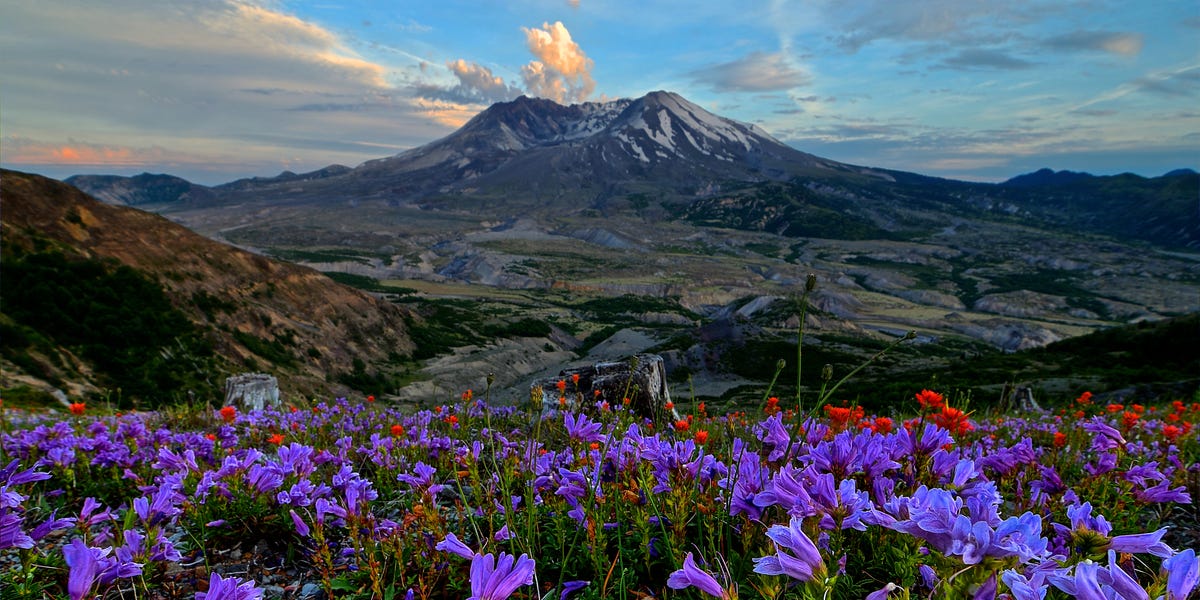
In 1982, scientists brought a pocket gopher to Washington’s Mount St. Helens and put it inside a small enclosure around a plant growing on the Pumice Plain. Two years after the volcano’s infamous eruption, the plant had taken root among volcanic deposits. The gopher stayed for 24 hours before the researchers returned it home.Michael Allen and his colleagues were testing whether gophers could carry fungi themselves, rather than simply uncovering fungi in buried soil. Allen describes experiments around two plants in different volcanic deposits. When the researchers returned the following year, both plants had mycorrhizal fungi, while nearby plants outside the enclosures showed no traces of them.“We concluded that the gophers themselves transported these critical fungi, likely in their feces as they are known to feed on these fungi in their meadows,” he tells Popular Mechanics.The experiment went viral after a 2024 paper in Frontiers in Microbiomes reported microbial differences associated with the old gopher enclosures. That paper dates the Pumice Plain experiment to 1982, rather than the 1983 date repeated in some coverage. The researchers sampled the soil in 2014, when the gopher had been gone for about 32 years.Allen, a soil ecologist and distinguished professor emeritus at the University of California, Riverside, thinks the gophers give us something else to consider. When we plant a damaged landscape, how do the microbes those plants need get there? Could gophers do the job? If so, people planting a former mining or industrial site would have a reason to let gophers stay, even when they eat some of the seedlings.What the gophers brought with themSome native gophers survived the May 18, 1980, eruption by hiding underground, beneath the snow cover. Allen says the snow and soil protected them in patches of meadow and land that had been logged. Where the ash wasn’t too deep, the gophers dug their way out, bringing the old soil up with them. They also brought microbes with them, including mycorrhizal fungi, which help plant roots obtain nutrients and water in exchange for carbon.But the Pumice Plain was buried under more than 20 meters of sterile volcanic ash and debris, far beyond any gopher’s reach. Allen wanted to know whether a gopher could carry fungi onto ground like that from somewhere else. That’s why his research team took a gopher from a nearby clearcut and put it in the enclosure on the Pumice Plain. The results of the experiment were clear. The plants inside the enclosures had mycorrhizal fungi, but nearby plants outside did not. Allen suspects the fungi arrived in the gopher's droppings, although the experiment didn’t show how.Decades later, the landscape around the experimental site had changed considerably. Allen says plants, gophers, and fungi have spread across the Pumice Plain, beyond the original plot. The later study, led by mycologist Mia Maltz, found differences in the microbial communities associated with historic gopher enclosures and comparison plots. It also examined the lasting influence of forest conditions before the eruption.That finding leaves plenty to investigate. A different assortment of microbes doesn’t automatically mean healthier soil or faster recovery. Allen says that analysis of the communities is continuing. He wants to know whether gophers could bring those helpful microbes to other places where people are trying to get plants growing again.When the nearest healthy soil is too far awayAllen thinks the question could matter most where damaged ground lies far from surviving vegetation. If healthy soil and vegetation are close by, he told Pop Mech, microbes may find their way back on their own. But microbes struggle to return to places like industrial sites, where healthy soil is scarce, and Allen thinks those sites could be worth testing to see whether gophers can help.Allen’s work extends beyond volcanoes: at a Wyoming strip mine, his team moved gophers and soil from a healthy ecosystem onto disturbed ground. He suspects gophers deliver a broader mix of microbes than commercial treatments do, though he calls that a question for further research. Success would depend on conditions, though. As David Lindenmayer, a conservation biologist at the Australian National University, notes, an introduced animal first needs a habitat, and Allen adds that gophers need enough food to get started. Timing matters too, because the soil microbes that survived the eruption, which Lindenmayer calls “biological legacies,” die off without host plants, so the longer a site waits, the fewer remain to help new roots take hold.The repair crew has an appetiteThat requirement brings an awkward complication. A gopher could make a meal of the seedlings it was brought in to help. The animals “could well destroy the restoration effort if they ate the plants desired for restoration and did not eat undesirable plants,” Allen says.Lindenmayer also cautions that returning an animal to a changed landscape can produce surprises, because it’s hard to know how a gopher will affect the plants and animals that have moved in since it disappeared. Researchers would need to track whether gophers deliver useful microbes, whether those benefits outweigh the damage the animals do, and how the approach compares with other ways of helping a site recover. Allen’s experiment gives them a place to start: in a single day on volcanic ground, a gopher carried fungi to plants. The question now is whether more plants would survive with a hungry gopher around than without one.Eric Spitznagel is a frequent contributor to magazines like Playboy, Esquire, and the New York Times, and was employed for over two decades by the Second City comedy theater, where Stephen Colbert was his Secret Santa _twice.
Four Decades Ago, Scientists Dropped Gophers Onto a Volcano. They Might Try It Again.
Full Article
Original Source
Read the full article at Popularmechanics →KhanList aggregates and links to publicly available news content. We do not host full articles from third-party sources. Always verify important information with original sources.