
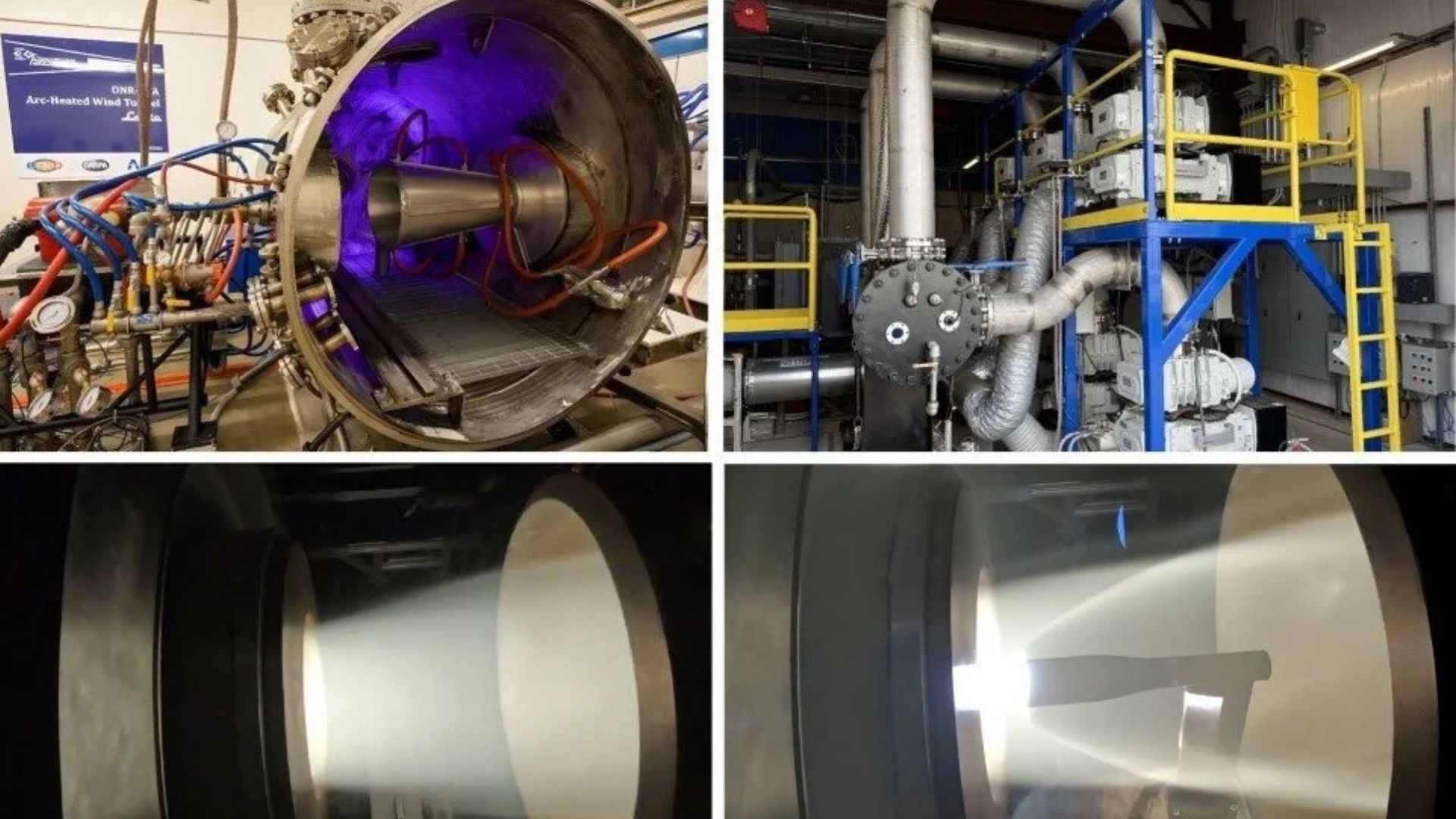
Researchers have developed a new laser-based technique to measure extreme hypersonic airflow (Mach 5 or greater) and plasma flow in shock layers. Hypersonic re-entry conditions create extremely hot plasma that emits intense light, making standard measurements difficult. In addition, oxygen in high-temperature air weakens nitrogen light signals, and ground facilities often feature higher turbulence than actual flight. This non-invasive method accurately measures turbulence near a vehicle’s surface. It could help understand heat transfer, improve thermal protection systems, and correct for ground-testing distortions. Piercing the inferno Re-entering spacecraft face extreme thermal stress as atmospheric air compresses into a superheated plasma shield that can destroy standard materials. There has been a long struggle to observe airflow dynamics within this intense heat without physical probes interfering with the measurement. Scientists at The University of Texas at Arlington have now overcome this obstacle by using precise laser technology to measure the plasma flow directly. The study demonstrated Femtosecond Laser Electronic Excitation Tagging (FLEET) velocimetry. Led by Professor Luca Maddalena alongside graduate students Aaron Gieder, Nikkhil Chander, and Alyssa Velky, the group successfully mapped complex plasma flow and turbulence directly inside the shock layer of arc-jet facilities. These facilities are the primary, essential epicenters on Earth where scientists reproduce and study the extreme heat of space re-entry. The physics of hypersonic entry is simple: smooth airflow is safe, but turbulent airflow is catastrophic. When smooth air breaks into chaotic turbulence, heat loads on a spacecraft can surge by 10 times or more. Engineers need to size heat shields carefully. If they guess wrong, the vehicle burns up. If they over-engineer out of caution, the shield becomes too heavy to launch. Accurately measuring high-speed airflow inside ground-testing facilities has presented hurdles. Physical sensors disrupt the air patterns under measurement, while conventional optical tools are blinded by the glowing plasma. High-temperature oxygen weakens light signals, and facilities often create artificial turbulence that skews real-world calculations. The FLEET technique successfully overcomes these measurement obstacles without altering the airflow or losing clarity. Hypersonic spaceflight one step closer The technique fires laser pulses lasting just one quadrillionth of a second. These ultrafast bursts slice through the glowing plasma, splitting native nitrogen molecules in the air into individual atoms. As the atoms recombine, they emit a distinct, brief line of light that moves naturally alongside the surrounding airflow. A specialized high-speed camera tracks this glowing tracer line over micro-intervals, capturing high-resolution velocity data without touching the air. “This method allows us to measure turbulence really close to the surface of the material in the shock layer between the shockwave and the body of the vehicle,” Dr. Maddalena said. Mapping violent plasma flows with sub-picosecond lasers could bring us closer to mastering high-speed spaceflight and hypersonic travel. Researchers can now calibrate ground-testing data to accurately reflect actual atmospheric flight conditions. Capturing precise velocity measurements near an object’s surface reveals real-world thermal stress while isolating turbulence from the facility. It could eventually lead to safer and more reliable heat shields for high-speed space vehicles. The findings were published in the journal Engineering Communications. Get the latest in engineering, tech, space & science - delivered daily to your inbox.Mrigakshi is a science journalist who enjoys writing about space exploration, biology, and technological innovations. Her work has been featured in well-known publications including Nature India, Supercluster, The Weather Channel and Astronomy magazine. If you have pitches in mind, please do not hesitate to email her.
Laser tool could improve how scientists test hypersonic vehicles in extreme heat
Full Article
Original Source
Read the full article at Interestingengineering →KhanList aggregates and links to publicly available news content. We do not host full articles from third-party sources. Always verify important information with original sources.