
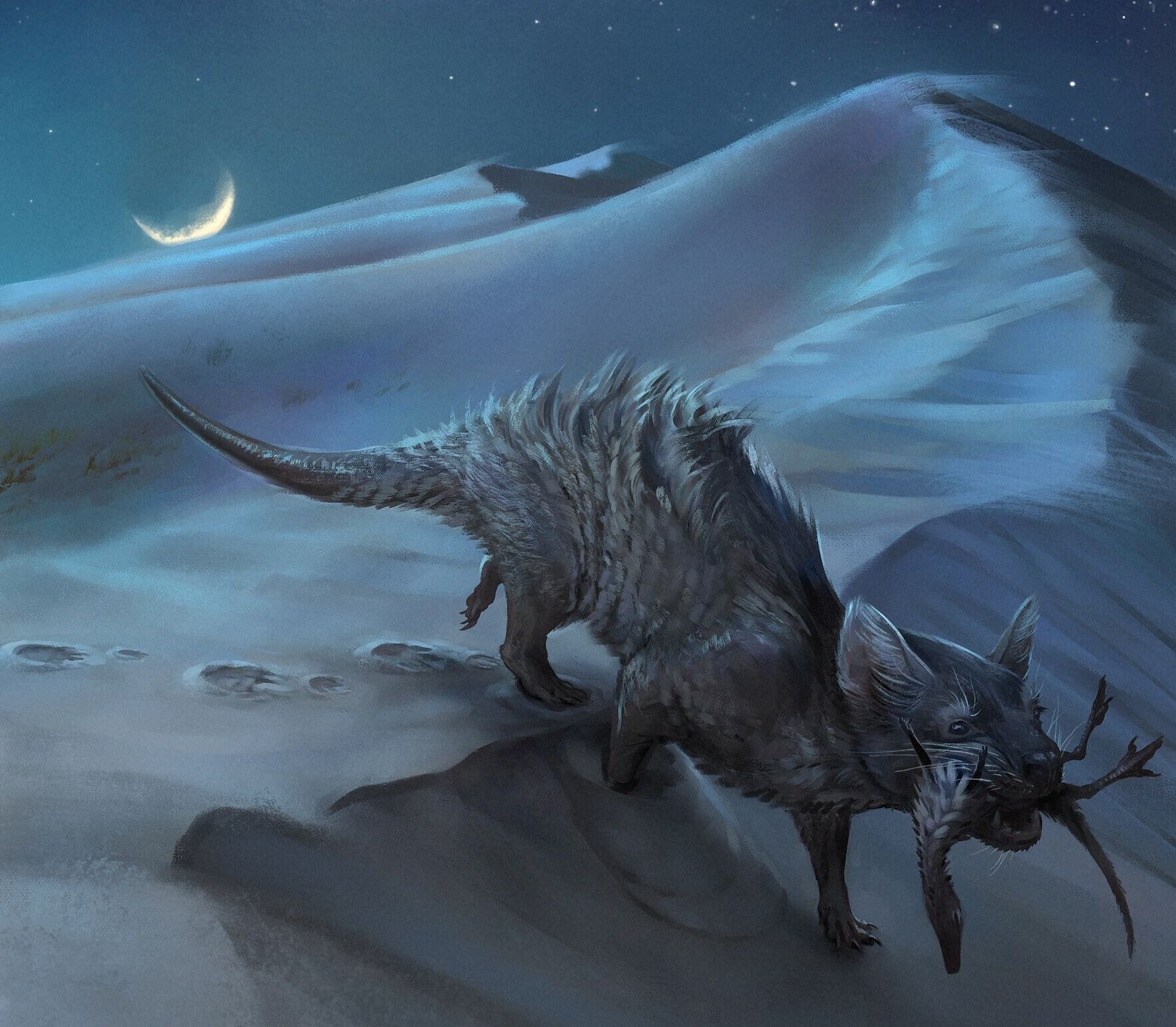
Fossil Footprints in Brazil Hint at a Cougar-Size Mammal That Walked Among Dinosaurs. It’s Another Sign That Some Early Beasts Grew to Impressive Sizes After All Don’t think of all Mesozoic mammals as meek and tiny—alongside the terrible lizards, some were giants in their own right November 6, 2026 7:30 a.m. In Cretaceous Brazil, a prehistoric mammal the size of a cougar or a large dog left telltale tracks on sand dunes. Júlia d’Oliveira The sand feels moist under the beast’s paws. It’s so late now that it’s early, the moon gone but the sky still dark in every direction. Predators are most active at this time, but the mammal has little to fear. There’s no scent of meat-eating reptiles on the breeze, and even if there was, the creature is large enough to intimidate the smaller ones and bite the larger ones on the snout. As the mammal steps through the sand dunes, it leaves five-inch-wide tracks in its wake. Paleontologists know such a creature existed because of these fossilized prints, uncovered by quarry workers among the 130-million-year-old rocks of southern Brazil in 2019. Exactly which species made the marks is still a mystery, but the imprints are nearly twice as big as the next-largest mammal tracks from the same deposits. “Their exceptional size was immediately striking,” says Rio de Janeiro State University paleontologist Hermínio Ismael de Araújo-Júnior, co-author of a recent study describing the creature in the Journal of South American Earth Sciences. After careful analysis, which indicated that the animal walked on all fours and had short legs ending in paws, the conclusion was clear. The creature was bigger than any other mammal known at the time—a roughly cougar-size beast. “If these are the footprints of mammals or their near relatives, it’s very exciting,” says National Museums Scotland paleontologist Elsa Panciroli, who was not involved in the new study. “The fossil record is very incomplete, but we’ve already discovered evidence for some larger mammals, around badger-size, in other parts of the world.” The tracks found in Brazil are roughly the size of a cougar’s. Hermínio Ismael de Araújo-Júnior This pattern suggests that there may be more such fossils out there—enough to begin overturning old conceptions of how mammals fared during the time of the dinosaurs. Since the 19th century, paleontologists have assumed that mammals were little when the dinosaurs thrived. Our ancestors and relatives were generally thought of as small, snuffling insect-eaters that scurried through the primordial night in hopes of evading reptilian jaws. This imagery has been in place for decades, a fossil myth that dinosaurs somehow kept mammals down until a six-mile-wide asteroid smacked our planet, knocking out the mega-reptiles and giving our lineage a chance to thrive. But the tracks from Brazil, amid a smattering of other clues, are beginning to reveal that mammals and their relatives really did live large during the Mesozoic, the Age of Dinosaurs. Contradictions to the idea of dinosaurian dominance go all the way back to the Triassic, the time between 201 million and 252 million years ago, when dinosaurs first emerged. Not only were dinosaurs just one of many different groups of prehistoric reptiles to proliferate at that time, countering the idea that dinosaurs staged an ecological coup as soon as they appeared, but some protomammals could have easily cast tall shadows over the “terrible lizards” of the day. The mammal ancestor Lisowicia bojani was a hefty herbivore, standing more than eight feet tall at the shoulder. Juandertal via Wikimedia Commons under CC BY-SA 4.0 One of these giants was a pig-like, elephant-size herbivore that paleontologists Tomasz Sulej and Grzegorz Niedźwiedzki named Lisowicia in 2018. Its bones, uncovered in the roughly 205-million-year-old rock of Poland, indicate that the animal was over eight feet tall at the shoulder and weighed more than five tons. Lisowicia was not a mammal, instead belonging to the broader group from which mammals emerged, called synapsids. But the existence of such a creature indicated that mammal ancestors were not all on their way to miniaturization in a world of reptiles. And if an elephant-size animal could go so long without being noticed in Triassic rock, surely more surprises awaited paleontologists in Earth’s strata. An illustration of the mammal Repenomamus robustus grappling with and sinking its teeth into the larger dinosaur Psittacosaurus lujiatunensis Michael Skrepnick via Han, G. et al., Scientific Reports, 2023, under CC BY 4.0 It wasn’t all that long before the next clue emerged. In 2023, Hainan Tropical Ocean University paleontologist Gang Han and colleagues described an incredible moment preserved in rock. The event was bad luck for the animals involved but a stellar find for the fossil hunters: Sometime around 125 million years ago, in what’s now eastern China, a badger-like mammal bit into the ribs of a small, horned dinosaur just before the two were buried under a messy flow of volcanic debris. The mammal was already known as a dinosaur-eater. Named Repenomamus, its fossils had previously been found with stomach contents of baby dinosaur bones. The remains revealed that these mammals may have raided dinosaur nests, putting them among the many threats that baby dinosaurs faced. But the horned dinosaur in the 2023 study was a nearly mature adult, and the Repenomamus had seemingly bitten it so hard that its teeth were embedded in the reptile’s ribs. Perhaps the mammal was trying to eat the larger dinosaur, the researchers suggested—and it clearly was not afraid of taking on a reptile about three times its own size. Most mammals during the Mesozoic, or Age of Dinosaurs, were small insectivores, but exceptions are emerging in the fossil record. Mark Witton via Sweetman, S. et al., Acta Palaeontologica Polonica, 2017, under CC BY 2.0 On the surface, such occurrences might seem like outliers. Even though mammals evolved in the Triassic and thrived through the Jurassic and Cretaceous, most known species were smaller than a housecat. The beasts were incredibly diverse, evolving into ancient equivalents of otters, aardvarks, flying squirrels, raccoons and more—but most were little. And the few mammal fossils from the time with preserved fur indicate dark coats, which likely served as camouflage for moving through Mesozoic nights prowled by raptors and other dinosaurs. But even today, most mammals are small. “Bats and rodents vastly outnumber all the other groups put together,” Panciroli says. Of the more than 6,495 mammal species alive on Earth, over 2,552 are rodents, along with more than 400 shrews and over 1,300 bats. That’s more than half of all mammal biodiversity, so a future paleontologist looking at our present time might conclude that the mammals of our era are still mostly small. Giants like elephants and blue whales still exist, of course, but they are far rarer than the innumerable small beasts all around us.So, even though it seems that there were fewer large mammals during the Mesozoic, their rarity in the fossil record doesn’t mean that none evolved. “As we discover more about Mesozoic mammals,” Panciroli notes, “it’s clear that they were flourishing,” diversifying and dispersing all over the globe. Some of them were likely larger than experts ever thought they could be. The footprints found in Brazil indicate that teeth and bones from other big mammals of the dinosaurs’ time could be awaiting discovery. “Most known Mesozoic mammals were indeed small, and competition and predation from dinosaurs may have influenced their evolution,” de Araújo-Júnior says. “But our tracks show that these pressures did not impose an absolute or universal upper limit on mammal body size.” The seeming lack of large, predatory dinosaurs in the formation where the tracks were found might indicate that mammals, rather than dinosaurs, evolved to be the biggest predators in the area. And if that could happen in one place, it could have happened in other places throughout time. “Our findings suggest that large body size may have evolved earlier, and perhaps more frequently, among mammals than skeletal fossils have indicated,” de Araújo-Júnior says. All paleontologists have to go on so far is the tracks, but those tracks offer strong evidence that early mammals are not to be underestimated—not merely shivering prey for hungry dinosaurs but vital parts of the ecosystems they inhabited. And if Repenomamus is any indication, some of these beasts gave dinosaurs reason for pause. You Might Also Like Get the latest Science stories in your inbox. More about: Brazil Dinosaurs Discoveries Evolution Fossils Mammals New Research Prey and Predators Wildlife
Fossil Footprints in Brazil Hint at a Cougar-Size Mammal That Walked Among Dinosaurs. It's Another Sign That Some Early Beasts Grew to Impressive Sizes After All
Full Article
Original Source
Read the full article at Smithsonianmag →KhanList aggregates and links to publicly available news content. We do not host full articles from third-party sources. Always verify important information with original sources.