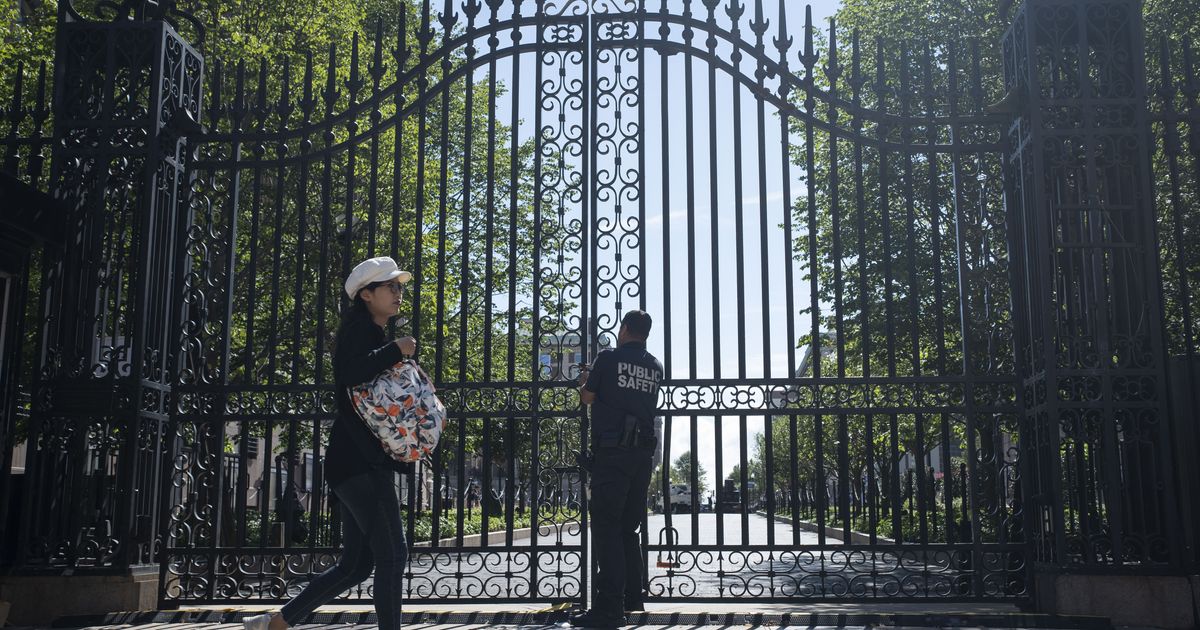
Fortress Columbia, Two Years Later The university closed its gates in a crisis. But now it’s courting a new one. By , New York Magazine’s architecture and classical-music critic since 2007 and was the recipient of the Pulitzer Prize for Criticism in 2002. Photo: Mostafa Bassim/Anadolu/Getty Images Photo: Mostafa Bassim/Anadolu/Getty Images Photo: Mostafa Bassim/Anadolu/Getty Images Getting onto the Columbia University campus these days is easy, as long as you’ve already gotten into Columbia (or landed a job there). With the right card, you’re free to swipe in at one of the few functioning gates and stroll down College Walk, sprawl and kibitz on the Low Library steps, eat lunch on a granite bench, play Frisbee on a plush lawn, and engage in erudite (or wannabe erudite) chatter. Everyone else: Keep away. This arrangement might seem obvious and inoffensive in our day of restricted access, secure perimeters, hardened schools, and retinal scans — we are used to being told where we can’t go. But college campuses have always been different. They’ve been beacons of free speech and free access, treating their private landscaped grounds as space that is morally, if not legally, public. Columbia is not just an enclave but a neighborhood within a neighborhood, a 36-acre concentration of urban activity — activity that has always included regular doses of protest, speechifying, electioneering, and petition waving. Complaining about the government, the environment, the powerful, or the university’s policies is a fundamental part of higher education. Like Harvard’s Johnston Gate, UC Berkeley’s Sather Gate, and Indiana University’s Sample Gates, Columbia’s 116th Street portal once invited all to enter an intellectual community, at least for a while, and at the same time encouraged those within to go out into the world and return with a little more experience. After all, the university’s magnetic pull depends on its being embedded in a global metropolis with its profusion of experts, employers, and opportunities. Columbia isn’t just in New York; it’s embedded in the neighborhood. Photo: Nisian Hughes/Getty Images Two years ago, though, Columbia barricaded itself behind walls and checkpoints. Residents to the east could no longer cut through to the subway station on Broadway. Researchers at other local universities had their reciprocal library rights cut off. Students with non-Columbia friends could no longer casually walk in with them. That strictly enforced division between those who do and don’t have the right ID has remained in place long enough that the university is now betraying its own identity. The more Columbia asks who you are, the less it knows what it is. A new academic year is about to begin. A new president, Jennifer Mnookin, has been installed and (a university official tells me) is consulting with the Campus Safety Advisory Committee and getting up to speed on the issue. Perhaps I can help. I possess the golden ticket. As an adjunct faculty member in the Architecture School, where I teach a course on the urbanism of New York, I can come and go at will. My students, who come from all over the world, spend the semester fanning out across the city, analyzing individual blocks, reimagining entire coastlines and transportation systems, trying to make sense of its politics and bureaucracy, and wrestling with the multiple meanings of the term community. I hope that by the end of the class they have acquired an appropriate sense of awe at our city’s abundance, variety, and accessibility of public space. They have also learned to distinguish it from privately owned public space — the kind that is legally required to remain free and open but is managed and policed by a company or institution. The first is protected by the First Amendment; the second limited by corporate rules. Columbia’s campus is neither; it’s private property that the university has the right to maintain and control. A stalled lawsuit challenging the gate closures centers on a 1953 agreement between the university and the city in which one block of 116th Street, between Broadway and Amsterdam Avenue, was turned into the pedestrian College Walk. But even if Columbia lost the case, it could theoretically erect a whole new set of checkpoints and fences channeling the public along that corridor and exclude it from the rest of the campus. In practice, this would be almost impossibly cumbersome. The Low Library stairs double as a stage for free and open impromptu performances. Photo: Getty Images Still, having the legal right to a closed campus doesn’t make it a good idea. Students converge on Morningside Heights because the university distills — and instills — the ideals of an open, democratic, pluralistic nation. “Before I built a wall I’d ask to know / What I was walling in or walling out / And to whom I was like to give offense,” wrote Robert Frost, on whom Columbia bestowed an honorary doctorate. The university moved to the stone-girdled estate that McKim, Mead & White designed for it in 1897. But the walls were more ornamental than defensive. A 1903 photo of Low Library shows College Walk animated by a horse-drawn cart, a woman wheeling a bicycle, and a man walking a dog up the steps. Columbia’s campus in 1903 welcomes a cart, a bike, and a dog. Aside from brief interruptions, the campus remained open for 120 years — through the upheavals of 1968, when protestors occupied several buildings until they were violently dislodged by the NYPD; a succession of other student occupations prompted by outrage over the Vietnam War, South African apartheid, fossil fuels, and racism; the slump of the 1970s; the crack epidemic of the 1980s, when the 26th Precinct, which includes Morningside Heights, was shuddering with daily violent crime; the aftermath of 9/11, when a new security apparatus clanged all over the city; the pandemic; and the Black Lives Matter protests of 2020. Then came Hamas’ murderous invasion of Israel on October 7, 2023, and the even more murderous Israeli invasion of Gaza, which triggered protests and encampments on college campuses from Mexico to Australia. Columbia, which doesn’t have its own police force, handled the unrest by shutting, reopening, and resealing its borders, confusing even itself. On April 15, 2024, it instituted what was supposed to be a temporary closure to prevent what then-mayor Eric Adams termed “outside agitators” from stirring up mayhem. Outsiders got in anyway. After letting the situation fester, Columbia finally called in an NYPD crackdown, a move guaranteed to infuriate much of the faculty and split the academic community. The police cleared the encampments and arrested 112 people, of whom nearly a third were unaffiliated with the university. Blaming disruption on outsiders is a timeworn strategy to distinguish between us (good) and them (bad), but in fact the majority of people who the NYPD arrested in April 2024 had the correct credentials. The 1968 antiwar protests and the occupation of Hamilton Hall scarred the university — but didn’t close it. Photo: Don Jacobsen/Newsday RM via Getty Images The semester ended, students went home, and the gates reopened — until just before the fall 2024 semester. They’ve been shut ever since. And so a policy that had failed to keep out instigators of unrest became permanent, on the theory that it would probably work next time — if there is a next time. The rationale is contorted: A hypothetical gang of outsiders might gin up more hypothetical protests over fresh (but still hypothetical) political firestorms, and then the administration would be faced with the decision of when to summon unpopular reinforcements. But for a pluralistic educational institution in the middle of New York, uncertainty is a poor excuse for a clampdown without end. Pro-Palestinian students and supporters demonstrate with a protest encampment on the Columbia campus in April 2024. Photo: Spencer Platt/Getty Images Other urban universities experienced protests and encampments and responded with temporary closures. Harvard closed off its yard for six weeks in the spring of 2024. USC erected fences and checkpoints and barred entry to outsiders for more than a year. Trinity College Dublin negotiated the removal of an encampment after five days. UNAM in Mexico City let its encampment stay for a while and university life went on around it. But only Columbia has made exclusion normal. (A provisional guest-pass program for some area residents does little to alter that.) Neither Mnookin nor anyone else in the administration has made it clear when, under what circumstances, or whether the chains might be removed. Over time, the reasons for keeping the security regime in place has broadened from the need to forestall political violence into a generalized desire for tranquility. In December 2025, David Greenberg, executive vice-president for facilities and operations, mentioned “those who are very happy about it because they feel safer on campus.” He pointed out that the inconvenience had reduced the number of cell-phone thefts. Many current students — and all incoming ones — have no memory of the pre-closure days, and I can imagine that parents might be relieved to see their kids enter a policed haven free of street crime and drug-addled shouters. (Of course, legitimate students sometimes commit outrages too.) International students and faculty members, leery of the Trump administration’s hostility, are surely grateful that the gates are a barrier to ICE agents as well. A university official commented that the closure had brought the Columbia community closer together, which may be true; imposing a physical barrier between insiders and outsiders will do that. The retreat reverses the longer-term pattern of the university binding itself to the neighborhood. For decades, Columbia has been buying up shabby buildings and converting them into graduate-student and faculty housing, curating the mix of businesses on Broadway, and running a K-8 private school with half the seats reserved for non-Columbia-affiliated neighborhood residents. (The institutional juggernaut has also tended to treat its surroundings with high-handed stinginess, contributing minimally to the upkeep of parks that its students wear down every day.) Columbia had good reason to court its neighbors: It wanted to expand into new quarters a quarter-mile uptown. To win the necessary approvals, it promised a campus that would be outward-facing and inviting instead of armored. The zoning resolution for the Manhattanville extension explicitly forbids encircling any of the outdoor spaces with gates or fences. As a result, Columbia now operates on two diametrically opposed principles: openness in Manhattanville and exclusion in Morningside Heights. The reasoning that applies in one place means nothing in the other. The political response to Columbia’s campus closure has ranged from supportive (in Adams’s case) to tacit tolerance or anemic complaint. City Council majority leader Shaun Abreu co-wrote an op-ed in the New York Daily News in early 2025 rapping his alma mater on the knuckles for “undermining the university’s stated commitment to being part of the city’s fabric.” Then he moved on to other priorities. Perhaps elected officials are unwilling to come down too hard on an institution that the Trump administration has targeted for arbitrary and vindictive punishment. President Trump used the Gaza protests as a bludgeon, accusing the university of systematic antisemitism, cutting off $400 million in federal aid and threatening to pull billions more. Columbia responded with abject surrender. That history stirs up another cloud of menacing maybes. A fresh round of unrest could reawaken Trump’s ire. It might hand the hostile culture warriors in the White House a new weapon with which to hammer higher education. The university’s finances would possibly come under attack again, and important research might once more grind to a halt. This array of perils suggests that the gate closure has less to do with the passions around the Middle East than with domestic politics of appeasement. Columbia should have learned by now that it will never achieve safety by cowering. It should dismantle the checkpoints and take the risk. Fortress Columbia, Two Years Later Your product is saved! You’ll receive emails when your saved products go on sale. Manage preferences.
Fortress Columbia, Two Years Later
Full Article
Original Source
Read the full article at Curbed →KhanList aggregates and links to publicly available news content. We do not host full articles from third-party sources. Always verify important information with original sources.