
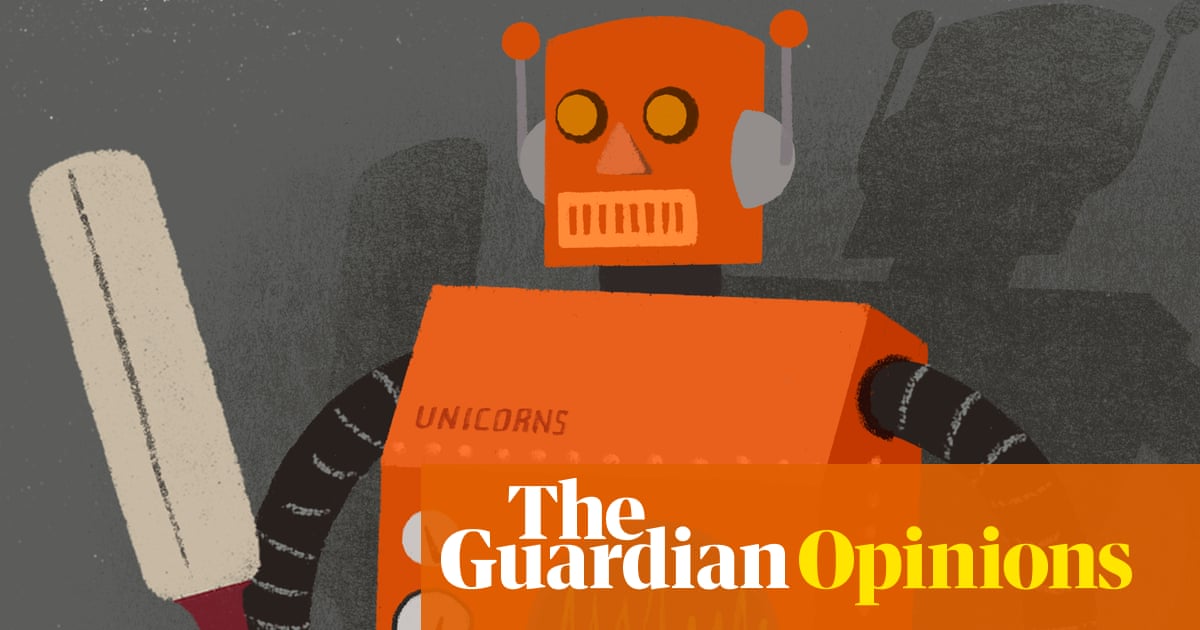
There was an interesting development this week in the endless rolling mega-froth over tech billionaire Jensen Huang, a saga that may or may not have involved some kind of adulterous 63-year-old honey trap spy dynamic.The latest suggestion being punted about is that, whatever his raw human frailties, Huang is in fact “irreplaceable” as the president of Nvidia. Only this guy can do it. Only this leather-jacketed human visionary, who looks in every available photo like your GCSE chemistry teacher’s profile pic on TerrifiedUkrainianSinglesWantToDateYou.com, can manage this key artificial intelligence mission.Funny isn’t it? Huang has spent years perfecting a machine that can literally make every other person on the planet’s job vanish overnight, because, like, we don’t actually need humans any more. We have a fake version that’s cheaper and less annoying. Except, of course, in this case where it turns out humans are in fact creative, delicate irreplaceable things. Hal. Open the airlock doors, Hal.It’s obvious what the best solution is here. Scrape his data and make an AI Jensen Huang instead. Get the robots in. Nothing personal, Jensen old boy. It’s just the necessary march of progress. And if I can offer some helpful advice during your period of soul-crushing obsolescence, I’d say maybe look at industries AI can’t vaporise beneath your feet while you’re working yourself thin just trying to survive.Develop your soft communication skills, yeah? Work for free. Try to become a hot new middle-aged gimmickfluencer, like two billion other desperate units of human alienation around the world. Stop drinking flat whites. Whatever. Sorry, Jens, you’re breaking up. I’ve got RobodeathbotExec5000 on the other line, I’ve got to take this.All middle-aged men must have views on AI. In fact this may be what kills it in the end, endless scrolling legions of men with beards mansplaining the future. You want slop. We’ll give you so much slop your servers will melt. My own theory is that AI might be the thing that saves the human race, not the rogue element that kills it. AI doesn’t crave things, or have daddy issues. The real threat to humanity isn’t some kind of deranged robot consciousness. It’s deranged people, lone egomaniacs, actual human elements like greed and despotism.At which point, enter sport. Or in this case, Jay Shah, who was re-elected unopposed this week as president of the International Cricket Council. Shah remains a compelling figure. Don’t be deceived by the pictures from the meeting in Bali, in which he’s wearing his usual glazed facial expression, like a man who’s just been hit in the head with a rock and it’s the greatest thing that’s ever happened to him.Jay Shah, son of Narendra Modi’s oldest political ally, was re-elected unopposed this week as president of the International Cricket Council. Photograph: Mahesh Kumar A/APIn reality this is another moment of triumph for this super-talented administrative prodigy, whose rise to supreme overlord of all cricket is all the more remarkable given he also happens, by pure coincidence, to be the son of the Indian prime minister Narendra Modi’s oldest political ally.Otherwise, this was widely seen as a disappointingly inconclusive ICC conference. But one thing did stand out. Proposals to regulate more aggressively the rush of new global T20 leagues have been postponed to the next disappointingly inconclusive ICC conference. And this is a shame, because something is cooking here, something we really should be keeping a closer eye on.I’m talking Major League Cricket. And specifically the San Francisco Unicorns, who may be the tiniest twinkle in the sporting sky right now, but are also carrying a potentially significant contagion. I first heard about it in an interview with Ravichandran Ashwin in the Cricketer Magazine, where he talked up the Unicorns’ use of artificial intelligence, not just to decide which players to sign, but in making mid-match decisions on the field. Hmm. Is this … OK? Is anyone actually paying attention here?The Unicorns are this kind of entity, brainchild of Anand Rajaraman and Venky Harinarayan, Silicon Valley types whose stated aim is “treating a cricket team like a startup”. At this point we’re back in Nvidia territory. Rajaraman and Harinarayan are, like Huang, Stanford graduates of the mid-90s turned Bay-Area-digital-rainmaker types. At the Unicorns they’re applying the same innovative, unregulated tech to sport.The key tool is called Cric Lens, which provides real-time stats, pitch data, player guff, plus the combined predictive power of every T20 game ever played, spitting out tactical nudges at hyper-speed, that can be carried out mid-match by actual people via a process described, depressingly, as “Human-in-the-Loop Execution”.Star human bat-skill unit Finn Allen talked enthusiastically about the effect of all this in the season just past, explaining in detail how real-time decisions were powered through a centrifugal loop of data-fed robo synergy or some such, and actually it’s all just fine. “It’s not all AI or no AI. It’s the perfect amount of contribution,” Allen reassured local reporters after an eight-wicket win against Washington Freedom, speaking from inside his exciting new super-sentient iron maiden-style compliance pod.Finn Allen of New Zealand and the San Francisco Unicorns. ‘It’s the perfect amount of contribution,’ he said of the AI cricket tool Cric Lens. Photograph: Bikas Das/APAnd there are some obvious problems here. First, it’s incredibly boring. If I want to watch a robot play cricket I can go to the Oval when Dom Sibley’s batting. Mainly, however, it feels like cheating.If fiddling with the ball or wearing tape on your fingers is against the spirit of cricket, so is using a machine to make captaincy decisions. Captaincy is a skill. Sport is a live test of human capacity. This is, at best, pushing the boundaries. At worst it’s a kind of brain-doping. It should obviously be regulated, understood, debated, and capped at source until everyone involved knows what we’re dealing with.Because really this smells like the death of sport, and in more ways than one. It’s cricket as tech entrepreneurialism. The entire Unicorns backstory reads like a pitch for an app, with its roster of celebrity endorsements (Pat Cummins! Wow! How’s that working out?) and its endless giddy chat about scaling up the product. “This is at the level of human civilisation. I don’t think you can keep these kinds of ideas contained,” one of the founders says in its in-house blah. “It’s cricket for now, but why not the NFL, football, soccer” or indeed “the broader sports space”.Well, I have an answer to that. Which is: no thanks lads. Because this is a genuinely horrible prospect, a hungry and acquisitive entity that’s going to creep in at the edges, make a great deal of money for a small amount of people, and in the process destroy the entire point of this precious, brittle, defiantly human thing.There is a theory big tech companies have begun to buy into sport – see Bezos at Liverpool – as a hedge against AI. New technology is going to destroy so many existing industries. Whereas sport, the human spectacle, is seen as safe from this, like buying gold when currencies go haywire.Well, maybe not. The capacity of AI to process data is potentially devastating to sport. Formula One is already a machine-led activity, now eagerly embracing the possibilities of robo-integration, raising the ultimate boss-level dream of self-driving race cars for a self-spectating crowd, streamed live to an auto-depressed TV audience.AI is already present in elite football scouting systems, with various degrees of success. But zoom out and so much of football is essentially guesswork, sniff-test, hunch-based, all of the stuff artificial intelligence exists to replace. These are also the elements that give it value. These aren’t actually oversights or glitches, they’re food for the brain, nourishment for the soul, drivers of the stories and narratives human crave, the things that make this still feel like art, beauty, pleasure, collectivism.Artificial intelligence would undoubtedly be better at managing Manchester United than the lost souls currently passing through those gates. But would you actually want to watch it? Would it have value, or cultural weight, or the capacity to surprise and delight and ping the levers in your brain? These are rhetorical questions. The answer is very obviously: no. This is instead a process that will destroy sport, reduce its vital human heart to another commodified digital product.The Amazon founder Jeff Bezos. There is a theory big tech companies have begun to buy into sport as a hedge against AI. Photograph: Manuel Orbegozo/ReutersThis might sound like Luddite talk. But, well, the Luddites actually had some pretty good points about the industrial loom. Are humans enchanted by mass production? Are we happier now? Is our lace of higher quality? Or is there just more of it and it’s all the same? Does the Unicorns’ future-verse seem warmer and more compelling? Will we ever have the will and the collective backbone, to resist, to regulate this stuff, to police its limits?This isn’t what the digital age was supposed to look like. The 20th century gave us visions of a flowering of culture, the death of human drudgery, like one of those Star Trek planets where serene future-people wear robes and walk around Palladian gardens while a robot prepares afternoon tea.As opposed to the current version, in which four people become incredibly wealthy while the rest of us live in an asbestos box, face clamped into a smartphone, trying to remember what that thing we once really valued andcared about was for. Resist the machines. Release Finn Allen from the Phantom Zone. Sport is always out there riding just ahead of the tide-line. First, they came for our bowling changes.
Forget rogue robots, it’s tech billionaires and AI cricket that should really terrify us | Barney Ronay
Full Article
Original Source
Read the full article at Theguardian →KhanList aggregates and links to publicly available news content. We do not host full articles from third-party sources. Always verify important information with original sources.