
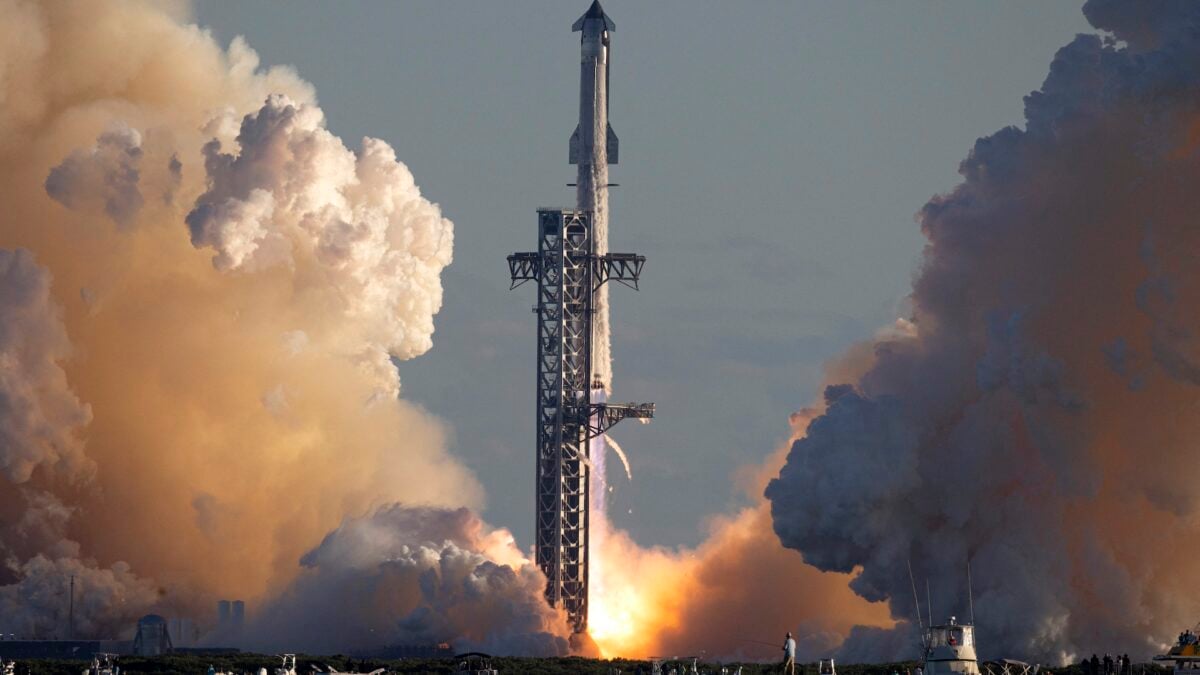
There are several major hurdles standing between Elon Musk and his plan to deploy armadas of data centers in space. How do you keep them from getting fried by radiation? What’s going to shield them from meteorites and other floating debris? Who’s going to make repairs? But his biggest obstacle, ironically, could turn out to be much more down to Earth than all that. Before it can actually build orbiting data centers, Musk’s SpaceX will first need to launch a considerable number of Nvidia chips into space. The problem is it’s already promised those same chips as collateral to the lenders behind its latest debt package, a $43 billion deal dubbed “Project Saturn.” And as the Financial Times reported on Friday, those lenders have some very understandable concerns about all that collateral potentially being blasted hundreds of miles off of Earth’s surface—where they may not be recoverable, much less resold, should SpaceX default on its loans. SpaceX has reportedly said it plans to use the $43 billion worth of Nvidia chips inside data centers here on Earth. But its lenders are looking for some legal assurance that Musk won’t later change his mind, load them into a Starship rocket, and launch them into orbit. The Financial Times wasn’t able to determine if such an assurance made it into the finalized documents for the deal, and SpaceX did not immediately respond to Gizmodo’s request for comment. In any event, it’s an early glimpse of some of the questions lawyers will be considering as tech companies headed by mercurial billionaires look to the stars to siphon as much profit as possible from the AI boom. Musk has promoted the concept of orbiting data centers—which could hypothetically be powered by a limitless supply of solar energy and release excess heat into the vacuum of space—as a more cost-effective and sustainable alternative to their terrestrial counterparts. They could also be more politically practical: “Data centers in space looking pretty appealing right now,” Musk wrote on X shortly after the U.S. midterm elections earlier this month, which saw nationwide rejections of plans to build the facilities on terra firma. In January, SpaceX requested approval from the U.S. Federal Communications Commission to launch one million orbital data center satellites—a project which a recent preprint paper from researchers at the University College London estimated would increase rocket emissions by a factor of 150 compared to their 2025 levels. Jeff Bezos’ Blue Origin has also asked the FCC for permission to launch a constellation of 51,600 satellites, which would collectively function as an orbiting data center, and Google is testing orbiting Tensor Processing Units through Project Suncatcher. SpaceX’s orbital data center ambitions, like its longer-term mission to colonize Mars, are still very much in the blueprint phase. Both were used to sell the company’s IPO in June, which, prior to Anthropic’s stock market debut on Thursday morning, was the biggest in history, briefly making Musk the world’s first trillionaire. While it’s known primarily as a space and aeronautics company, SpaceX has been leaning much more heavily into its AI business. It merged with xAI, Musk’s AI startup, in February, and in an earnings call last month, Musk reported that the company had turned its first quarterly profit since going public, thanks in large part to its AI investments. The company has also received a boost from two of its erstwhile competitors in the AI race, Anthropic and Google, both of whom agreed earlier this year to pay handsome monthly sums ($1.25 billion and $925 million, respectively) to access compute from SpaceX data centers. Yet in order to realize its extraterrestrial ambitions, it’s still relying on huge quantities of Nvidia chips, and more importantly, on the generosity of third-party lenders. Even after SpaceX’s successful Starship catch this past weekend, SpaceX is going to need a clear plan for returning its collateral chips to the surface in the case of a default. Until then, Musk’s orbital data center dream will remain grounded.
Elon Musk’s Lenders Have One Request: Please Don’t Launch Our AI Chips Into Space
Full Article
Original Source
Read the full article at Gizmodo →KhanList aggregates and links to publicly available news content. We do not host full articles from third-party sources. Always verify important information with original sources.