
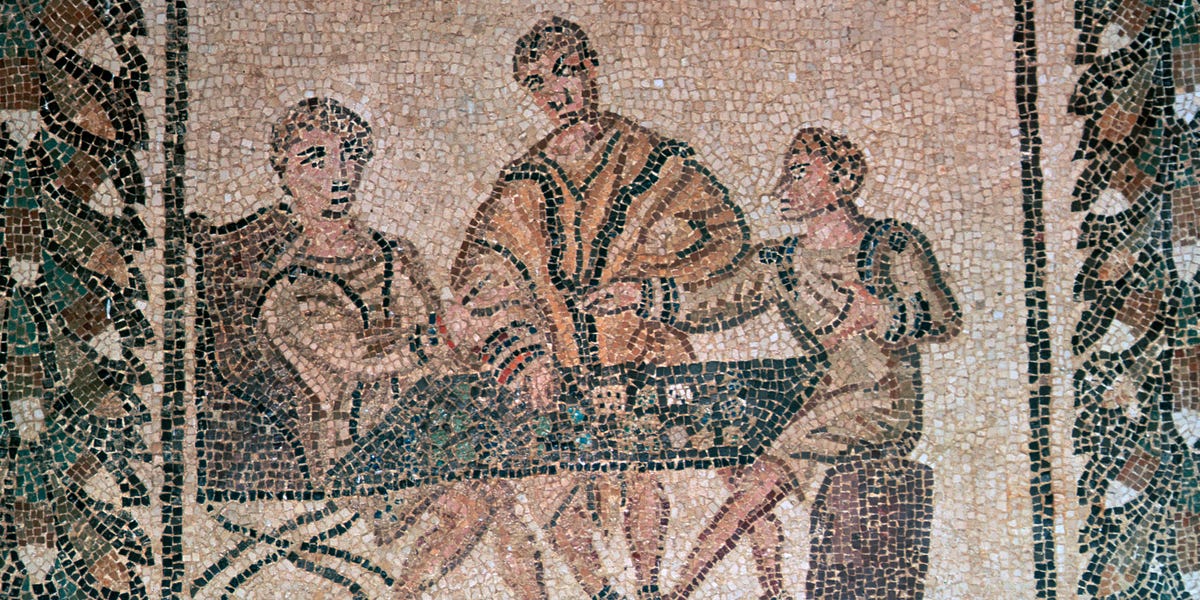
3 min readHere’s what you’ll learn when you read this story:Archaeological excavations near an ancient Roman basilica in France uncovered a collection of 1,000 Roman-era dice.On every die, opposite faces add up to seven, just as they do on modern dice.Discovering so many dice beside a monumental building at a once-thriving Roman hub raises big questions.Today, Grand is a quiet village in northeastern France. But nearly 2,000 years ago, it was as grand as its name implies. And now, that history has a fresh layer of mystery. Nearly two millennia ago, the Roman-Gaul city featured a 17,000-seat amphitheater and an impressive basilica with painted walls and mosaic floors. There are also clues of an intricate bath system tied to the basilica, which honored the Gallo-Roman god of healing, Apollo Grannus. All of that is easily explained. What’s not so easy to explain is the discovery of over 1,000 bone dice there.Excavations this summer near the basilica first unveiled 500 dice. As crews kept working, they revealed another 500. And after that: naturally, lots of questions.The dice were unearthed near the basilica’s foundation, an area with ample evidence of daily living, including pottery fragments, bronze coins, eyed needles, shoe nails, and jewelry. Locating a handful of dice there might not have been surprising, but finding so many in one spot was puzzling. Was the site a workshop for making dice? Were the pieces used as part of some ritualistic element of the basilica? Or did archaeologists just discover a Roman-era casino?Every bone die bears the Roman-style pips: small concentric circles, or ocelles, cut into the faces with a metal tool, according to ArkeoNews. Some of the dice have wax and charcoal mixed into the holes to help make their circles appear more distinct against the light-colored bone. On all of the dice, the pips follow the “sevens” arrangement, with opposite faces adding up to seven (Egyptian dicemakers invented that scheme more than a millennium before Rome). Medieval Europe later dropped it for a different layout, then reverted around 1450, which is why your modern dice are numbered the same way.Grand once held a far more prominent place in the Roman world than today’s village lets on. Experts believe it may have been one of the largest Roman centers in the region at its height, from the first through third centuries C.E. Remnants of the monumental architecture there backs that claim. The basilica ranks among the largest in Europe, and its builders could afford to finish it accordingly: walls painted in red and yellow and a 2,300-square-foot mosaic floor. Further excavations near the basilica over the last three years revealed the intricacy of its design, unearthing 65 feet of water piping and what was once likely a wooden basin, possibly part of a bath system that drew travelers searching for healing in the waters of Apollo Grannus, the god of healing. Nearby stood an amphitheater with seating for 17,000, which is far more people than could ever have lived here.The finds at Grand resist easy categorization. This was no ordinary settlement, but the domestic debris—pottery, coins, needles, shoe nails—suggest that it wasn’t a purely ceremonial site, either. And the discovery of 1,000 dice only complicates the picture. Until more evidence surfaces, the largest collection of dice ever found in the region remains unexplained, along with the deeper nature of ancient Roman Grand itself.Tim Newcomb is a journalist based in the Pacific Northwest. He covers stadiums, sneakers, gear, infrastructure, and more for a variety of publications, including Popular Mechanics. His favorite interviews have included sit-downs with Roger Federer in Switzerland, Kobe Bryant in Los Angeles, and Tinker Hatfield in Portland.
Forget Las Vegas—Archaeologists Just Found 1,000 Dice Underneath an Ancient City
Full Article
Original Source
Read the full article at Popularmechanics →KhanList aggregates and links to publicly available news content. We do not host full articles from third-party sources. Always verify important information with original sources.