
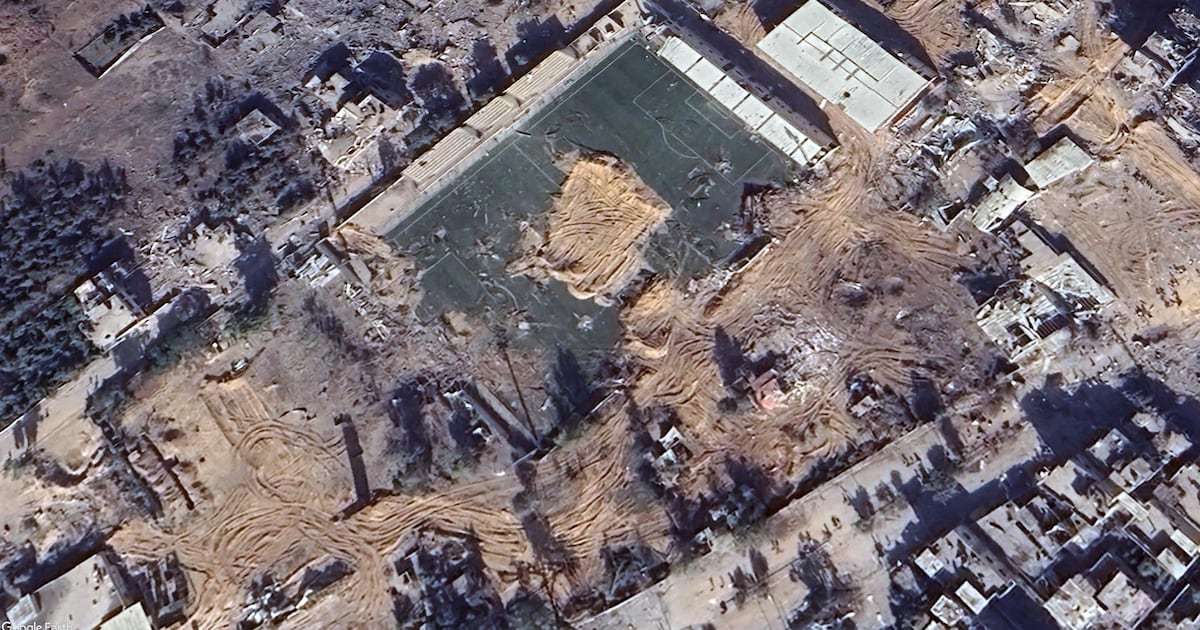
“I am Omar al-Jamasi. I owe one shekel (€0.29) to a boy named Abdul Karim al-Nirab [who] lives on Abu Nafez Street. And I, my loved ones, love you...” This was a note, scribbled on a scrunched-up piece of paper, of a young football player who carried it with him until March 2025, six months before the current ceasefire was agreed, when he was killed.Omar was one of 10 boys killed in the last three years at a single club, Al Helal Football Academy, that, 10 years ago, had sent their under-16 team to Ireland – a trip commemorated by hanging the Irish flag outside their new astroturf pitch on the beachfront in Gaza City.Omar Al-Jamasi, a young Palestinian footballer for Al Helal Football Academy killed in Gaza in March 2025, and the note he was carrying on his death Today, the pitch, like many in Gaza, has been reduced to a pile of sand and rubble.“The war brought sports activities in Palestine to a halt,” said Mustafa Siam, who serves as secretary general of the Palestinian Sports Media Federation, speaking to The Irish Times via WhatsApp from Gaza. “Sports infrastructure has been a direct target of the Israeli military machine.”In a statement, the Israeli military said it does not deliberately target sports facilities and that any such site struck would have been targeted because of what it described as military activity or infrastructure in or around it.Since October 2023, Israel’s bombardment and ground operations in Gaza have killed more than 1,000 people from Gaza’s sporting community, according to the Palestine Olympic Committee in Ramallah, destroying 70 per cent of sports facilities, and damaging the remaining 30 per cent. Football clubs on the ground report that Israel continues to block the deliveries of footballs to the Strip.Here, The Irish Times analyses the fate of Gaza’s largest football stadiums with satellite imagery, and what they reflect about the evolution of Israel’s military assault on Gaza since October 2023. Beit Hanoun StadiumBeit Hanoun Municipal Stadium in May 2022 compared with November 2023Before October 2023, the Ittihad Beit Hanoun Sports Club trained at one of the few stadiums in Gaza with artificial grass, allowing them to play in varying weather. Situated around 2km from Israel in northern Gaza, Beit Hanoun Stadium was among the first stadiums to be destroyed, after Israeli forces launched their first ground invasion in Gaza weeks after the October 7th attack. Large vehicles destroyed the centre of the pitch in particular, with the artificial grass dug up and piled in mounds of earth either side of the centre line, making it impossible to be played upon.The pitch was progressively destroyed with vehicle tracks since then and lies in ruins today within territory the IDF continues to occupy one year on from the October 2025 ceasefire.Al-Yarmouk StadiumAl-Yarmouk Stadium in May 2022 compared with April 2024Built in the 1930s, Al-Yarmouk Stadium featured a football pitch surrounded by a running track used by aspiring Palestinian Olympians since Palestine joined the International Olympic Committee in 1995. By Christmas Eve in December 2023, the stadium had been converted into a detainment yard, according to a video uploaded to YouTube by an Israeli soldier. The footage showed images of men of all ages, including what appears to be at least two young boys, stripped to their underwear, with some forced by IDF soldiers to kneel in the middle of the pitch, according to CNN.An edited video circulating on social media appears to show Palestinian women and men blindfolded with their hands with their hands tied behind their backs as they sit on the grass in front of a soccer goal in the stadium Palestinian women were pictured blindfolded kneeling by one of the stadium’s goals under an Israeli flag, with their hands bound behind their backs. Thousands of Gazans were detained throughout the past three years and moved to Israeli prisons or makeshift IDF detention camps, including Sde Teiman detention camp in the Negev desert. At the end of June 2026, the Israel Prison Service was holding 9,187 Palestinians in detention or in prison on what it defined as “security” grounds, including 1,554 from the Gaza Strip, according to BT’Selem, an Israeli human rights organisation.Al Helal ClubAl Helal Football Academy and Gaza Sports Club in October 2023 compared with November 2024 For nearly a century, Palestinians have played football on the Gaza Sports Club’s pitches. The beachfront sports complex in Gaza City received over $500,000 from the now defunct United States Agency for International Development (USAid) in 2022 to develop facilities for boys and girls to learn sports like tennis, basketball and martial arts. Not far from the club in Gaza City is Al Helal Academy, which before October 2023 trained some of Gaza’s young football talent. In 2016 and 2017, a team of under-16 boys from the Al Helal Club travelled to Ireland with the assistance of Gaza Action Ireland, an Irish pro-Palestinian solidarity group. The Palestinian teenagers played local teams in Ballybrack in Dublin, Nenagh in Tipperary, Kinvarra in Galway and the People’s Park in Limerick. Ahmed Jahjouh (24), a professional Palestinian footballer, was one of those children.“Those were some of the most beautiful days of my life,” Jahjouh said, speaking to The Irish Times via WhatsApp from Gaza. “The first team to come out of Gaza to represent Palestine was Al Helal Club. We received the warmest welcome from the Irish people.”After Israel launched an all-out military assault on Gaza after the October 7th attack, the sports clubs suffered bomb damage.Video posted to Al Helal Football Club's Facebook page from the football academy's administrative offices showing destroyed facilities. Source: Yahya Al-Madhoun Satellite footage from October 2023 shows three bomb blasts encircled by craters in the vicinity of the clubs, including: one 6m crater on the southeastern pitch of the Gaza Sports Club; while one crater filled the road outside the main Al Helal club building, causing damage to the pitch.By November after over a year of conflict, every pitch had been completely destroyed and rendered unrecognisable from before.The next satellite footage available is from December 2024. By then, almost every building in the block appeared to have been destroyed, either by bulldozers or by the impact of bombing, including the roof over the Al Helal indoor astroturf pitch. “There are no stadiums or buildings left for Al Helal Club,” Jahjouh said. “All the stadiums have been bulldozed and demolished.”Jahjouh said 10 children who played for Al Helal Club had been killed since October 2023, and six adult professional players on the club’s first team, including 20-year-old Muhammad Khalifa, a young footballer who had visited Ireland with him and played football in 2016. He was killed with seven other members of his family when Israel bombed their home in Nuseirat refugee camp.“Khalifa was one of my closest friends,” Jahjouh said. “He was killed in the war. The missile tore his body apart because of the force of the explosion.”Khalifa was one of more than 1,000 athletes killed in Gaza since October 2023, and one of over 73,000 deaths officially recorded by Gaza’s health ministry. A further 10,000 deaths are unconfirmed due to bodies believed to be under rubble.The Israeli government had long denied the death toll as “exaggerated tolls” from Gaza’s health ministry as it was officially run by the Hamas-led government. But in January 2026, a senior Israeli military official confirmed to The Times of Israel that the IDF believed the figure of roughly 70,000 killed to be accurate.This would account for at least 3 per cent of Gaza’s population - or roughly one in 33 people who were alive in September 2023.Palestine StadiumPalestine Stadium in May 2022 compared with July 2025Before October, Palestine Stadium had capacity for 10,000 football fans to support their teams, while the football grounds in one of Gaza City’s most affluent neighbourhoods, Al Rimal, became a regular training venue for the Palestine national team. After October 2023, the pitch became arid as north Gaza’s population was forcibly evacuated south and then besieged for months starting in October 2024. Today Palestine Stadium sits just within the limits of the so-called “yellow line”, which marks the boundary line between territory in Gaza controlled by the Israeli military and territory where Palestinians can live. Gaza’s population of more than two million people now live on land roughly half the size of what was available to them before October 2023. With space at a premium, the Palestine Stadium’s famous pitch is now crowded with tents housing displaced Palestinians. Tents of internally displaced Palestinians set up in Al Yarmouk stadium in central Gaza City in May 2025. Photograph: EPA Future of football in GazaMost of the boys playing for Al Helal Football Club, who once travelled to Ireland are now displaced in tents across Gaza, with little access to play football, said Zoe Lawlor, chairperson of the Irish Palestinian Solidarity Campaign and co-ordinator of Gaza Action Ireland. “Sport is so important as an outlet to any young people but especially to those living under siege and occupation and now surviving genocide,” said Lawlor, who had visited Al Helal Club in Gaza as part of an Irish sports outreach programme in 2013.“Gaza was so beautiful even under siege. To see every aspect of civil society destroyed by Israel is horrendous,” she said. “It is a crime … what has been done.“There must be accountability for the international community.”“To see every aspect of civil society destroyed by Israel is horrendous”In December 2023, South Africa initiated proceedings against Israel before the International Court of Justice (ICJ) alleging that Israel’s military actions in Gaza constituted genocide against the Palestinian people. In January 2024, the ICJ issued a provisional measures order. An ICJ ruling on the substantive genocide claim against Israel is not expected for years.As part of parallel criminal proceedings at the International Criminal Court (ICC), arrest warrants were issued in November 2024 for Israeli prime minister Binyamin Netanyahu and former Israeli defence minister Yoav Gallant for alleged war crimes and crimes against humanity, in addition to Hamas military leader Mohammed Deif who was later confirmed to have been killed in an Israeli strike in July 2024. In issuing the arrest warrants, the ICC chamber stated that it “found reasonable grounds to believe that Mr Netanyahu and Mr Gallant each bear criminal responsibility as civilian superiors for the war crime of intentionally directing an attack against the civilian population”.“Sports facilities are by definition civilian objects,” said Heidi Matthews, assistant professor at Osgoode Law school in Canada and expert in international criminal law. “When they are intentionally and directly attacked, that constitutes the war crime of attacking civilian objects.”Under international law, Matthews said, civilian objects can only be targeted if there is evidence that militants were using them to “make an effective contribution to military activity” and even then, only if the destruction “offered a clear and concrete military advantage to Israel”.In response to a request for comment from The Irish Times, a spokesperson for the Israeli military stated “the IDF does not deliberately target sports facilities”. The spokesperson said: “If a sports facility was struck, this was due to its military use or the presence of military infrastructure or military activity in or around the site, and not because it was a civilian sports facility.”The statement continued: “The IDF does not seek to cause excessive damage to civilian infrastructure, and its strikes are carried out solely on the basis of military necessity and in accordance with international law. It must be emphasised, however, that Hamas unlawfully embeds its military assets in, beneath, and in proximity to densely populated civilian areas, and cynically exploits civilian infrastructure for terror purposes.” The IDF did not respond to a further request for evidence supporting the allegation that Hamas used sporting grounds in Gaza.Matthews said: “There are separate crimes of causing disproportionate damage and extensive and wanton destruction to civilian objects. The level of destruction of sports facilities raises the question whether there is a justification based in military necessity or is this unjustified destruction? All of the evidence points in the direction of the latter.”“Football is a part of our lives. We don’t want to give up on it.”For now, Gaza’s footballers are without pitches to play on, and according to Mustafa Siam, secretary general of the Palestinian Sports Media Federation, even footballs are denied entry to the Strip.“The destruction of sports facilities has undoubtedly had a profound impact on players, clubs, and local communities … leaving players without an income, depriving children, and the local community of the opportunity to play football and engage in other sports, as large and small stadiums – as well as schools – have been demolished.“Israel continues to impose a total blockade on Gaza, banning the entry of sports equipment – specifically footballs – which further exacerbates the suffering of players. Many are now living in tents under dire humanitarian conditions after the destruction of both their homes and their clubs.”Jahjouh, a former professional footballer, said: “Before the war, we actually received a salary from playing football. Now, we have to pay out of our own pockets just to be able to play. Renting a football pitch costs around $50 for just one hour.“The balls we have are very few and of poor quality. Footballs are not allowed,” he said. “Before the war, they cost $30. Now they cost $300 and are in terrible condition.”Cogat, the unit within the IDF that is responsible for facilitating the delivery of aid to occupied Palestinian territories, declined to comment and then did not answer further requests regarding whether football equipment and building material to repair sports facilities were allowed to enter the war-torn Palestinian enclave. Fifa's Gianni Infantino attends the inaugural meeting of the Board of Peace at the Institute of Peace on February 19th, 2026, in Washington. Photograph: Getty Images In February of this year, following the tentative ceasefire, Fifa announced a “landmark partnership agreement” with the Board of Peace – Donald Trump’s alternative to the United Nations that he has tasked to rebuild Gaza’s infrastructure. Fifa’s president Gianni Infantino appeared alongside the leaders of the Board of Peace to announce that Fifa would implement a five-phase recovery plan for Gaza’s football facilities.The plan promised that in the first three to six months, Fifa would install 50 arena mini-pitches and the rollout of a Fifa Football for Schools programme, which would see the distribution of equipment and structured grassroots activities. By phase five, it promised to build a 20,000-seat national stadium in Gaza within three years of initiation.[ Ireland v Israel was no ordinary match assignment. Irish journalists were watched and filmedOpens in new window ]“Together with the support of the Board of Peace, Fifa will drive this partnership which is built to deliver impact at every stage,” a post to Infantino’s Instagram page read.However, when approached by The Irish Times, a spokesperson for Fifa said that, while the organisation was still committed to the plan, phase one was yet to begin as it was tentative on the stated condition that “implementation will proceed in line with ongoing monitoring of safety and security conditions”.Fifa declined to comment on requests for further information on a planned timeline and budget.For now in Gaza, despite few footballs being delivered and most pitches destroyed, last week a group of former professional football players found a way to play.In the same week Ireland was playing Israel in the Uefa Nations League, two teams in green and blue jerseys took to one of Gaza’s few remaining green pitches in their first club game in three years for a new tournament – the Thousand Martyrs Cup.Surrounded by destruction and the grey dust of Gaza’s rubble, spectators watching players from atop dilapidated buildings.October 2026: Gazan footballers return to the pitch in one of the first club football tournaments since 2023. Video: Palestinian Sports Media Federation “It is very difficult, but we still play,” said Jahjouh, who lost his mother, brother and his brothers family as well as his best friend Khalifa in the past three years.“Football is a part of our lives and we don’t want to give up on it.”All satellite imagery sourced through Google Earth
Game over: Inside the ruins of Gaza’s football stadiums
Full Article
Original Source
Read the full article at Irishtimes →KhanList aggregates and links to publicly available news content. We do not host full articles from third-party sources. Always verify important information with original sources.