
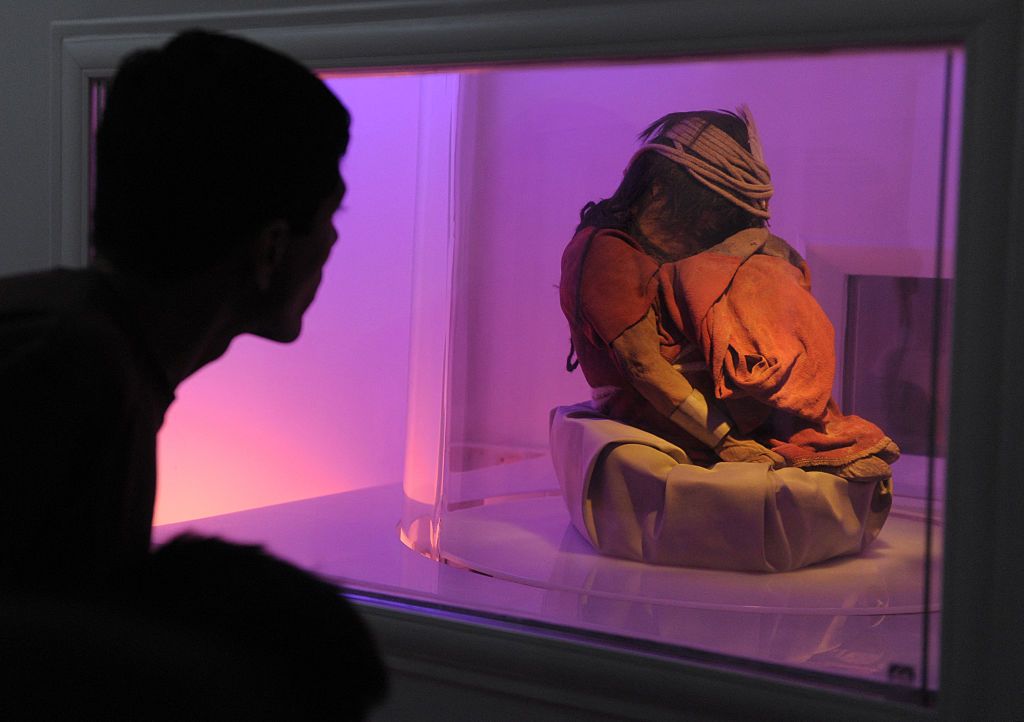
Five centuries after children were sacrificed on volcanic peaks in the Andes, chemical clues preserved in their hair and fingernails show how the empire used intoxicating blends to soothe the children during their final months November 4, 2026 8:00 a.m. A mummy known as El Niño (The Boy), a seven-year old Inca child found in 1999 on the top of the Llullaillaco volcano in the Argentine Andes. Juan Mabromata / AFP via Getty Images The capacocha was one of the most sacred ceremonies of the Inca Empire, involving the sacrifice of children on the high-altitude volcanic peaks of the Andes. Now, new research reveals how children were drugged in preparation for their fate. Researchers analyzed hair and fingernail samples taken from eight frozen child mummies discovered on mountains across Peru and Argentina: one boy and seven girls who were between the ages of six and 14 when they died some five centuries ago. The toxicological screenings revealed that the youths were administered intoxicating and mind-altering substances including cocaine, ceremonial corn beer and an alkaloid linked to ayahuasca brews, according to a study published in Antiquity this week. While earlier studies primarily focused on coca leaves, Dagmara Socha, a bioarchaeologist at the University of Warsaw and the study’s first author, explains in a statement, “our aim was to identify a broader range of psychoactive substances administered to the children and to determine whether patterns in their use could provide new insights into how capacocha ceremonies were conducted at different locations.” “Recent advances in toxicology now allow for the identification of low concentrations of such substances,” she adds. Early Spanish chroniclers like friar Martín de Murúa noted that capacocha ceremonies were meant to ensure there would be “no famine nor lack of fruits of the earth, nor would there be drought, nor pestilence, nor rebellion.” But how priests managed the victims’ emotional and physical states remained poorly understood. Inca rulers sacrificed healthy young boys and girls from across the vast empire during moments of profound crisis like prolonged droughts, famines or political turmoil to appease the mountain deities and restore cosmic order. Rather than viewing these victims as mere casualties, the Inca considered the children to be sacred ambassadors destined to ascend as eternal messengers between humanity and the gods. “The ritual also had a political dimension, helping the Inca state establish relationships with local communities and incorporate regional deities into the imperial religious system,” Socha tells Gizmodo’s Gayoung Lee. “Being selected for capacocha was an extraordinary honor that elevated not only the social status of the children but also that of their entire families,” she tells Discover’s Anastasia Scott. Figurines recovered from sacrifical sites on Llullaillaco and Ampato showing bulging cheeks representing the chewing of wads of coca leaves Johan Reinhard Because chemicals become locked in the keratin protein of growing hair and nails, they preserve a record of an individual’s final months alive. Using sensitive modern forensic techniques, the team detected cocaine in all eight mummies, confirming that each child chewed coca leaves, a plant held sacred by the Inca. Figurines buried alongside the mummies also feature prominent bulges in their cheeks, representing coca quids. Besides a ceremonial importance, the coca leaves likely helped suppress hunger, relieved exhaustion and counteracted severe altitude sickness during the victims’ ascents to the mountaintop sacrificial sites. Four of the victims also showed chemical signs of alcohol consumption. This likely came from chicha, a fermented maize beer that was given to the children to dull their senses and calm them as the sacrifice neared, per the statement. Chicha residue was also discovered in vessels interred with the mummies. “What is interesting is that, although coca appears to have been a common element of the capacocha ritual, the use of other psychoactive substances varied between individuals and locations,” Socha tells Gizmodo. “This suggests that the preparation of children for sacrifice was not uniform across the Inca Empire.” Among the mummies examined was the famous “Lady of Ampato,” popularly known as Juanita, an adolescent girl discovered on Ampato, a Peruvian stratovolcano, in 1995. In her fingernails, researchers identified traces of harmine, an active alkaloid derived from a vine that is one of the foundational ingredients of ayahuasca. Because harmine possesses notable antidepressant properties, researchers believe it was administered specifically to elevate her spirits, ease her fear and attune her senses. Did you know? Cocaine use Researchers identified traces of cocaine use in the brain tissue of two people buried in Italy in the 1600s. It was previously thought to have spread to Europe only in the 19th century. Since the vine only grows in the Amazon rainforest and had to travel hundreds of miles over trade networks to reach the sacrifice sites in the Andes, it shows that ensuring “emotional wellbeing and positive mood of the children, who were regarded as messengers to the gods, may have been an important part of the ceremony,” Socha tells Discover. The chronological record in hair strands allowed the team to map out how ritual preparations intensified over time. For an eight-year-old girl found on Mount Chuscha in Argentina, chemical markers revealed that her coca intake climbed over six months, while signs of alcohol appeared exclusively during her final weeks, signaling a transition into the final ceremonial stage. “We cannot reconstruct the children’s emotions or determine precisely how they experienced these events,” Socha tells New Scientist’s James Woodford. “However, we should not assume that being selected for a prestigious religious ceremony necessarily meant that the experience was not frightening or traumatic.” You Might Also Like Get the latest stories in your inbox every weekday. More about: Argentina children History Illegal Drugs Incas Peru Psychology Religion Religious History South American History
Forensic Analysis of Frozen Inca Mummies Reveals That Sacrificed Children Were Plied With Coca Leaves, Corn Beer and Ayahuasca Compounds Before Death
Full Article
Original Source
Read the full article at Smithsonianmag →KhanList aggregates and links to publicly available news content. We do not host full articles from third-party sources. Always verify important information with original sources.