
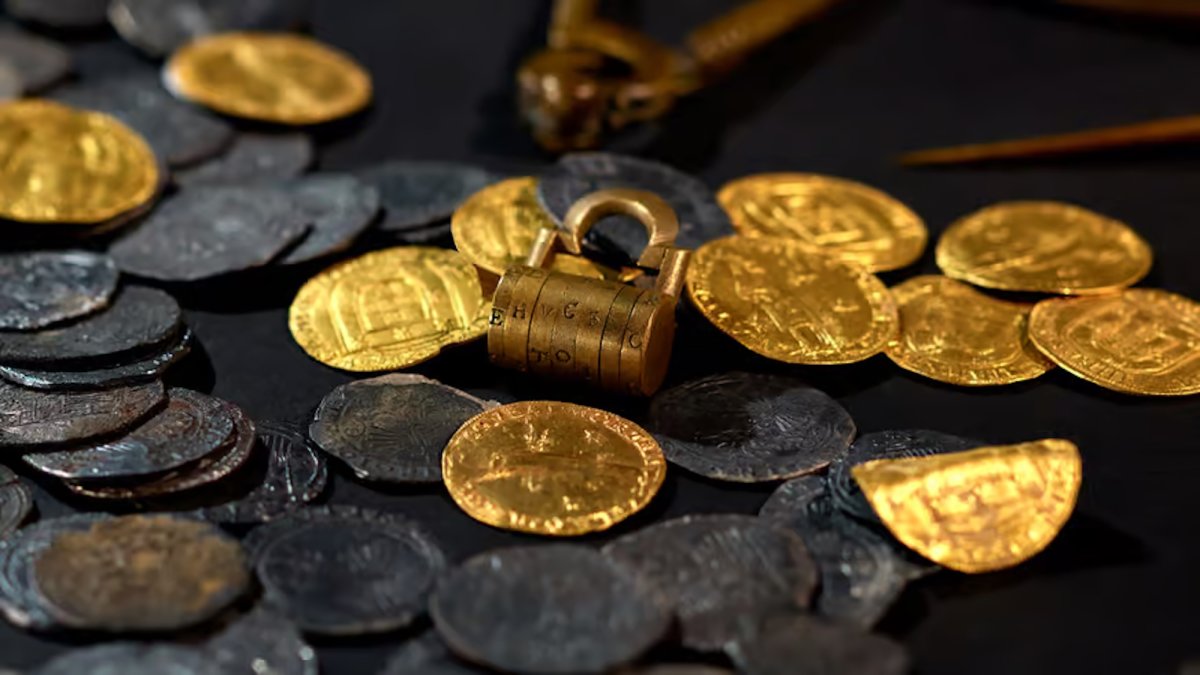
Over 800 gold and silver coins have been found from the Ann Francis wreckage. Credit: Amgueddfa Cymru / Cardiff University Archaeologists have finally cracked the code to the famed Ann Francis shipwreck’s brass combination treasure lock. However, the 16th century relic didn’t open after hours of painstaking trial-and-error. Researchers at Cardiff University and Amgueddfa Cymru, the National Museum of Wales, relied on highly detailed CT scanning equipment to peer inside the mechanical device and learn the code without touching the lock itself. “It’s not every day you get to solve a 400-year-old mystery,” David Williams, a Cardiff University biomechanics engineer, said in a statement. The lock’s combination was lost on December 28, 1583, when the merchant ship Ann Francis sailed into a powerful storm during a return voyage from Spain. The exact crew number is unclear, but all of them (around 14 sailors) reportedly drowned after veering off-course and wrecking along the coast of southern Wales. Unfortunately, at least one other death is likely directly tied to the Ann Francis. Archival evidence suggests locals later accused a “detestable woman” named Mother Gabley of being an “execrable witch” and casting the foul weather responsible for the maritime tragedy. While Mother Gabley’s fate remains unknown, she would have almost certainly been hanged under the recently passed “Act Against Conjurations, Enchantments and Witchcrafts” if brought to trial. The Ann Francis remained missing for 415 years, until metal detectorist Peter Hughes rediscovered the wreckage while surveying southern Wales’ Margam Beach in 1998. Hughes and archaeologists subsequently spent more than 20 years scouring the area for the ship’s remains. By 2017, preservationists had documented over 800 gold and silver coins from Germany, Spain, and Portugal along with artifacts like compasses, ship equipment, and cutlery. Still, the wreck’s most famous remnant is the brass combination lock still in working condition after four centuries buried in sand. It’s possible the lock was used to guard those coins, or potentially other valuables that didn’t survive exposure to the elements. Regardless, the lock has remained close with no hints to its four-letter combination for hundreds of years. “Elizabethan combination locks are known in Britain, but this one is in exceptionally good condition and is associated with a dated wreck, making it a unique find and the code a tantalizing mystery to solve,” said Alastair Willis, senior numismatics curator at Amgueddfa Cymru. Tampering with the delicate lock was out of the question, but Willis and his colleagues knew what to do. Using micro-computed tomography (micro-CT) scanning, they looked inside the device and determined the correct code. “By creating a detailed 3D image of the internal mechanism, I could see how the notches lined up with the letters and identify the exact combination,” explained Williams, who called the experience “certainly a first” for his team. The correct four-letter combo? A-N-C-E. But with one longstanding question finally answered, another one has arisen. “Of course, now we’ve solved it, we are left wondering if the code meant something to its owner,” added Willis. 2026 Popular Science Home of the Future Awards 39 products that will improve your everyday life.
Archeologists crack a shipwreck’s 400-year-old combination lock
Full Article
Original Source
Read the full article at Popsci →KhanList aggregates and links to publicly available news content. We do not host full articles from third-party sources. Always verify important information with original sources.