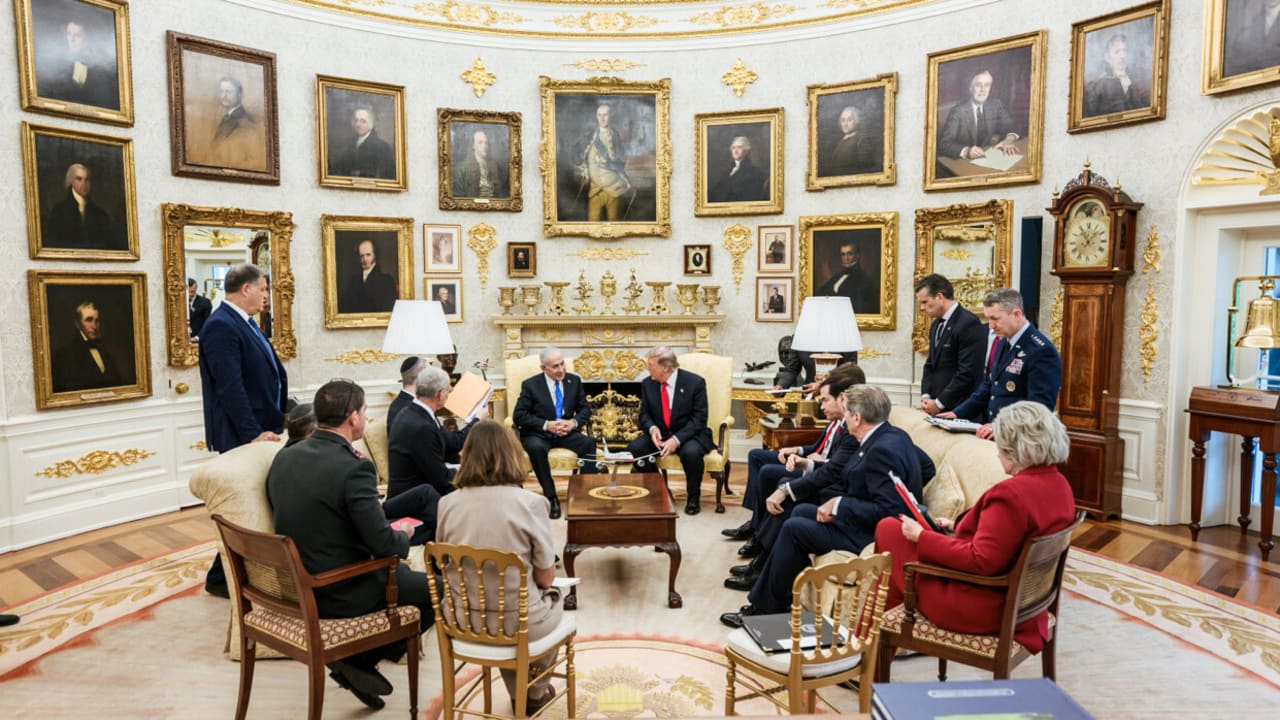
ByYAAKOV KATZJULY 31, 2026 14:02On the one hand, it was the eighth meeting between Prime Minister Benjamin Netanyahu and US President Donald Trump – the most Trump has held with any foreign leader since returning to office nearly two years ago.On the other hand, there was nothing routine about it.There were no cameras. No journalists. No photo-op at the South Portico. No warm embrace like the one Trump offered Lebanese President Joseph Aoun when he visited the White House just a week earlier.To some extent, this was not necessarily a bad thing for Israel’s prime minister. A public appearance would have carried a measure of risk. Trump continues to insist that his relationship with Netanyahu is good, but there is little doubt that it has become more complicated in recent months.He has used unusually harsh language when referring to the Israeli leader and, just hours before Tuesday’s meeting, he publicly downplayed the importance of Netanyahu’s views on Iran.Prime Minister Benjamin Netanyahu and US President Donald Trump meet at the White House, July 28, 2026. (credit: MAAYAN TOAF/GPO)A televised Oval Office meeting could have produced exactly what Netanyahu wanted: a visible endorsement of his candidacy that would resonate back home, ahead of Israel’s election on October 27.But it also carried the possibility of something different – a public rebuke or humiliation, similar to what happened to Ukrainian President Volodymyr Zelensky in the Oval Office in 2025.Keeping the meeting behind closed doors eliminated that risk, especially when considering that the expectations from the visit were modest from the beginning.For weeks, Netanyahu had been trying to get onto Trump’s schedule but repeatedly found his requests ignored. It took the scheduling of the memorial service for senator Lindsey Graham to provide the opening. Once Netanyahu was already traveling to Washington, he was able to get time with the president.The reason for the cold shoulder has been the continued war with Iran. Trump – and particularly many members of his inner circle – are increasingly frustrated with Israel, which is accused of “dragging” America into what is being described as a “forever war,” a harkening to the past quagmires of Iraq, Afghanistan, and Vietnam. Even though that assessment is far from fair, it has shaped thinking inside the White House.This was evident not only in Trump’s own rhetoric but also in comments by other officials like Vice President JD Vance, who said last week that Israel had waged a pressure campaign aimed at drawing the US deeper into a confrontation with Iran, even when doing so might not serve American interests.Against that backdrop, Netanyahu did not necessarily need dramatic announcements or historic breakthroughs but rather something simpler: to demonstrate that despite some policy disagreements and tension, the strategic relationship between Israel and the US – and specifically between him and Trump – remains intact.A quiet meeting without public friction may have been more valuable than a highly publicized summit that risked exposing divisions.That balancing act defined Netanyahu’s challenge going into the meeting. He needed to advocate for what Israel believes is essential – keeping the military pressure on Iran and ensuring that the ayatollahs do not advance toward a nuclear weapon while at the same time countering the perception that Israel is seeking to pull the US into another Middle East war.The next stepSo was the meeting a huge success like some in Netanyahu’s orbit are trying to portray? Even two days later, we still do not know for certain. On the one hand, the strikes that the US launched on Wednesday night against Iran indicate that the administration remains focused on using military pressure to get Iran to capitulate, a definite Israeli preference.On the other hand, there is little doubt that what the Americans ultimately want is a deal, and when that deal is announced, it will quickly become political fodder in Israel. If it is seen as a JCPOA-style deal, the opposition will claim that Netanyahu failed, while the government supporters will do what they did in June when Trump signed the MoU with Iran – claim that he turned on Israel.With elections around the corner, this is the challenge right now in Israel – nothing will be seen for what it is – a meeting without explosions, without public disagreements between two leaders, working together to try and solve one of the world’s most pressing threats.This is why the success will not be determined by the photographs that were not taken or the statements that were never made.It will be set by what comes next: whether Iran is prevented from rebuilding its nuclear capabilities, whether American and Israeli strategy remain aligned, and whether two leaders with a complicated relationship can put differences aside when the stakes are this high.The writer is a co-founder of the MEAD Forum, a senior fellow at the Jewish People Policy Institute, and former editor-in-chief of The Jerusalem Post. His latest book (with Amir Bohbot), While Israel Slept, is a bestseller in the United States.Follow us on Google
For Israel, an undramatic meeting between Netanyahu and Trump was enough - opinion
Full Article
Original Source
Read the full article at Jpost →KhanList aggregates and links to publicly available news content. We do not host full articles from third-party sources. Always verify important information with original sources.