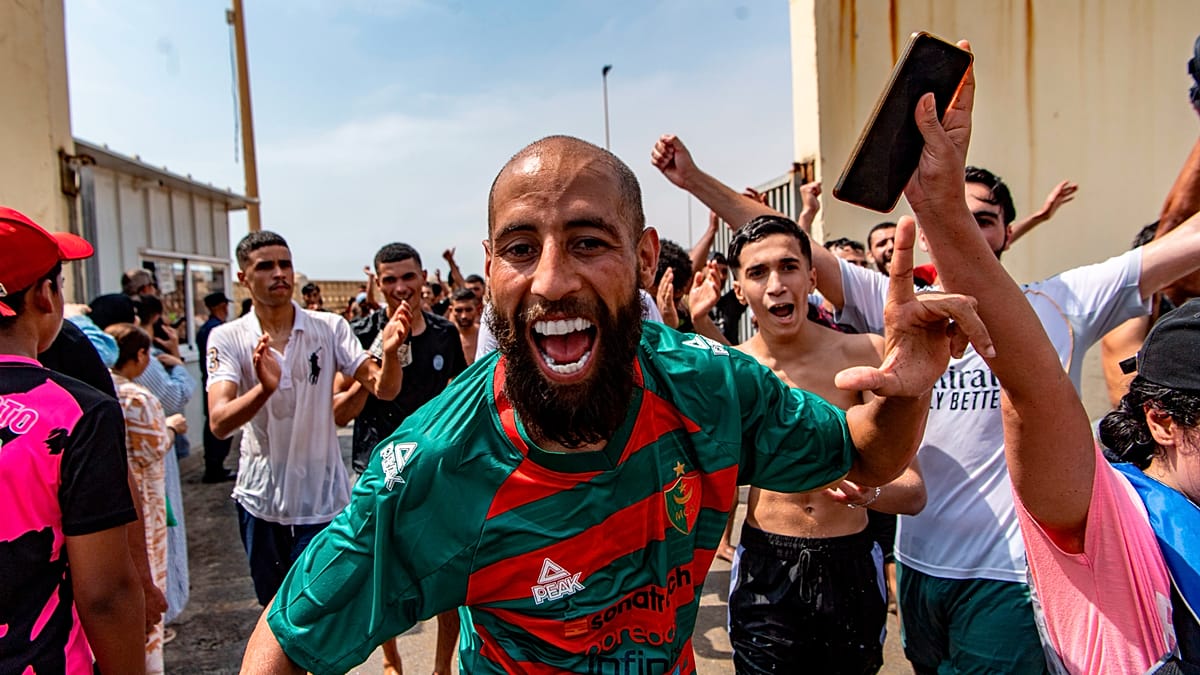
No one expected a small city of just 19 square kilometres to become the epicentre of a humanitarian and diplomatic crisis whose repercussions stretch across southern Europe. ADVERTISEMENT ADVERTISEMENT In the space of a few hours on Thursday, Ceuta saw thousands of migrants enter from Moroccan territory, marking the largest mass crossing the city has experienced since the 2021 crisis. Ceuta officials said some 60,000 migrants entered the city, and the human cost was also high, with the death toll rising to 34 people by Friday afternoon, according to Spain's interior ministry. Videos filmed on Ceuta's Tarajal beach reveal the chaos that accompanied the crossings, showing large crowds running between the breakwater and the roads around the border area. Most of the new arrivals were young people, but the footage also showed women with children and entire families, on a journey fraught with the risk of drowning and exhaustion. How did official and popular reactions in Morocco and North Africa more broadly respond to what happened? Euronews Arabic takes a look. Morocco's sovereignty claims come to the fore The events that unfolded in Ceuta on Thursday have reopened one of the most sensitive issues in Moroccan-Spanish relations: the question of sovereignty over the cities of Ceuta and Melilla, which Rabat historically regards as part of its own territory since its independence from France and Spain in 1956. The crisis coincided with Morocco's Throne Day celebrations, which commemorate the king's accession to the throne and the renewal of the bonds of allegiance and unity between the kingdom and the people. One of Morocco's most popular news outlets Hespress wrote that "the waves of incursions into Ceuta and the attempts to cross that later extended to Melilla have brought back to the fore the debate on the social and economic situation in the areas bordering the two enclaves." "What happened once again shines a light on the cities' connection with their Moroccan environment and the complexities of their historical and sovereignty dossier," it added. Hespress said that the crisis prompted the local authorities in Ceuta to call for the intervention of the central government in Madrid, which moved quickly to contact the Moroccan authorities to discuss ways to contain the situation, before agreeing to return those who had managed to enter the city to their point of origin. Hespress quoted Yahya Yahya, head of the national committee for reintegration of Ceuta and Melilla and adjoining islands, who said that the way the Ceuta authorities handled the events revealed "the fragility of the Spanish presence in the area," arguing that the request by the head of Ceuta's government to deploy the army amounts to a "political failure". What is Algeria's position? Meanwhile, Algiers' bid to score political points against Rabat, and the historic hostility between the two neighbouring countries, were very much present in Algeria's public stance on the events in Ceuta. The Tout sur l'Algerie ("Everything About Algeria") news website described what happened as a "mass escape of Moroccans" and said that Rabat — which it called "Europe's spoilt child" — had once again used the "migration bomb" against Madrid. Tout sur l'Algerie claimed that European leaders prefer to direct their criticism at Spain rather than confront what it considers to be the main source of this human tide of migrants, pointing in particular to the position of Italian Prime Minister Giorgia Meloni, who called for Spain's Schengen area membership to be suspended in the wake of the events. The privately owned news platform went further, accusing Italian Foreign Minister Antonio Tajani of seeking to curry favour with Morocco in this case because of the close relationship he is claimed to have with the royal palace. The site further alleged that Moroccan security forces allowed crowds of migrants to cross into Ceuta without intervening, claiming that either Rabat is unable to control its borders, or it is using migration as a weapon against its Spanish neighbour. It also cited the reaction of the right and far right in France to what unfolded in Ceuta, saying they "heaped accusations on Spain without uttering a single word about Morocco." Algeria's state television was similarly critical of Rabat, arguing that what happened amounts to a "mass escape" that reflects Morocco's difficult economic and social conditions. Algeria's own youth unemployment stands at around 31%, and its government has faced criticism for suppressing the Hirak protest movement — which brought millions onto the streets between 2019 and 2021 — and for using criminal prosecutions to silence journalists, activists and opposition figures. Unsurprisingly, politics cast a shadow over social media users' tweets in Algeria. Platforms were awash with sarcastic comments, including one that dubbed Morocco "Switzerland" and insisted that Ceuta is Spanish. One Moroccan user responded that among the migrants fleeing to Spain were Algerians who were also escaping the grim reality in their own country. Another posted a video showing people of other nationalities seeking a better life away from their homelands, noting that the drivers of migration extend beyond national belonging. Another video posted by a Moroccan account shed light on irregular migration in Algeria and the accompanying media blackout. Tunisia: 'Only the king is left' In Tunisia, social media users shared videos of the mass crossing towards Ceuta, accompanied by comments that in some cases took on a humorous tone. Some wrote: "Only the king is left," in reference to the large number of people who left Morocco in just a few hours. Others, by contrast, felt that the images laid bare the depth of the social and economic crisis facing large segments of North African youth, arguing that rising unemployment rates are pushing people to risk their lives in order to reach Europe. Tunisia faces its own deep structural economic problems. Youth unemployment stood at 38% in 2025, the highest of the three Maghreb countries. The country has itself become a significant source of irregular migration to Europe — Tunisian nationals are now among the largest groups crossing the Mediterranean to Italy — which adds a layer of irony to Tunisian social media commentary on the Ceuta crossing. President Kais Saied consolidated near-total executive power in July 2021, dissolved parliament and adopted a new constitution in 2022 that has been described by human rights organisations as dismantling the gains of the 2011 revolution. What do we know about Ceuta and Melilla? Spain has two exclaves bordering northern Morocco, Ceuta and Melilla. Ceuta was captured by the Portuguese in 1415 and remained under Portuguese control for around two centuries before passing to Spanish rule in 1668, under the Treaty of Lisbon, signed that same year. Melilla came under the rule of the Spanish crown at the end of the fifteenth century, when the Spaniards seized it in 1497, five years after the fall of Granada, the last stronghold of Islamic presence on the Iberian Peninsula. In 1995 Madrid granted self-government rights to both cities, bringing them into line with other Spanish regions that enjoy the same decentralised system. Morocco still regards Ceuta and Melilla as occupied territories, which it refers to as "the two enclaves", and has long called for this issue to be resolved through dialogue with Spain. Madrid, for its part, insists on its sovereignty over the two cities, which have become among the most important gateways for smuggling and irregular migration into Europe via Spain. This reality prompted the Spanish authorities in 1995 to build an 8.4-kilometre-long fence separating the city from Moroccan territory, rising to 10 metres in some sections. It is equipped with barbed wire, electronic sensors and loudspeakers to prevent any attempt at infiltration. Another border fence was constructed between Melilla and Morocco in the mid-1990s. This fence is 12 kilometres long and about two metres high, and is fitted with the same electronic equipment to prevent migrants from entering the city irregularly. The 2021 crisis, which involved around 8,000 crossings over a few days, was widely attributed to a diplomatic row between Madrid and Rabat after Spain allowed the Western Sahara's Polisario Front leader Brahim Ghali to receive medical treatment on Spanish soil. Morocco has denied any involvement in the crisis at the time.
Sovereignty, sarcasm, blame: How North Africa reacted to Ceuta crisis
Full Article
Original Source
Read the full article at Euronews →KhanList aggregates and links to publicly available news content. We do not host full articles from third-party sources. Always verify important information with original sources.