
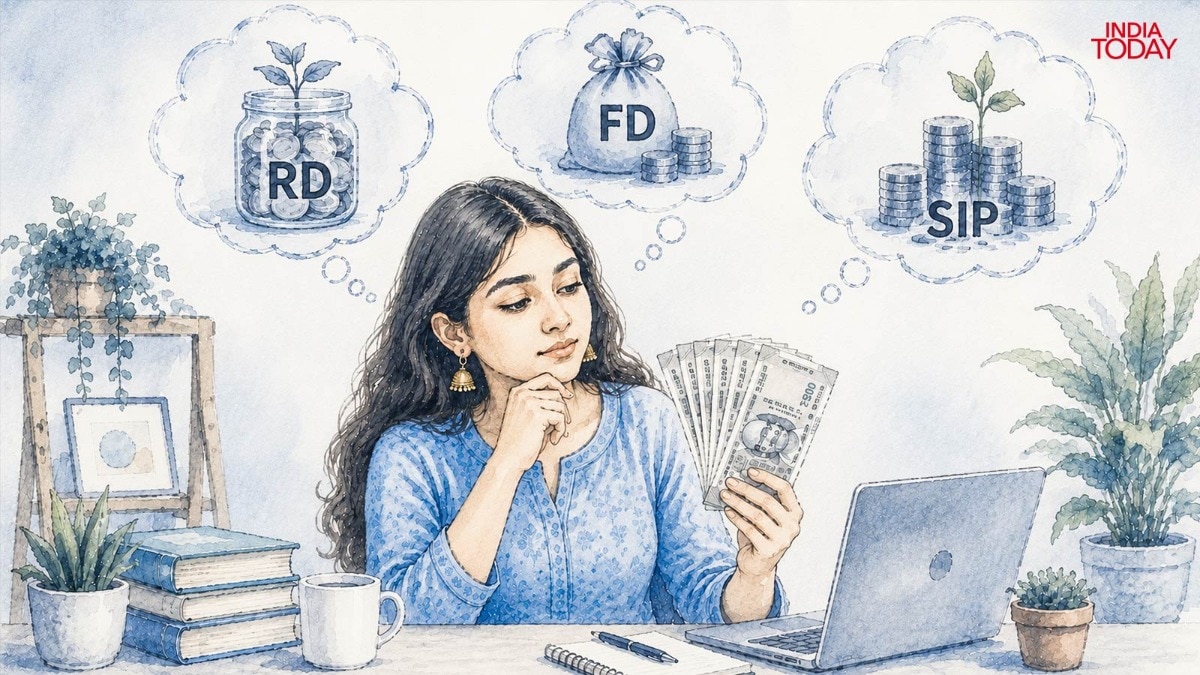
A first salary marks the beginning of financial independence, but your first investment decision can shape your future too. Should you put your money in an FD, an RD or a SIP?A first salary is exciting, but it also marks the beginning of your financial journey. (Photo: India Today)"Salary credited." Few messages bring as much excitement as this one. For many young professionals, that first salary is a milestone... one that often comes with celebrations, shopping and a sense of financial freedom.But it can also be the beginning of another journey, i.e., building wealth. So, where should your first investment go: an FD, an RD or a SIP?There isn't a one-size-fits-all answer. Your first investment shouldn't be driven by what your friends are doing or what's trending on social media. It should reflect your goals, how soon you may need the money, and how comfortable you are with risk.DON'T ASK 'WHERE SHOULD I INVEST?' ASK 'WHAT AM I INVESTING FOR?'Most first-time earners start by comparing returns. Experts say that's the wrong place to begin. "The right starting point depends less on the investment product and more on an individual's financial goals and cash-flow requirements," says Saumeet Nanda, Co-founder, SalarySe.Before investing, he says every young professional should evaluate three things—liquidity needs, investment horizon and risk appetite. Vedant Gupte, Co-Founder and CEO of investment platform Trackk, echoes the same thought."There's no single 'correct' first investment. It depends on how soon you might need the money, how much market volatility you can stomach, and whether you already have a savings cushion."In other words, the best investment isn't necessarily the one offering the highest return, it's the one that fits your financial goals and stage of life.BEFORE CHASING RETURNS, BUILD YOUR SAFETY NETImagine you've just started working. Three months later, your laptop crashes, or you suddenly need money for an emergency. If all your savings are locked away or invested in the market, you may end up borrowing.That's why almost every financial planner starts with the same advice: build an emergency fund first.Gupte says if someone has zero savings, choosing between an FD, SIP or RD shouldn't even be the first decision."If you have zero savings, the priority isn't FD, SIP or RD at all; it's building that cushion first, in something liquid. Once that's in place, someone with a long working runway ahead can afford to lean into SIPs for growth, while still keeping a portion in FDs for stability."Nanda agrees."The first financial priority should be building an emergency fund equivalent to at least three to six months of essential expenses. It should ideally be parked in low-risk and highly liquid instruments such as FDs."Interestingly, experts say you don't necessarily have to wait until your emergency fund is complete before starting to invest.A small SIP of Rs 500 or Rs 1,000 every month can run alongside emergency fund creation.Think of these three options as tools rather than competitors. Each has a different job to do. The right choice depends on whether you're saving for an emergency, a short-term goal or long-term wealth creation.FD, RD OR SIP: WHICH ONE IS RIGHT FOR YOU?Each investment option serves a different purpose.Choose an FD if...You already have a lump sum and want guaranteed returns without taking market risk. It works well for emergency savings or money you'll need in the near future. Just remember that the returns are fixed and may not always beat inflation after taxes.Choose an RD if...You don't have a lump sum but can save a fixed amount every month towards a short-term goal.Pankaj Kumar Gera, Founder & CFP, Gera Wealth Pvt Ltd, explains, "If the objective is short term, like buying a laptop, vehicle or building an emergency fund in six months, then an RD would work better. For long-term goals beyond 18 months, a SIP should be considered."Gupte describes RDs as the guaranteed-return version of a SIP."RDs work well for someone who doesn't yet have a lump sum but wants a guaranteed-return way to save monthly towards a specific short-term goal—a course fee, a gadget or a wedding expense."Choose a SIP if...Your goal is long-term wealth creation.Unlike FDs and RDs, SIPs invest in mutual funds, meaning returns aren't guaranteed. But over longer periods, they have historically delivered higher returns than traditional fixed-income products. That's why experts generally recommend SIPs for goals that are several years away rather than for money you may need soon.But if SIPs have the potential to generate better long-term returns, why do so many first-time earners still prefer FDs?IS PLAYING SAFE ACTUALLY RISKY?Ask a first-time investor why they prefer an FD, and the answer is usually simple: "It's safe."That's true, but safety comes with a trade-off."FDs are genuinely safe for capital protection. But once inflation and tax are factored in, real returns can be thin. An FD-only strategy trades away a meaningful chunk of long-term compounding for peace of mind," says Gupte.Gera puts it even more simply. "The real risk at a young age is not losing money—it's not growing it fast enough."Nanda believes young investors shouldn't see it as a choice between safety and growth. "The objective should not be choosing between safety and growth, but creating a balanced portfolio that accommodates both."CAN Rs 500 REALLY MAKE A DIFFERENCE?Many young earners delay investing because they think the amount is too small.Experts say that's one of the biggest mistakes."Most mutual funds allow SIPs starting at Rs 500 a month. At this stage, the amount matters far less than the habit," says Gupte.Gera agrees. "Starting small builds discipline and emotional resilience to stay invested through market ups and downs."Nanda adds that time, not money, is the biggest advantage young investors have. "Starting with Rs 500 or Rs 1,000 helps build investing discipline while allowing compounding to work over decades."HOW MUCH OF YOUR SALARY SHOULD YOU INVEST?Knowing where to invest is only half the battle. The next question is: how much should you invest every month?A popular thumb rule among financial planners is the 50:30:20 rule. Around 50% of your income goes towards essentials like rent and bills, 30% towards lifestyle spending, and 20% towards savings and investments.But these numbers aren't fixed. Gera says young professionals with fewer responsibilities can even aim to invest 30% to 40% of their income.Nanda, meanwhile, recommends following a "save first, spend later" approach by automating investments as soon as the salary is credited.THE MISTAKES THAT COST MORE THAN MARKET FALLSExperts say the biggest financial mistakes have little to do with stock markets.Waiting for the "right time" to invest, spending every salary hike on lifestyle upgrades, ignoring emergency savings and buying expensive insurance-cum-investment products are some of the most common errors.Gupte advises young earners to automate investments and increase them every time income rises."Start now, however small the amount. Automate it. Every time income rises, increase the investment amount before lifestyle expenses do."In other words, your first salary isn't about choosing the perfect investment product. It's about building the right financial habits.Create an emergency fund. Start investing early, even if it's just Rs 500 a month. Use an RD if you're saving for a short-term goal, an FD for stability and emergencies, and a SIP if you're looking to build wealth over the next 10 or 20 years.As Nanda sums it up, "Focus on building financial habits rather than chasing returns... Over the long term, wealth creation is driven by consistency, disciplined cash-flow management and the power of compounding, not by trying to time the market."Your first salary is unlikely to make you rich overnight. But it can help you build the habits that eventually do. Whether it's an FD for stability, an RD for a short-term goal or a SIP for long-term wealth creation, the most important step is simply getting started. After all, the earlier you begin, the longer your money gets to work for you.- EndsPublished By: Jasmine anandPublished On: Aug 7, 2026 08:00 IST
First salary, first investment: Should you choose an FD, SIP or RD?
Full Article
Original Source
Read the full article at Indiatoday →KhanList aggregates and links to publicly available news content. We do not host full articles from third-party sources. Always verify important information with original sources.