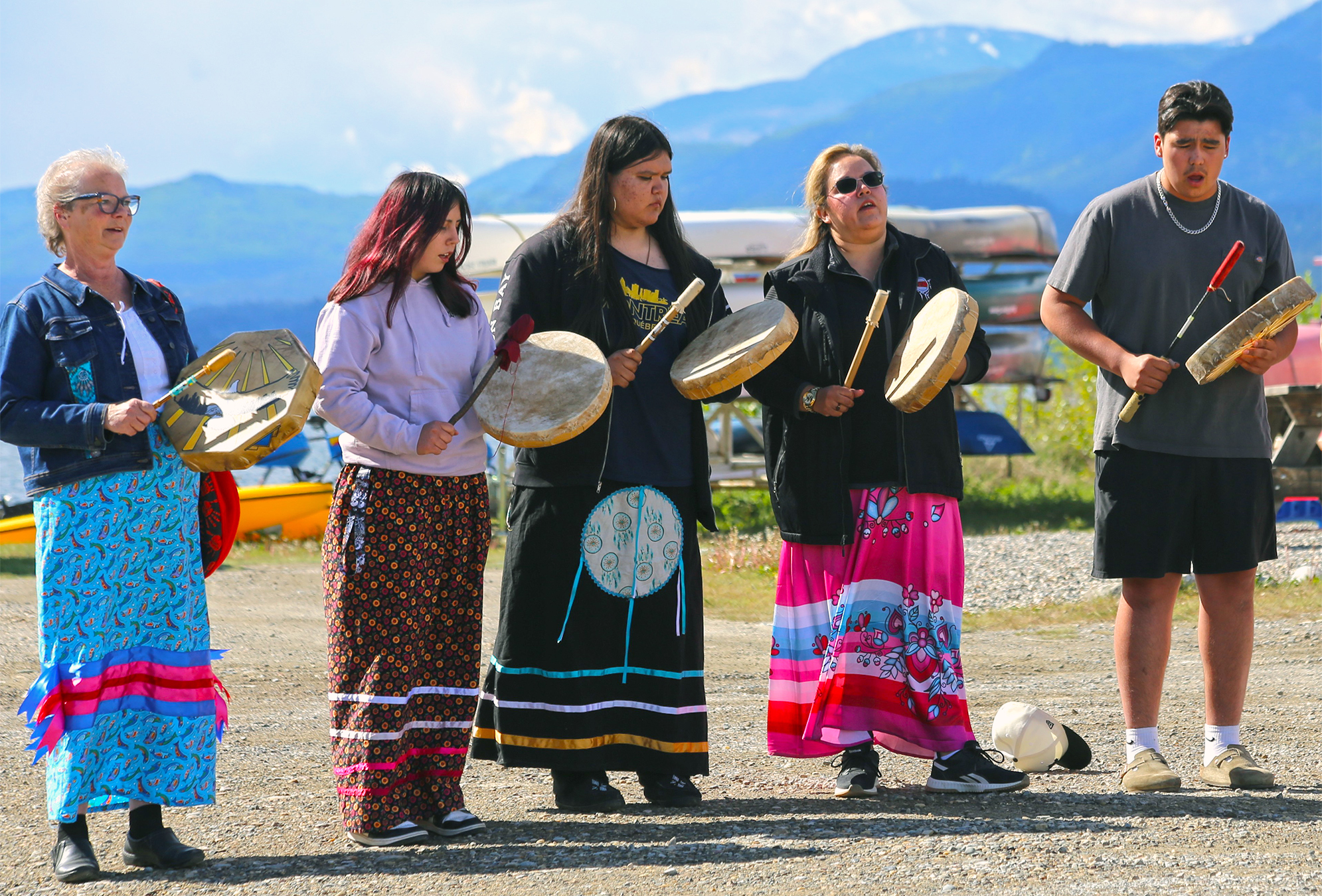
First Nations in British Columbia, western Canada, are working to restore salmon to the Upper Columbia Basin and leading ceremonial salmon fry releases to reestablish connections between salmon and salmon people.The Columbia River was once one of the greatest salmon-bearing rivers in North America, but the construction of the Grand Coulee Dam, built without fish passage mechanisms, blocked salmon from a significant portion of the river’s length.The loss of salmon has profoundly affected Indigenous nations and tribes, with a loss of food sovereignty and cultural connections.The Bringing the Salmon Home initiative, led by the Secwépemc, Syilx-Okanagan and Ktunaxa nations, in partnership with the governments of British Columbia and Canada, is advancing salmon reintroduction to the Upper Columbia Basin, with technical studies showing reintroduction is feasible. INVERMERE, Canada — Mark Thomas, Secwépemc salmon chief for the Upper Columbia, welcomes groups of students to a narrow stretch of the Columbia River, between the Rocky and Purcell mountains in western Canada. It’s late May, and snow still graces the distant peaks. For the past five months, students from schools nearby towns have raised sockeye salmon (Oncorhynchus nerka) in their classrooms. They have watched pea-sized eggs transform into tiny, newly hatched fish known as alevin, with an egg sac still attached to their silvery bodies, and then to free-swimming fry. This morning, they will slip the fry into the river, just downstream from its headwaters in the province of British Columbia. “When you go down to the river, tell the water your name, introduce yourself to the water spirits,” Thomas tells them. “Then you can pray for whatever you want. You can pray to be smarter, or taller. You can pray for your family — or the fish.” Thomas begins by smudging the group as part of a traditional ceremony, using an eagle’s wing to gently waft smoke from a bundle of juniper and sage that is smoldering in an abalone shell. The kids then make their way to the riverbank and, to the sounds of drumming and traditional song, each takes a plastic cup with a fish inside. When they are ready, they send it down a DIY funnel and watch the tiny fry swim away. The morning’s fry release, through the Fish-in-Schools program, and an afternoon ceremonial release for community members are part of an array of Indigenous-led efforts to reconnect salmon and salmon people along watersheds. The Columbia River runs 2,000 kilometers (about 1,200 miles) from its headwaters in B.C., Canada, to its mouth in the U.S. states of Washington and Oregon, where it spills out into the Pacific Ocean. It was once one of the greatest salmon-bearing rivers in North America, with salmon sustaining Indigenous peoples throughout its sprawling watershed for millennia. But in 1938, the Grand Coulee Dam, in Washington state, built without fish passage, blocked salmon from more than half of the river’s length as well as from spawning grounds and nursery lakes in the upper portion of the Columbia Basin in Canada. The Chief Joseph Dam, built downstream of the Grand Coulee in 1955, further blocked fish passage to its north. But the salmon have not been forgotten, say First Nations members on the ground. Sockeye salmon are anadromous with life stages in both freshwater and the ocean. Image by Milton Love via Wikimedia Commons (Public domain). After lunch, a crew from the Okanagan Nation Alliance’s (ONA) kł cp̓əlk̓ stim̓ hatchery in Penticton, B.C., arrives with 1,500 sockeye fry in oxygenated tanks. ONA fisheries biologist Tyson Marsel tells Mongabay they loaded the truck at 5 a.m., before setting off on the seven-hour journey. As the crew transfer the finger-length fry to buckets, Thomas brushes the assembled crowd with the sweet-smelling smoke, inviting each person to cleanse. After a few short words from some speakers on the importance of restoring salmon to the watershed, drummers from the Shuswap Band, a member of the Secwépemc Nation, start up again. To the sound of a traditional song, community members — elders, knowledge holders, youths, biologists, fisheries technicians, and others, Indigenous and non-Indigenous — line up to receive fry in plastic cups and, with a prayer, send them on their way. “It’s all about reconnection, it’s all about advocacy … and understanding the importance of salmon to us as people and to the ecology,” Thomas, who is also a Shuswap Band councilor, tells Mongabay in a follow-up phone call. This year, the Shuswap Band hosted ceremonial fry releases in two communities, reaching 300 students in addition to community members, while the Syilx-Okanagan Nation hosted fry releases in three communities within blocked areas in the Upper Columbia Basin. The Syilx-Okanagan also hosts fry releases in the Okanagan sub-basin, which the Grand Coulee and Chief Joseph dams have not blocked. The Secwépemc, Syilx-Okanagan and Ktunaxa nations are also advancing salmon reintroduction in the Upper Columbia through the Bringing the Salmon Home initiative, launched in 2019 in partnership with the governments of B.C. and Canada. It builds on decades of work by nations and tribes throughout the watershed. Thomas chairs the initiative’s executive working group. The work is underpinned by reciprocity, Vickie Thomas, the Ktunaxa Nation representative on the initiative’s Indigenous knowledge counsel and a member of the implementation team, tells Mongabay. “We need to make sure that we’re creating that pathway for the [salmon],” she says, “that we’re setting that good foundation for them to find their way home.” (From left) Junior salmon chief Devin Capilo with Mark Thomas, Bringing the Salmon Home initiative executive working group (EWG) chair and Shuswap salmon chief, and Kukpi7 (Chief) and EWG member Barb Cote (Secwépemc Nation), at a ceremonial fry release, Invermere, British Columbia, May 20, 2026. Image courtesy of the Bringing the Salmon Home Initiative. Mark Thomas welcomes groups of students from elementary, middle and high schools in Invermere, Windermere and Kimberley at the Fish-in-Schools fry release. Image by Ruth Kamnitzer. A technical challenge The task will not be easy. Before the dams and other impacts of colonization, sockeye and chinook salmon (O. tshawytscha) runs in the Upper Columbia River once numbered in the millions. (Coho, O. kisutch, and steelhead, O. mykiss, were also found in parts of the Upper Columbia Basin, but are not the focus of this reintroduction initiative.) Like other Pacific salmon, sockeye and chinook have a complex life cycle, starting out as eggs laid in freshwater, moving to nursery lakes or streams as fry, and then to the ocean as smolts. After a number of years at sea, the adult salmon, driven by instinct, return upriver to their natal spawning grounds to reproduce and then die. More than a dozen major hydroelectric and flood control dams now interrupt the salmon’s journey from river mouth to headwaters. Of those dams, two in the U.S. (Chief Joseph and Grand Coulee) and three in Canada (Hugh Keenleyside, Mica and Revelstoke) were built without fish passage mechanisms. Additional dams without fish passage also block tributaries to the river. Critical spawning grounds and nursery lakes are now inaccessible to salmon. With climate change, the loss of these colder waters in Canada affects salmon throughout the system, even below the dams. The dams and development have also fundamentally altered the watershed, flooding former salmon habitat, and destroying Indigenous sites and gathering places linked to salmon and culture. Schoolchildren join members of the Shuswap Band for a ceremonial fry release, Columbia River side channel, Golden, British Columbia, May 21, 2026. Image courtesy of the Bringing the Salmon Home Initiative. Salmon reintroduction is feasible, Scott Cope, a recently retired biologist with the Shuswap Band, tells Mongabay, and has been demonstrated by technical studies undertaken by the Bringing the Salmon Home initiative. Experimental releases by the initiative of tagged sockeye juveniles in the Upper Columbia Basin have shown smolts navigating downstream, past some dams, to the ocean. Last summer, in another milestone, two tagged sockeye, released as juveniles in the Upper Columbia, returned to spawn. They were detected swimming back upriver near the Wells Dam in Washington state, just downstream of the Chief Joseph Dam. The team has also tracked a small number of adult chinook moving into Canada, after being released upstream of Grand Coulee Dam by tribes, with some swimming as far as the first major dam. They have also translocated some Okanagan-origin adult sockeye to Arrow Lakes on the Upper Columbia River in Canada, with one seen moving into spawning grounds in 2024. “So, it can work,” Cope says. The Grand Coulee Dam, in Washington state, U.S. Construction of the dam from 1938-1941 without fish passage blocked salmon from more than half of the mainstem of the Columbia River, with disastrous consequences for Indigenous Tribes and Nations for whom salmon was central to culture and diet. Image by Chris Light via Wikimedia Commons (CC BY-SA 4.0). Expanding efforts Now the challenge is to ramp up. To overwhelm predators, smolts must go out to the ocean in the millions, “just like a flock of birds — and you want to be in the middle,” Cope says. “We need to go from releasing tens of thousands of fish to millions of fish.” To do that, the team needs to build up genetic lines from broodstock, the group of fish used for breeding. In the past 25 years, the Syilx-Okanagan Nation has had remarkable success rebuilding salmon runs in the Okanagan subbasin, which were heavily impacted by land development and overfishing. This was done by removing barriers to fish passage, improving habitat, developing the hatchery program, and through ceremony. The ONA’s kł cp̓əlk̓ stim̓ hatchery supplies sockeye fry for technical releases on the Upper Columbia from broodstock taken from the Okanagan subbasin. It also supplies egg stock for the Fish-in-Schools programs, which are behind involving students in raising sockeye, and fry for the ceremonial releases hosted by First Nations. The hatchery program is also building up chinook runs. The initiative plans to start using spawners too, female fish that are ready to reproduce, either translocated or straying into the main Upper Columbia Basin as broodstock to build up genetic lines, Cope says. Chinook, the only salmon species to historically reach the headwaters, will be more challenging, as stocks across B.C. and much of the U.S. are endangered, Cope adds. The other major challenge is the dams themselves — but this is changing. In the U.S., the Upper Columbia United Tribes’ phase 2 implementation plan, with $200 million promised by the Biden administration in 2023, is testing the feasibility of reintroduction on the U.S. side. The plan includes planned interim fish passage through the Chief Joseph and Grand Coulee dams, with a technology called “trap and haul” already moving fish around the Chief Joseph Dam. Fish passage through the U.S. dams “will be our big milestone, where technically … there’s no longer an obstruction,” Cope says. Now is the time to look at fish passage on the Canadian dams, he adds. “I see fish passage and the broodstock as the big hurdles right now, which the three [First] Nations, plus Canada and B.C., are actively working on,” Cope says. 8. Salmon Warriors assist the Okanagan Nation Alliance’s fisheries team in netting adult sockeye salmon for broodstock collection in the Okanagan River, a tributary of the Columbia River, Oliver, British Columbia, October 2025. Image by Billie Jean Gabriel, courtesy of the Bringing the Salmon Home Initiative. Chinook, also known as king salmon, are the largest species of Pacific salmon and were the only salmon species to reach all the way to the headwaters of the Columbia River in British Columbia. Image by Michael Humling, U.S. Fish & Wildlife Service via Wikimedia Commons (Public domain). Re-establishing connection and culture Reintroduction will also mean rediscovering cultural relationships impacted by colonialism, residential schools, and the dams. “The salmon have not been here for 85 years, and so oftentimes I get stories from our older people about, ‘I don’t know, I was never taught [about the salmon],’ and I just let them know, ‘you need to be gentle with yourself,’” Vickie Thomas says. “We haven’t had the opportunity to know, remember, or be told and taught what our salmon ceremonies were. But they’re still there, they’re just sleeping.” Five years ago, the Bringing the Salmon Home initiative started a Salmon Warriors program to ensure youths learn about salmon. The program brings together young adults from the three First Nations to work on both the hands-on and advocacy sides of salmon reintroduction, such as broodstock collection and outreach events. “It’s really trying to get them to the point where they are salmon warriors and they have the knowledge that they’re able to carry that forward,” Vickie Thomas says. Nineteen-year-old Devin Capilo participates in the program and is also being mentored by Mark Thomas as a junior salmon chief, a way to ensure that the traditions are carried on, Mark Thomas says. Devin Capilo releases hatchery-raised salmon fry during the ceremonial fry release at Invermere. Image by Ruth Kamnitzer. Capilo says the reintroduction initiative makes him feel “very hopeful.” He says he especially enjoys going into classrooms as part of the Fish-in-Schools program and seeing students “enjoy their small part of this bigger work.” Working with the hatcheries on broodstock collection has also piqued his interest in a possible career in fisheries, Capilo says. For Mark Thomas, returning the salmon is a way to reclaim culture and language. It’s also a path for Indigenous and non-Indigenous people to work together and heal regions impacted by salmon loss resulting from the construction of the dams. “We have to figure out how we persevere, like salmon,” Mark Thomas says. “Salmon are the most relentless creatures that’ll go and go and go, until they no longer can.” Banner image: Shuswap Band drummers at a ceremonial fry release in Invermere, May 2026. The ceremonial fry releases and Fish-in-School educational releases on the Upper Columbia River connect salmon and salmon people, bringing together Indigenous and non-Indigenous community members working for salmon reintroduction. Image by Ruth Kamnitzer. First Nation and scientists partner to revive climate-saving eelgrass Photos: Drones help First Nations track down cold-water havens for salmon amid warming FEEDBACK: Use this form to send a message to the author of this post. If you want to post a public comment, you can do that at the bottom of the page. Cite this articleRuth Kamnitzer (2026). First Nations lead the return of salmon to Canada’s Upper Columbia River. Mongabay Conservation news. DOI: https://doi.org/10.66709/news-324764 Credits Topics
First Nations lead the return of salmon to Canada’s Upper Columbia River
Full Article
Original Source
Read the full article at News →KhanList aggregates and links to publicly available news content. We do not host full articles from third-party sources. Always verify important information with original sources.