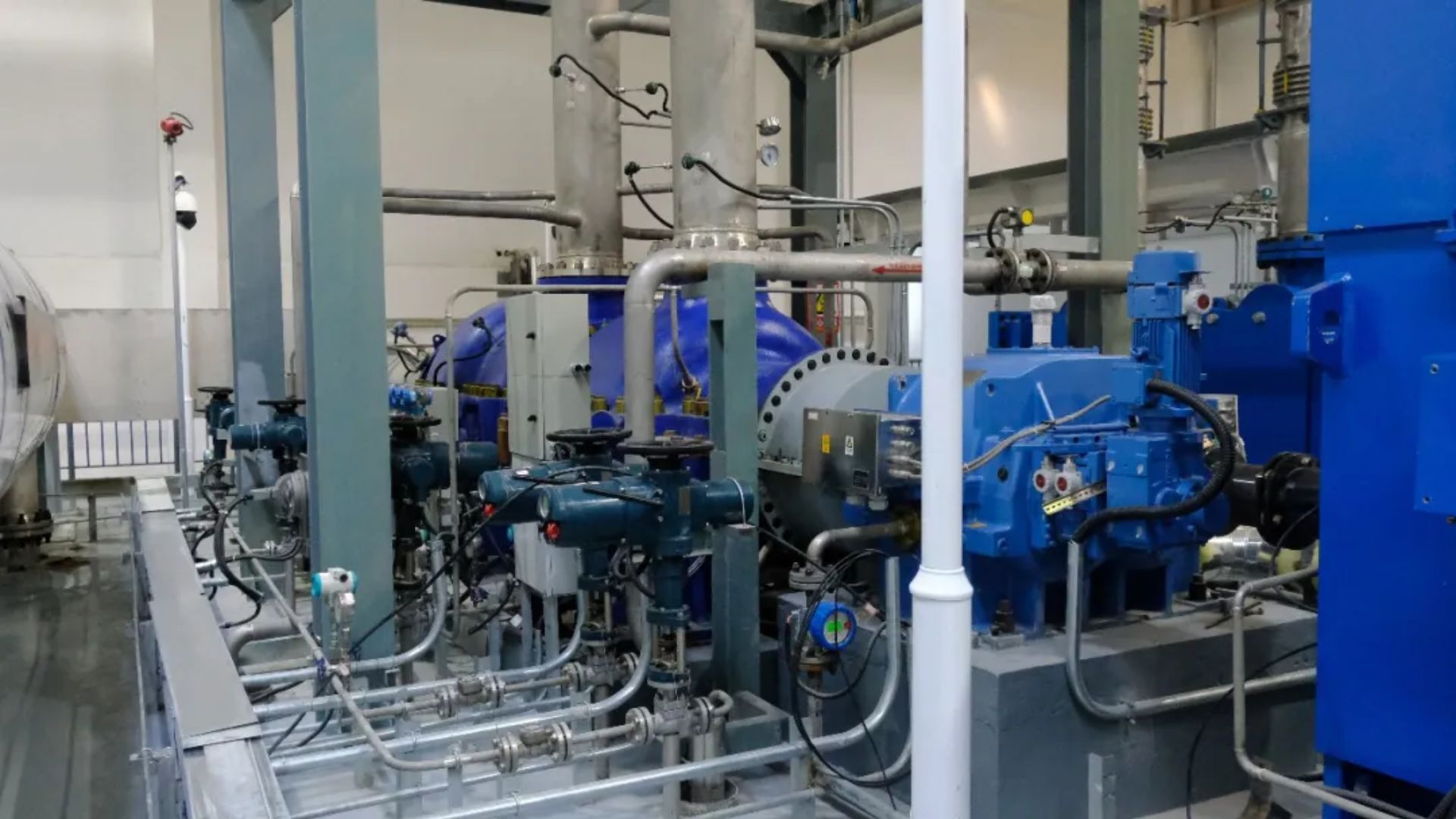
Engineers in China have successfully generated electricity using a megawatt-class turbine driven entirely by pure helium gas. Constructed by CNNC Huaxing, a subsidiary of the China National Nuclear Corporation, the facility marks the first time the country has powered a high-capacity turbine using helium as its primary fluid. The test provides essential engineering data to help move small gas-cooled reactors off the drawing board and into production. Traditional power plants rely on steam or open gas systems that exhaust their working fluids after a single cycle. This test facility uses a closed-loop Brayton cycle system instead. Trapping helium inside piping network The design traps pure helium inside a sealed piping network. By constantly recirculating the gas, the system prevents heat loss and maintains stable internal pressure. Helium offers distinct physical advantages for high-temperature nuclear environments. It is chemically inert, meaning it will not corrode internal reactor parts even at extreme temperatures. It also absorbs large amounts of heat directly from the reactor core. Because helium is lightweight, it expands rapidly under heat, driving specialized turbine blades with minimal energy loss. “Unlike the traditional open-loop system’s ‘use and discard’ working mode, this test bench is a precise and rigorous ‘energy scheduler,’ allowing helium to circulate repeatedly within a closed pipeline system, greatly improving working efficiency and stability,” said CNNC. Requirement of precise engineering However, housing helium requires precise engineering. Because helium atoms are small, engineers must design the sealed loop to withstand high pressure without allowing micro-leakage. Building the test bench required tight integration between civil engineering and specialized nuclear hardware. CNNC Huaxing had to assemble heavy structural components while maintaining micron-level alignment for the high-speed turbine system. If the turbine components are off by even a fraction of a millimeter, intense rotational speeds can cause severe vibrations and break the helium seals. Workers welded and inspected every pipe joint to guarantee a pressure-tight boundary. “Faced with a series of technical challenges, such as the cross-disciplinary construction of the test bench project, the complex civil engineering and special pipeline construction, and the micron- level installation accuracy requirements, CNNC Huaxing relied on process optimization and technological breakthroughs to overcome various construction difficulties one by one and successfully complete the project construction,” concluded the agency. This mechanical setup allowed researchers to progress safely from initial cold checks to full-temperature electricity generation. Global shift toward gas-cooled microreactors The trial highlights a broader global shift toward high-temperature, gas-cooled microreactors. In the United States, the Air Force recently chose NANO Nuclear Energy to adapt its KRONOS microreactor technology for military bases. Like the Chinese test facility, the KRONOS design uses inert helium rather than liquid water to cool the reactor core. Because helium replaces water as the cooling medium, these reactors do not need to be built near rivers or coastlines. This flexibility allows compact, off-grid nuclear generators to operate in isolated military posts and remote industrial sites. Recommended ArticlesGet the latest in engineering, tech, space & science - delivered daily to your inbox.An active and versatile journalist and news editor. He has covered regular and breaking news for several leading publications and news media, including The Hindu, Economic Times, Tomorrow Makers, and many more. Aman holds expertise in politics, travel, and tech news, especially in AI, advanced algorithms, and blockchain, with a strong curiosity about all things that fall under science and tech.
First megawatt-class helium turbine for nuclear microreactors successfully tested in China
Full Article
Original Source
Read the full article at Interestingengineering →KhanList aggregates and links to publicly available news content. We do not host full articles from third-party sources. Always verify important information with original sources.