
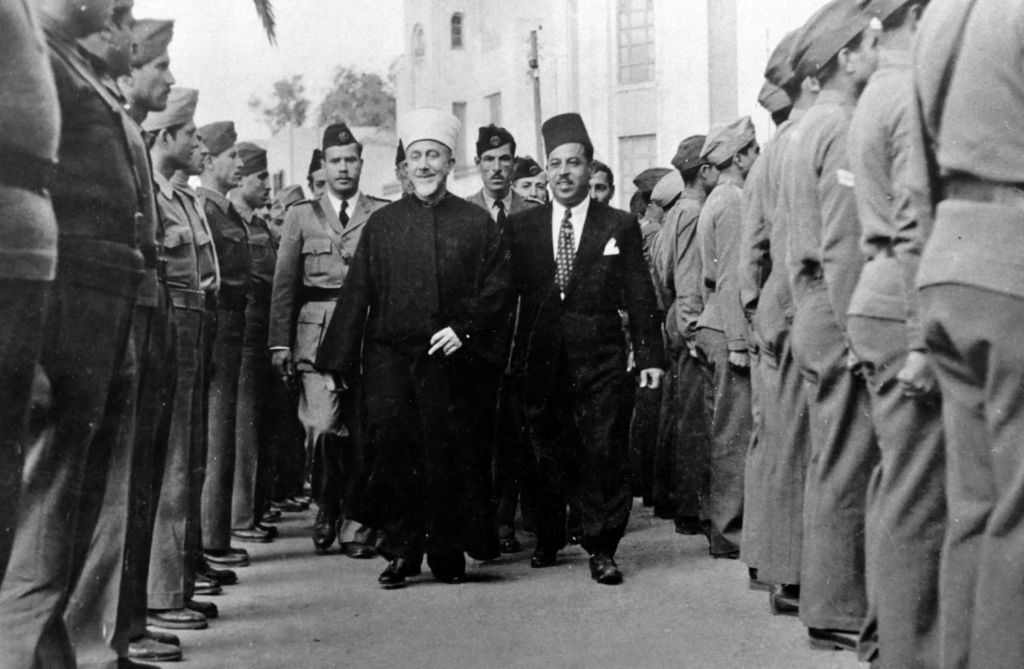
Simon Sebag Montefiore is nothing if not ambitious. The British historian is, after all, the author of a book he nervily titled Jerusalem: The Biography. His new work, a sweeping history of the entire Middle East from 1900 to the present day, The Cauldron, is even more daring. Both fluid and disjointed, The Cauldron cannot find a simple through line that connects the consequential ideological, political, and military conflicts that have shaped North Africa, the Levant, and Eurasia. That is due to the topic itself. There is no through line. Yet this is one of the best, and most succinct, histories of the Middle East written in decades. How can a 493-page book be succinct? When it covers 126 years and 43 countries. Montefiore’s achievement stems from the fact that he has refused to center his book on the Arab Middle East or the Arab–Israeli conflict. Rather, The Cauldron tackles the “multi-ethnic, multi-sectarian patchwork” of the region. Actors as various as the Kurds, Maronites, Shiites, Alawites, Copts, Armenians, and Assyrians played a crucial role in forging this cauldron, to name just a few. And that’s before the great powers stepped in to make an even greater mess of the region. The Cauldron is a story of chaos in which history repeats itself continually. Example: In March 1917, General Sir Stanley Maude captured Baghdad and announced, “Our armies do not come into your cities and lands as conquerors or enemies, but as liberators.” These words were echoed a century later, ironically, by the George W. Bush administration and its defenders as they celebrated regime change in Iraq and Afghanistan. But, as Montefiore reports, by 1922, the brand-new state of Iraq was “seething with Sunni tribal revolts, urban Shiite discontent, Assyrian turbulence, Turkish infiltration.” Plus ça change. Here’s another: Between 1915 and 1918, in a “deliberate Ottoman famine aimed at Christians, half the Maronites of Mount Lebanon—200,000—died in the great famine known as the Kafno (starvation).” That was a genuine man-made famine perpetrated by the Turks, whose neo-Ottoman present-day ruler, Recep Tayyip Erdogan, today feels free to issue false claims of mass starvation in Gaza. The 1920 call to “kill the Jews” by the mufti of Jerusalem, Haj Amin al-Husseini, is sounded still by the Palestinian terrorist group Hamas, the descendants of the mufti’s anti-Semitic ideology superficially draped in anti-Zionism. The French proconsul to Morocco (from 1912 to 1925), Marshal Hubert Lyautey, was the man who invented the concept of winning “hearts and minds.” This idea continues to rattle around in the heads of Western diplomats desperate to convince hostile Middle Easterners that we might all get along one day. British Prime Minister Neville Chamberlain, famous for appeasing Hitler at the outbreak of World War II, also makes a cameo. Perhaps not surprisingly, as he mulled whether to reverse the Balfour Declaration that recognized a “Jewish homeland in Palestine,” history’s most notorious appeaser stated, “If we must offend one side, let us offend the Jews rather than the Arabs.” European leaders today have adopted the same twisted logic in navigating the current war. On a more positive note, as World War II reached the shores of North Africa, and the Nazis sought to continue their genocide of the Jews on foreign shores, it was Mohammed V of Morocco who told the Vichy French, “There are no Jews in Morocco. Just Moroccans.” This protection of the Jews remains a pillar upon which a resilient Moroccan–Israeli peace agreement stands today. Sayyid Qutb, the famous Egyptian ideologue behind the rise of the Muslim Brotherhood in the late 1940s, was a classic racist. He described jazz as “the music that the Negroes invented to satisfy their primitive inclinations, as well as their desire to be noisy on one hand and to excite bestial tendencies on the other.” Fast-forward to today, and the Muslim Brotherhood continues to disdain American minority groups—notably those who are LGBTQ+. The difference now is that American minorities have embraced Islamism, for reasons that are not entirely clear. This is an example of what Lebanese-born professor Gad Saad calls “suicidal empathy.” During times of tumult, fleeting mergers have been the order of the day among Muslim states, which suddenly come together and then just as quickly spin apart—like the United Arab Republic (Egypt and Syria, b. 1958–d. 1961) and the Hashemite Arab Federation (Iraq and Jordan, which lasted from February to August 1958). These odd formulations were harbingers of the Mecca Pact—the hastily assembled alliance that puts Turkey, Saudi Arabia, and Pakistan under the same banner until some breeze blows that banner away. As future Supreme Leader Ayatollah Ruhollah Khomeini fomented unrest against the Shah of Iran in the 1960s, his followers chanted “death to the dictator.” These same chants were directed at the beginning of 2026 at Khomeini’s successor, Ali Khameini. In the 1960s, the Egyptians were drawn into the Yemeni civil war. “By 1964,” writes Montefiore, Nasser “had 40,000 troops in Yemen, costing $1 million daily.” Nasser called that war “my Vietnam.” Today, the Egyptians are preparing for a similar adventure in Yemen to fight the Houthis. Whether it becomes a Vietnam for Egyptian strongman Abdel Fattah al-Sisi remains to be seen. After the 1967 Six-Day War, Israeli Ambassador to the UN Abba Eban quipped, “If Algeria introduced a resolution declaring that the earth was flat and that Israel had flattened it, it would pass by a vote of 164 to 13 with 26 abstentions.” Nothing has changed on that score in decades. If anything, it has only grown worse. Montefiore reminds us of Alexander the Great’s quip about Iran: “Persia conquers those who capture it.” Trump might say the same today, as he is caught in a war that he wishes to leave. The Iranian regime won’t let him. Such nuggets can be found on nearly every page. Searching for them makes Montefiore’s rich history that much more enjoyable—and perhaps more disturbing—to read. If there are any quibbles, one might point to an overreliance on historian Eugene Rogan. Why not the legendary Bernard Lewis? Perhaps more worrying is the citation of Rashid Khalidi, the former PLO spokesman turned radical Columbia University professor. Seeing his name and work cited detracts from the credibility of this book. Still, the overall result is a triumph. What comes next? Another repetition of history, perhaps. Montefiore begins this journey with the unraveling of the Ottoman Empire. Today, as the “Third Gulf War” ravages the region, one gets a distinct sense that Turkey may be on the rise again. The cauldron continues to boil. Jonathan Schanzer is executive director of Foundation for Defense of Democracies and a contributing editor to Commentary.
Fire Burn and Cauldron Bubble
Full Article
Original Source
Read the full article at Fdd →KhanList aggregates and links to publicly available news content. We do not host full articles from third-party sources. Always verify important information with original sources.