
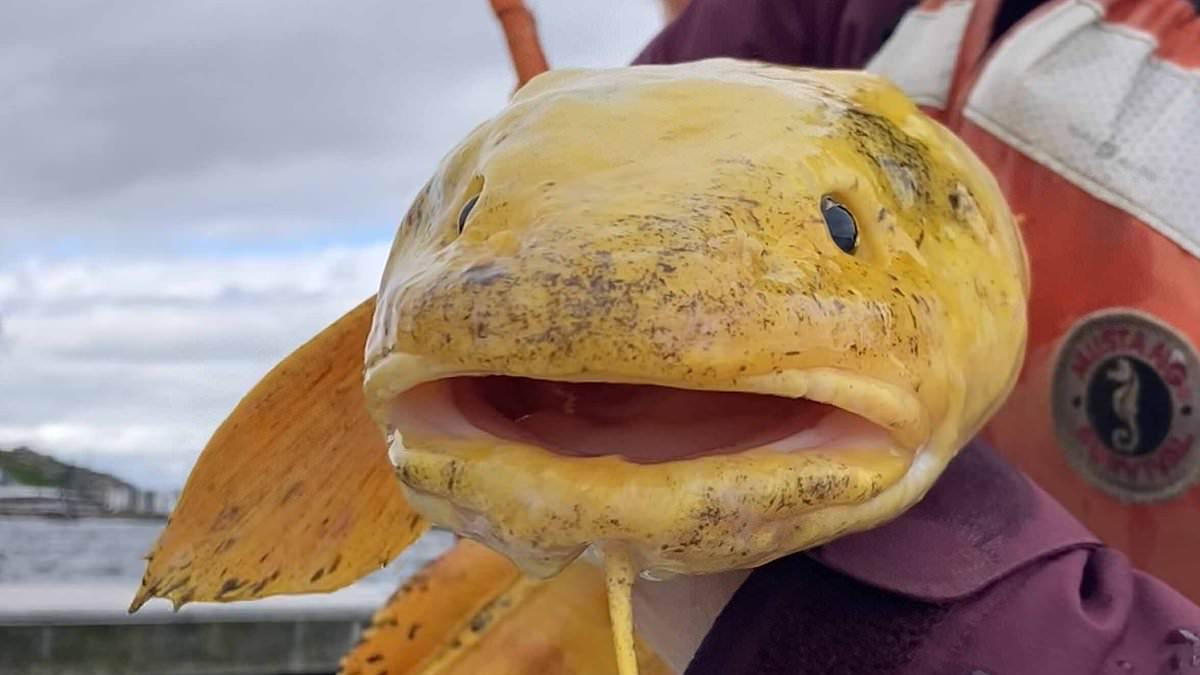
Published: 06:28 EST, 13 November 2026 | Updated: 06:28 EST, 13 November 2026 Scientists in Oswego, New York, were in for a surprise last month, after catching a bright yellow burbot. Most burbot have mottled skin that ranges in colour from black to grey to olive. However, this particular fish had a saturated yellow-orange appearance, thanks to a 'one-in-a-million' genetic mutation, known as xanthochromism.'Xanthochromism is a rare biological condition caused by a genetic mutation that suppresses normal pigmentation and produces a yellow-orange appearance,' explained the US Fish & Wildlife Service.'Xanthochromism is considerably less common in wild fish than albinism or melanism, making this an especially unusual capture.' Scientists in Oswego, New York, were in for a surprise last month, after catching a bright yellow burbot The rare fish was discovered during a routine Aquatic Invasive Species Survey in Oswego HarborThe rare fish was discovered during a routine Aquatic Invasive Species Survey in Oswego Harbor.While burbot is a native species, populations in the lake are extremely low, according to the team.The species usually lives in deeper, cooler waters than those found in the harbor Beyond its unusual colouration, the scientists realised that the fish was emaciated and appeared to be in poor health. 'Because of the fish's condition and the unexplained factors contributing to the continued suppression of its population, it was sent to the Cornell University College of Veterinary Medicine for a health analysis,' they explained.'The discovery could turn out to be lucky for the species too; this exceptionally rare fish may provide valuable insight into the health of the species' populations throughout the basin that can inform management actions.'This isn't the first time a creature with unusual colouration has been discovered in recent weeks. At the end of September, a 'ghost lobster' was discovered by scientists at Maine State AquariumAt the end of September, a 'ghost lobster' was discovered by scientists at Maine State Aquarium. The crustacean, named Casper, is startlingly white, with pale blue dots scattered across its hard shell.Its unusual colouring is because it lacks the pigment–producing proteins that give other lobsters their mottled brown colour.And the specimen is so rare that scientists estimate the chances of finding one are just one–in–100–million – the same odds as winning the lottery several times.Casper, who now lives at the University of New England (UNE) after being donated by the Maine State Aquarium, will play a key role in a project decoding the genetics of lobster colour. 'Animals like Casper capture people's attention because they are so rare and beautiful,' Markus Frederich, professor of marine sciences at UNE, said.'But, for us, they also provide an amazing opportunity to ask fundamental biological questions.'
Fin-tastic find! 'One-in-a-million' fish caught in New York is bright yellow thanks to a rare genetic mutation
Full Article
Original Source
Read the full article at Dailymail →KhanList aggregates and links to publicly available news content. We do not host full articles from third-party sources. Always verify important information with original sources.