
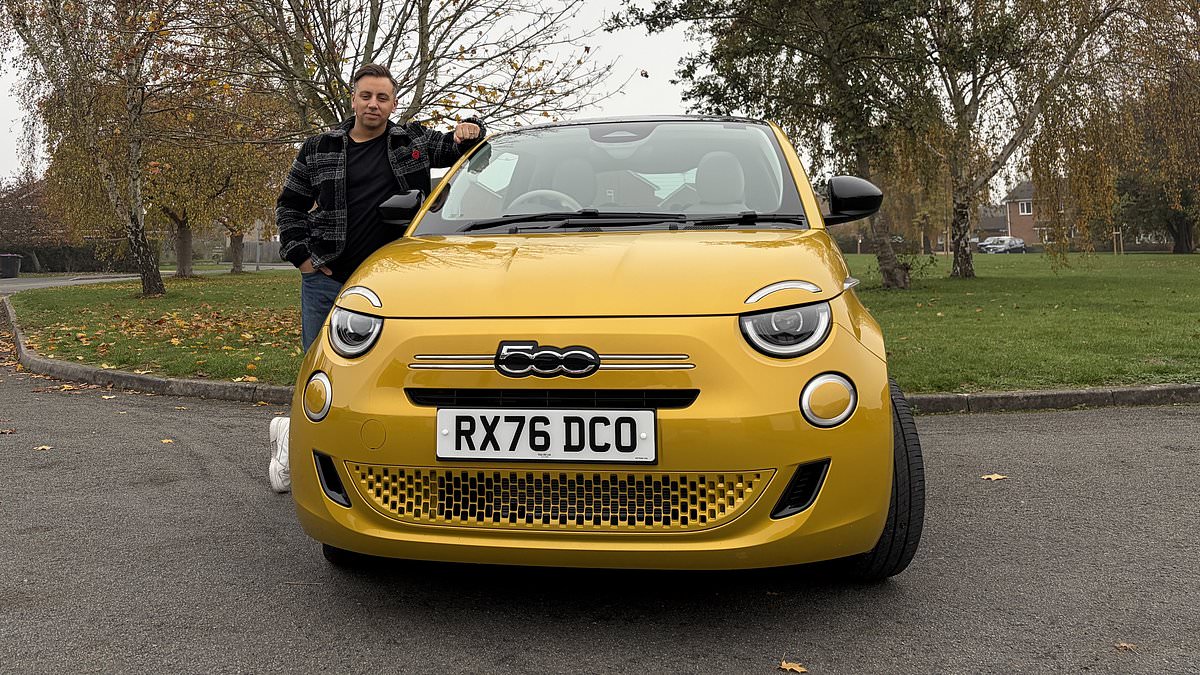
Fiat's new 500 Hybrid is not a car born of years of painstaking planning and thousands of miles of development.It's one spawned by bosses hammering a big red panic button at the firm's Turin HQ.That's because the Italian marque swore it would not launch a petrol-engined Cinquecento ever again. 'Arrivederci, unleaded!' Or so it thought.In 2021, putting all its eggs in one electric basket, it added the new, exclusively battery-powered 500e to showrooms; the car intended to drive the brand's most recognisable product into a new era of motoring.But there has been just one teeny-weeny problem... people haven't bought it.With sales freefalling and alarm bells ringing, Fiat has taken the drastic decision to shoehorn an internal combustion engine into the EV's body in the hope of resuscitating demand for the iconic retro city car.So, can the knee-jerk 500 Hybrid spare its blushes? I spent a week and more than 400 miles behind the wheel to find out... The 500 Hybrid is Fiat's new panic button car. It's been created purely because the electric 500e has underperformed in showrooms. Can it win fleeting customers back?The panic button 500Fiat continued to sell the previous-generation 500 alongside the new EV from 2021 to appease customers not yet ready to dive into EV ownership.But that ageing model, first launched way back in 2008, was eventually culled in summer 2024 when the EU's revised safety regulations rendered it non-compliant.Yet, in its last full year on sale, the petrol city car out delivered the EV two to one, despite being underpinned by 15-year-old architecture.In an interview with Autocar in July 2024, recently departed chief executive Olivier Francois conceded that the company had expected the 'world would go electric faster' and that older Italians in particular had refused to buy its 500e.It even triggered a seven-week shutdown of its assembly line in late 2024 while dealers scrambled to clear their growing stockpiles of unsold cars.Francois swiftly announced that a hybrid petrol would arrive in 2026 'to increase the number of 500s on the road in Italy and to answer the Italian customers'.And it's now on sale here in Britain. When Fiat launched its new electric-only 500e in 2021 using a bespoke EV platform, it boldly swore it would not launch a petrol-engined Cinquecento ever again. Yet, here it is... Due to the very short front end of the 500e, Fiat struggled to find an engine small enough to retrofit into the space. It's been forced to used the diminutive 1L petrol from the outgoing 500Converting EV to ICECramming a traditional drivetrain into the 500e's underpinnings has been no simple task.It's required new subframes front and rear to allow for a petrol engine and six-speed gearbox to be located respectively. And in the place of the EV's battery pack is a 37-litre fuel tank.The EV's incredibly short front end created another headache. Even the smallest engine in Fiat's existing arsenal, the 1.2-litre PureTech used across a range of Stellantis models, wouldn't fit.As a result, the new Hybrid comes with the same naturally aspirated 1.0-litre three-cylinder engine supplemented by a 12-volt starter generator. The same one that powered the outgoing 500, in fact.Producing 64bhp, it's officially the least powerful petrol car on sale in Britain today. Unsurprisingly, it's also among the slowest, taking 16.2 seconds to reach 62mph from rest. That's almost twice as long as its battery-powered counterpart.Inside, the dashboard has been reworked to accommodate a manual gear stick high on the dashboard. Outside, the 500e's smooth, flush front bumper has been punctured with holes and the number plate given a moustache-shaped grille to keep the engine cool.Aside from the exhaust pipe protruding from the rear, it's almost indistinguishable from the electric 500 that Fiat seemingly can't give away. With an engine putting out just 64bhp, the 400 Hybrid is officially the least powerful petrol car on sale today. Unsurprisingly, it's also among the slowest, taking 16.2 seconds to reach 62mphDoes it feel slow?Plodding between traffic lights in town at speeds up to 30mph, the modest engine delivers enough low-rev grunt to shift the car's one-ton bodyweight with reasonable urgency, accompanied by a lovely thrumming soundtrack.In these surroundings, it's a chirpy and joyful little motor.But take the 500 Hybrid out of this environment and onto a fast A or B-road and its shortcomings are instantly apparent.Even at 50mph, the litre engine's lack of mid-range power is startling. Stand on the throttle pedal to the point that it feels like it's about to punch through the floor and the little three-cylinder remains steadfast in its reluctance to gather pace. Without a downshift, you wonder if you'll ever see the digits '51' again.Only when you drop a couple of gears does the engine come to life. And to make any semblance of headway, you really have to wring its neck close to the 6,500rpm red line at all times.This turns what is a delightfully rorty engine note when cruising through villages into a painful rattle when attempting to keep pace with traffic at the national limit. Around town at speeds up to 30mph, the Fiat 500 Hybrid is a joyous little car. It has good instant poke and a lovely thrumming soundtrack to boot Once you get out of town, the Fiat 500's powertrain limitations hit... and they hit hard. The lack of performance is startling The 500 Hybrid's acceleration issues are two fold: the 64bhp engine lacks grunt and the six-speed gearbox is overkillStints on the motorway are a particularly laborious affair.Come across a fellow driver pootling in the middle lane at 65mph and you're left facing a dilemma: either accept defeat and trundle along in their slipstream until one of you eventually takes a slip road or muster the courage to attempt an overtake that could take minutes – not seconds – to complete and ultimately form a queue of impatient motorists in your rear-view mirror.What doesn't help matters is its oversupply of gears for a car with such runtish potency.Fifth and sixth are fundamentally obsolete, yet the digital gear-change indicator optimistically recommends that you shift up the 'box, even when you're barely making headway in fourth.Make the mistake of keeping it in top gear on a motorway incline, even with your foot planted to the mat, and the precious miles per hour you've spent the last few minutes building disappear five times as quickly. For such a tiny car, the ride comfort and handling is well balanced. The steering is precise, though lacks feedbackWhat's the ride and handling like?The ride comfort for this segment of car is surprisingly good. For a vehicle of such dinky proportions with a short wheelbase, it's nicely cushioned around town.Hit a bump or pothole on a back road and there's plenty of secondary rebound and bouncing, and the body tilts and leans when you corner at pace. But I'd take this trade-off for the better compliancy in the city.It's a similar story with the steering. It's so incredibly light that it almost feels disconnected, a bit like a pound-a-go kids fairground ride. However, for navigating tight village squares, squeezing into narrow town-centre bays and bombing around a multi-storey car park, it's ideal.Even with the lack of steering feedback, it's still precise. In fact, it's one of the Fiat's most enjoyable traits as you attempt to retain as much corner speed as possible to limit how hard you have to work the engine on the straight that comes after.For a compact city car, Fiat's also done a good job of shielding noise from the cabin.Vehicles in this category are rarely the last word in refinement, but there's enough isolation to hide the worst of the suspension components clanging away below. There's probably plenty of road and wind noise on motorways, though you won't hear any of it over the stressed engine's clatter. Vehicles in this category are rarely the last word in refinement, but there's enough isolation to hide the worst of the suspension components clanging away belowIs it cheap to run?With prices starting from £18,995, only the Dacia Sandero, Kia Picanto, MG3 and Citroen C3 cost less with a petrol engine today. And I'd argue the Cinquecento is the most characterful of the lot, though the C3 is infinitely more practical.The Grande Panda Hybrid, which uses Fiat's 1.2-litre engine, costs just £1,500 more. That's worth every extra penny, in my opinion.What's more, the 500e is now available with a £3,750 Government EV grant, meaning it costs just £2,000 more than the Hybrid - and isn't ruefully underpowered on faster roads.What about fuel economy?On paper, Fiat says the 500 Hybrid will return 53.3mpg. And while official figures are often well wide of the mark, this one might be achievable in everyday conditions.If you're only using it to nip to the supermarket or breeze into town, 50mpg is almost a dead cert.During my week-long test, including lots of motorway stints and plenty of pedal-to-the-metal driving, I averaged a more than respectable 48.5mpg. Starting at just under £19,000, the Fiat 500 Hybrid is one of the least expensive petrol cars you can buy today. Only the Dacia Sandero, Kia Picanto, MG3 and Citroen C3 are cheaper Fiat 500 Hybrid specs at a glance On sale: nowEntry price: from £18,995Body shapes: Hatchback and convertible DIMENSIONSLength: 3,631mmWidth: 1,684mmHeight: 1,532mmWheelbase: 2,322mm Weight: 1,066kg Boot capacity (backrests up): 183 litresBoot capacity (backrests down): 440 litres PERFORMANCEEngine: 1.0-litre, naturally-aspirated, three-cylinder petrol with 12-volt starter generatorDrive: Front-wheel driveTransmission: Six speed manualMax power: 64bhpMax torque: 92NmAcceleration (0-62mph): 16.2 secsTop speed: 96mphECONOMYFuel economy: 53.3mpgCO2 emissions: 119g/km What's it like inside?There's plenty of charm to the 500's cabin, which has bags more personality than most rivals at this price point.The 10.25-inch infotainment touchscreen isn't the slickest around, but most owners will use its wireless Apple CarPlay or Android Auto smartphone mirroring, making it instantly intuitive. Elsewhere, a large digital instrument cluster, with its bold tacho and speedo, clearly presents all the vital information you need.The driving position is elevated, largely due to its EV-readied platform. But this gives you decent command of the road ahead. A word of warning, though: some trim levels don't come with driver's seat height adjustment, which I think is a must-have feature.Another problem is the driver's footwell, which is incredibly tight. Given that the 500e only needs two pedals, the unforeseen addition of a clutch has made the area very compact and positions the controls close together. There's plenty of charm to the 500's cabin, which has bags more personality than most rivals at this price point The rear seats are wide enough for adults, but there just isn't the legroom. That said, children will have plenty of space The 183-litre boot is small, even by city car standards. You can just about squeeze three carry-on suitcases on the backIn terms of overall space, few city cars are what you'd call capacious. The 500's two rear seats are wide enough, but there's very little legroom for adults. And that's only if they can contort themselves between the door pillar and the front seat in this three-door-only body style.That said, I did manage to install a child seat, complete with a large base and floor-mounted support leg, with ease.As you'd expect, the boot is tiny too. At 183 litres, the same as the 500e, you can just about fit a couple of large rucksacks or, at a push, three carry-on suitcases. Considering the Citroen C3 offers 310 litres of luggage space and the Fiat Grande Panda has 412, there are far more practical alternatives available for similar money. The 500 Hybrid is nailed on to outsell the 500e EV. But if you're someone who regularly drives on the motorway, I would strong advise looking at one of its rivalsThe Cars & Motoring verdictIt's easy to understand why Fiat's bundled a petrol engine into its EV's body. At the end of the day, if it's failing to shift one of its best-selling products, the company has a major problem on its hands.The simple fact is, even despite its performance shortcomings, most customers will be far happier owning the Hybrid if it means filling up with unleaded rather than plugging into the grid.The dinky Fiat really is at home around town. In terms of style, charm and fun factor, it's one of the best in the city car segment. But if you're someone who regularly drives on the motorway, I would strongly advise looking elsewhere. CARS & MOTORING: ON TEST
Fiat said it wouldn't launch another petrol 500... until its EV flopped. Can this new £19,000 Hybrid spare its blushes?
Full Article
Original Source
Read the full article at Dailymail →KhanList aggregates and links to publicly available news content. We do not host full articles from third-party sources. Always verify important information with original sources.