
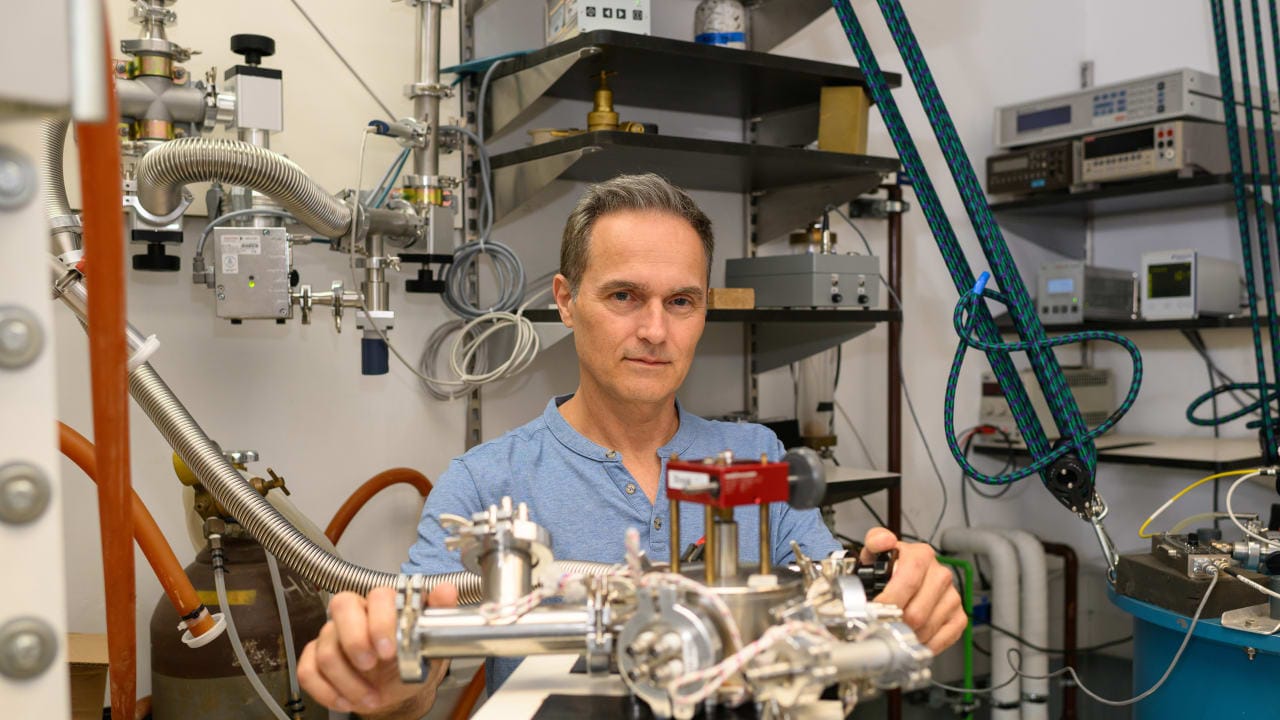
NOVEMBER 21, 2026 08:56Invented more than 2,000 years ago, the “Archimedes screw” machine is a giant corkscrew with a spiral blade that rotates around its axis to pump water uphill or transfer heavy bulk materials like grain or gravel.In recent decades, engineers have also used this ancient invention to work in reverse, using it as a turbine in hydroelectric power plants where flowing water forces the screw to spin and generate electricity.Now, researchers at the Weizmann Institute of Science in Rehovot and their international colleagues have created a molecular version of the famous screw and uncovered a surprising two-way relationship between electric current and rotational motion.Surprises during researchWhen an electric current causes the single molecule to spin, that rotation, in turn, dramatically enhances electrical conduction, boosting the current flowing through it by up to a hundredfold.The researchers recently published their discovery in the prestigious journal Nature, titled “Current-driven molecular machine with rotation-enhanced conductance.”The Archimedes screw (illustrative) (credit: SHUTTERSTOCK)Working in Prof. Oren Tal’s Weizmann laboratory in the chemical and biological physics department, the scientists suspended a single helical, or spiral-shaped, organic molecule between two gold electrodes at a temperature close to absolute zero.When they applied a voltage across the electrodes, they detected cyclical jumps in the electric current flowing through the molecule. The specific sequence of those jumps indicated that the molecule was rotating steadily in a single direction, with each step making it easier for electricity to pass through.When the team reversed the direction of the current, the jump sequence also reversed, demonstrating that the molecule had switched direction and was spinning the opposite way.Yet the biggest surprise came when they dialed up the voltage: above a certain threshold, the current flowing through the molecule suddenly surged by up to a hundred times.According to the researchers’ theoretical calculations, this dramatic spike occurs when the molecule transitions from sequential, step-by-step rotational jumps into smooth, continuous rotation.As it spins continuously, its changing physical configuration opens a much clearer pathway for electrons to pass through.“We also discovered that the threshold at which the current starts to increase sharply can be controlled by stretching or compressing the molecule, much like changing the angle of the blades in a turbine,” Tal explained in an interview with The Jerusalem Post.Dr. Anil Kumar Singh led the study and conducted the experiments at Weizmann during his postdoctoral research under Tal’s supervision and is now a faculty member at the Indian Institute of Technology Madras.The project was carried out in close collaboration with theoretical physicists and synthetic chemists abroad: Prof. Fabian Pauly at the University of Augsburg in Germany; Profs. Michael Pittelkow and Per Hedegård at the University of Copenhagen in Denmark; and Prof. Jing-Tao Lü at the Huazhong University of Science and Technology in China.Pittelkow’s group in Denmark synthesized the custom helical molecules, while the other international collaborators performed the complex quantum-mechanical calculations needed to interpret the experimental results.Capturing and wiring up a single molecule, something roughly a million times smaller than the width of a human hair, required an ingenious experimental setup.When asked how the team suspended the molecule and created a stable electrical connection, Tal explained that they began with a thin gold wire and physically snapped it inside a super-cooled vacuum chamber.Breaking the wire under these extreme conditions produced two atomically sharp gold tips.When those two tips were brought within a fraction of a nanometer of each other, a single molecule could bridge the microscopic gap, allowing electrons to flow from one gold electrode, through the spiraling molecule, and into the otherDR. ANIL KUMAR SINGH (credit: WEIZMANN INSTITUTE OF SCIENCE).Scaling upWhat makes the team’s discovery genuinely groundbreaking is not merely that scientists have managed to make a molecule spin using electricity, but the reciprocal feedback loop they uncovered between mechanical motion and electrical conduction.The system functions simultaneously as a molecular motor, converting an electrical energy input into directed mechanical spin, and as an electromechanical device whose physical movement directly alters its own electrical resistance.“These findings present a new operating principle for nanomachines: the electric current drives the molecule’s rotation, while the rotation, in turn, enhances electrical conduction, allowing more current to flow through the molecule under the applied voltage,” Tal said.“It is a fundamentally different operating principle from that of previously demonstrated molecular motors run on electricity,” he explained. In earlier electric molecular motors, energy is supplied in bursts to excite the molecule into a higher-energy state.As the molecule relaxes back down, its asymmetric structure favors a shift in one direction over the other, producing directional movement through a stop-and-go mechanism analogous to a mechanical ratchet.“But our molecular rotor is driven directly by the force generated by the electrical current, rather than by a sequence of excitation and relaxation processes,” Tal said.“The flowing electrons continuously transfer momentum to the molecule, exerting a torque, the turning effect of a force, that drives its rotation in a preferred direction.”Much like wind pushing against the angled vanes of a windmill or water rushing past a turbine, the stream of electrons physically pushes the spiral molecule into a spin.Looking ahead, Tal noted that this operating principle could eventually be harnessed to build molecular pumps, nanoscale switches, ultra-sensitive sensors, or even novel components for energy-storage technologies.At this stage, however, he emphasized that the team’s main achievement is uncovering a new physical mechanism for molecular machines rather than unveiling a ready-made commercial gadget.Turning a single spinning molecule into a practical technology will require scaling up. Tal suggested that in the long term, engineers could assemble vast arrays of these molecules into a coordinated system, with millions or billions of molecular rotors working in unison.“This is an exciting possibility, but many practical functions would require large numbers of molecules operating together,” he said.“The challenge would be to organize the molecules with controlled orientation, establish suitable electrical connections, and ensure that their collective operation produces a useful macroscopic effect.”Another major hurdle is temperature. The Weizmann experiments were conducted at a base temperature of 4.2 Kelvin, about -269 degrees Celsius, just above absolute zero, to keep thermal vibrations from drowning out the delicate molecular signals.Next, the team hopes to demonstrate the same torque-driven effect at room temperature, a crucial step toward real-world viability.The researchers also plan to test a wider variety of chiral (or twisted, asymmetric) molecules to map how subtle changes in molecular shape affect the transfer of force from flowing electrons, rotation speed, and the resulting surge in conductance.In the future, Tal said, the team wants to explore driving these molecular machines without traditional wires, using circularly polarized light for optical control, or spin-polarized electrical currents.The latter approach could link molecular machines to spintronics, an advanced field of electronics that exploits the magnetic spin of electrons alongside their electrical charge.“One of the interesting results of our work is that the operating conditions of the molecular machine can be adjusted mechanically,” Tal concluded. “In principle, similar mechanisms could be exploited in future molecular devices that respond to mechanical deformation, although such applications remain to be shown.“Among our challenges is the need to establish useful device functions and determine whether these molecular machines offer practical advantages over existing technologies.”Follow us on Google
Inspired by Archimedes, Israeli scientists shrink ancient invention to a single molecule
Full Article
Original Source
Read the full article at Jpost →KhanList aggregates and links to publicly available news content. We do not host full articles from third-party sources. Always verify important information with original sources.