
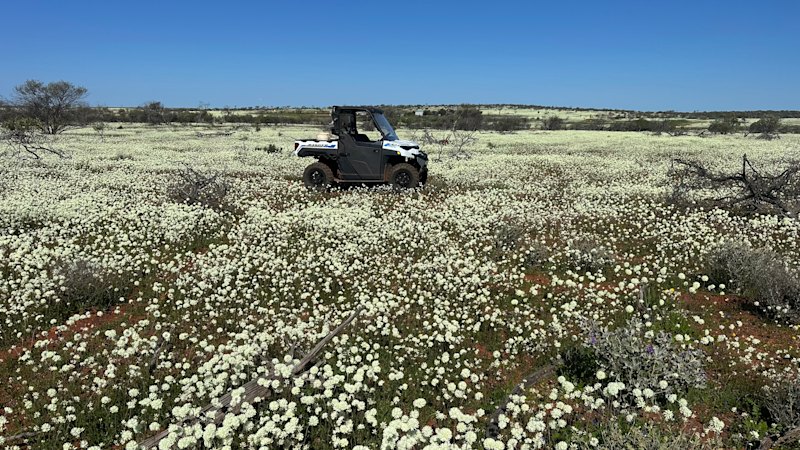
On a goat and cattle farm inland of Geraldton, a region that gets around 335 millimetres of rain annually, the grounds are awash with colour and life.But it wasn’t always the case. When Jeff Johnson first purchased the Mullewa farm Tallering Views, in the state’s Mid West, the 1750-acre property was already degraded from overgrazing and poor water management.Johnson’s own 20 cows and 400 goats continued to strip the land further. After a particularly heavy rainfall in 2017, he said he had a lightbulb moment.“Out of 25 millimetres of rain … about five millimetres of that water is sitting on the surface on the crust, the rest of it’s down the river and in the ocean, and everything’s dying,” he said.“I stood back in the shed and said, ‘holy crap, if I don’t do something about trying to catch this water and getting all the plants to grow again, we’ll be in a desert’, so it really changed my mind.”Johnson began researching methods to revegetate the land and discovered deep ripping or the ‘rip and tine method’.Machinery is used to dig long trenches in the soil, breaking the harder layer of compressed earth beneath the topsoil to improve water infiltration, boost nutrient availability and allow plant roots to grow deeper.It didn’t take long for Johnson to notice a change.“All the natural plants that normally grow here for the last 300 years all started springing up where I got these rip marks,” he said.“We even had earthworms coming out … in this dry, arid station country it was just mind-blowing because they’re the dudes that make it all happen under the ground.”He is now monitoring the return of each native species, including spring everlastings and mulla mulla.But Johnson said he had concerns for the future.“The way we’re managing land now with the chemicals and fertilisers, and the station country that overstock, we’ve got about 30 harvests to go and we’re in the shit big time,” he said.“The land won’t be able to support farming because nothing will grow, and all those native plants will be gone too.“It needs a whole policy change. The state government doesn’t know how to do it. It’s people like myself that are prepared to change. We are the ones that have to put this information out.”Eddy Wajon agrees.The Gondwana Link is aiming to reconnect country across south-western Australia, from the Karri forest to the woodlands and mallee bordering the Nullarbor plain. Godwana LinkIn 2002 he became the first private purchaser in the Gondwana Link project with his wife Donna – a block in Boxwood Hill covering 572 hectares and another smaller block spanning 46 hectares in the state’s Great Southern region.The project is a large-scale conservation effort to restore and reconnect a 1000-kilometre swathe of fragmented habitat.Wajon and his wife have now restored the cleared farmland they purchased into thriving habitat – in once abandoned paddocks, 95 per cent of revegetation has survived.“We could see the land was rapidly being cleared, and we stepped in,” Wajon said.“On the bigger block there are now 600 species of plants, 260 moth species, reptiles, birds, possums, wallabies and insects.“When we started we saw maybe one mallee fowl in five years, now we can guarantee you will see one.”Wajon said they had also seen six different orchard species sprout – varieties they had not deliberately planted – at the end of 2025.This year the region’s rainfall has been minimal, with around 200 millimetres falling compared to the average of 400 millimetres.But the early drier conditions also resulted in carpets of everlastings which usually don’t bloom until December.Wajon said plenty of visitors had come along to photograph the spectacle.The contrast between WA’s wildflower season and land protectionThe state’s 2026 wildflower season was described as the “best in recent memory”, drawing in plenty of tourists to view carpets of everlastings, orchids, and rare native species.But there is a contrast – the landscapes behind the internationally renowned spectacle remain critically underrepresented in Australia’s protected area network.While the South West is recognised globally as a biodiversity hotspot with exceptional flowering-plant diversity, parts of the Wheatbelt and Great Southern, have as little as 4 per cent of their area under formal protection.That is despite those regions being part of the Southwest Australian global biodiversity hotspot – one of 36 places on earth richest in threatened endemic species.Wajon said it was “distressing” that efforts to protect and revegetate more of the land, or to keep areas including roadsides abundant with native species, had so far recorded limited success.The upcoming UN Biodiversity Conference (COP17), held across the end of October, will also test Australia’s progress toward its target of conserving 30 per cent of land by 2030.Wajon said the state was no where close to that number.He said News South Wales and Victoria had schemes to compensate and incentivise conservation, and that WA needed something similar.Eddy Wajon and wife Donna were the first owners of land in the Godwana Link in WA.“What’s come from the government is a blank wall – we are going backwards not forwards,” he said.“We could do twice as much as we are now to revegetate the land with more support.“As a state we need to get serious about protecting the environment. At the moment, what is out there is a sham.”University of Western Australia Professor of Biodiversity Stephen Hopper also agreed that large parts of regional WA are on a “very poor trajectory” towards the UN’s 30 per cent goal.He said the “uplands” – including granite outcrops, lateritic mesas and sand plains – across the Wheatbelt and Great Southern were “almost impossible to restore”, while “lowlands” along rivers, creeks, coastlines were much easier.“Botanical survey work in the 1980s established that two thirds of threatened plants were concentrated in uplands,” he said.“These should be the top priority for conservation efforts. Lowlands along rivers, lakes and coastline had only 10 per cent of threatened plants – they are easiest to restore but least likely to contain threatened species.“[We need to] minimise disturbance of uplands especially bulldozing, applying fire and messing with water tables.”He said the state government could help landowners with fencing costs, weed and feral animal management subsidies and establishing landcare nurseries.Wajon said any financial support would be welcomed.“We are just ordinary people, but look what we can do,” he said.
Farmers fight to keep WA’s iconic wildflowers in bloom
Full Article
Original Source
Read the full article at Smh →KhanList aggregates and links to publicly available news content. We do not host full articles from third-party sources. Always verify important information with original sources.