
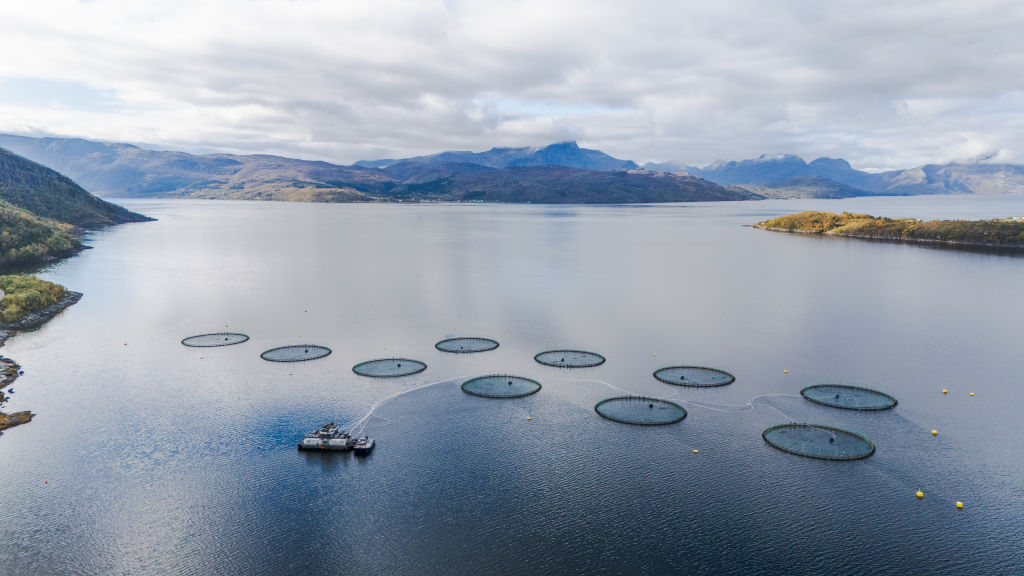
Hayek noted that it’s difficult to attribute soy consumption to individual fish species. But other research has found a rise in the use of crop-based ingredients fed to farmed salmon. In Norway, the world’s biggest producer of farmed salmon, 90 percent of feed ingredients were marine-based in 1990, but by 2020 that had dropped to about 23 percent. Advocacy groups there determined that 90 percent of the soy fed to farmed salmon in Norway comes from three Brazilian companies, each of which have sourced soy ingredients from illegally deforested patches of the Amazon rainforest. Other research has found that the shift to crop-based ingredients doubled the greenhouse gas emissions, per kilogram, of farmed fish in Europe and the United Kingdom from 2000 to 2020. “It’s trading one problem—marine exploitation—for another—land exploitation,” Cascada said. The industry is projected to continue growing, along with the population and rising demand for seafood promoted as healthy. Nutritionists and researchers say that farmed fish, including salmon, will play a major role in providing protein, though some environmental groups note the surge in salmon demand has disproportionately come from wealthy countries that don’t have nutritional deficits. “The claim is that the salmon industry is here to feed the world and provide this extra protein,” Cascada said. “But what it’s really doing is flooding the Global North with protein that is not necessarily needed at the expense of the Global South.” In the United States, lawmakers are trying to help the industry expand by passing legislation that would make it easier for salmon producers to obtain licenses to farm fish in offshore federal waters. In February, environmental advocates and fishermen sent a letter to members of Congress opposing the bill, the Marine Aquaculture Research for America (MARA) Act. Proponents of the bill say that putting fish farms in deeper, offshore waters would reduce the environmental issues caused by farming fish in sensitive, nearshore environments. Opponents say the legislation would enable a factory-farming model, much like the one that produces the vast majority of the world’s livestock, in the open sea. This article originally appeared on Inside Climate News, a nonprofit, non-partisan news organization that covers climate, energy and the environment. Sign up for their newsletter here.
Farmed salmon may not be as nutritious as it once was, new research suggests
Full Article
Original Source
Read the full article at Arstechnica →KhanList aggregates and links to publicly available news content. We do not host full articles from third-party sources. Always verify important information with original sources.