
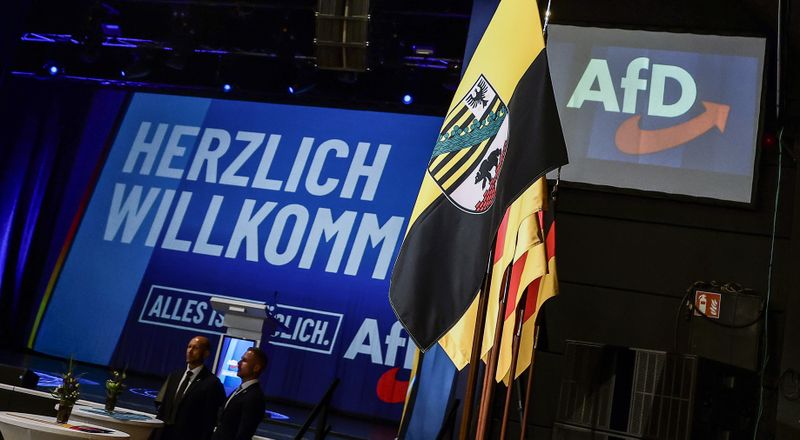
By Miranda Murray and Kirsti KnolleWith 44% of the vote, the AfD handed a drubbing to Chancellor Friedrich Merz’s conservatives, reflecting the deep unpopularity of Germany's ruling coalition and the rise of hardline parties in a fracturing political landscape.If the AfD can translate its win into a majority of seats in the state parliament, it will secure a foothold for advancing its agenda to heavily restrict immigration, restore ties with Russia, cut support to Ukraine and quit the euro.As counting continued, it remained unclear whether the AfD had secured enough votes to form a government but the wider political significance of the election, which according to broadcaster ZDF drew turnout of 77%, was clear."We have made history in this country," said Ulrich Siegmund, the 35-year-old AfD lead candidate in Saxony-Anhalt, who attracted thousands to his campaign rallies and who repeatedly cast victory in the state as a first step towards securing national power in federal elections due in 2029."The people have made it absolutely clear that they finally want political change and, above all, they have shown that they want it with us," Siegmund said.As the first exit polls were published, he stood arm-in-arm with his party's two national leaders, who laughed gleefully as the extent of the victory became clear. Jubilant celebrations broke out at the party's election night gathering in the city of Magdeburg, where people waved German flags and hugged each other in triumph.U.S. President Donald Trump posted a screenshot of the result without comment on his Truth Social site, while far-right leaders in other European countries cheered the election as a mandate for change.SETBACK FOR MERZThe result marks a significant setback for Merz, whose personal approval rating has sunk to historic lows as voters turn away from both his planned reforms to revive Germany's sluggish economy and his gaffe-prone personal communication style.A poll from the ARD broadcaster showed 87% of the state's voters were unhappy with the federal government. Siegmund has described Merz as the AfD's best campaigner, given his unpopularity in the state."This election result is, above all, a vote of no confidence in the federal government," Marcel Fratzscher, the president of the German Institute for Economic Research, told Reuters.Merz has vowed to revive Europe's largest economy with business-friendly reforms and increased spending, while warning that an AfD win in Saxony-Anhalt would damage the state and deter foreign companies from investing there.Germany's mainstream parties have all refused to work with the AfD, which has been classified as right-wing extremist by the local office of Germany's domestic intelligence service. But it may find a partner in the small BSW party, which looked set to clear the threshold to enter parliament.Although Saxony-Anhalt, formerly part of Communist-run East Germany, is one of the smaller German states, with a population of just over 2 million, the result underlines the rapid advance of the AfD since it was created in 2013.The AfD is now Germany's most popular party nationally, polling at 28% according to a recent INSA poll, comfortably ahead of the conservatives on 20%.The party is particularly popular in eastern Germany, although it also won around 20% in the prosperous western states of Baden-Wuerttemberg and Rhineland-Palatinate earlier in the year, underlining its growing national appeal.HARD LINE ON MIGRATIONWhile hard-right parties have gained ground elsewhere in Europe, Germany's Nazi past has contributed to a reluctance among mainstream parties to cooperate with the AfD.The AfD has dismissed accusations of extremism as scaremongering and an insult to the party's millions of supporters.During the campaign, the AfD tapped into growing disillusionment with established parties, which it characterises as tired and out of touch, offering instead a range of hardline policies and a nostalgic vision of a return to cleaner and safer streets and taking pride in being German."It is clear that we need change in Germany and in Western Europe. And I believe a starting signal is definitely going out from here - whether you like it or not," said Antony Lee, an attendee at the AfD's election party. "I am a father, I am an entrepreneur, and I know that things cannot continue like this in Germany."The AfD's programme includes plans to push schools and cultural institutions towards what it views as more traditional values, while curbing immigration and overhauling public broadcasting. It wants the children of refugees to be taught in segregated classes.It has called for rainbow flags in schools to be banned and for the German national flag to be hoisted every day. The national anthem would be sung by students and staff at school celebrations. Other proposals include citizen patrols, more teaching of Russian in schools and a halt to building new wind farms.(Reporting by Miranda Murray, Kirsti Knolle, Thomas Seythal, Cian Muenster, Christian Krämer, Andreas Rinke, Markus Wacket, Rene Wagner, Alexander Ratz, Francesca Landini, David Ljunggren; writing by Matthias Williams; Editing by James Mackenzie, Ros Russell, Toby Chopra and Edmund Klamann
Far-right AfD wins historic victory in German state election
Full Article
Original Source
Read the full article at Dailymaverick →KhanList aggregates and links to publicly available news content. We do not host full articles from third-party sources. Always verify important information with original sources.