
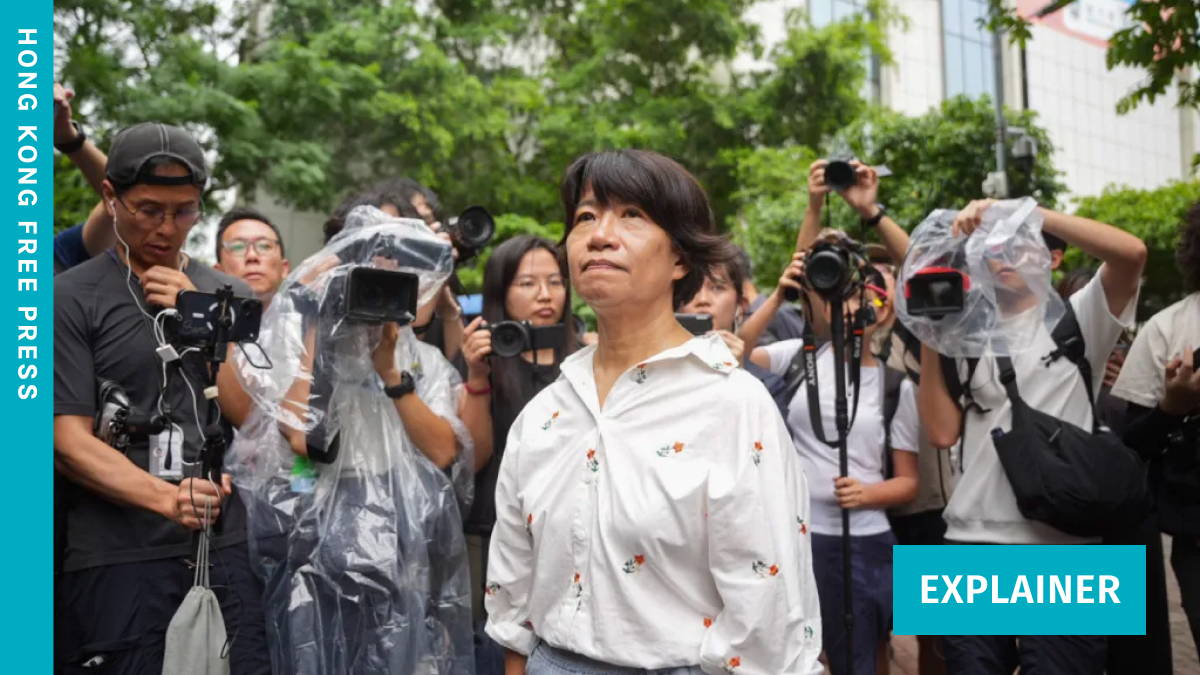
In August, two high-profile activists were found guilty in a national security case along with the organisation they once led – the now-dissolved Hong Kong Alliance in Support of Patriotic Democratic Movements of China. Chow Hang-tung, former leader of the group that organised Hong Kong’s annual Tiananmen vigils, was escorted to Court of Final Appeal on June 8, 2023. File photo: Lea Mok/HKFP. For over 30 years, the group and numerous pro-democracy activists organised an annual vigil in Hong Kong’s Victoria Park to mourn the victims of China’s 1989 Tiananmen crackdown and to call for the country’s democratisation. Chow Hang-tung, one of the activists found guilty of inciting subversion, told the court that the judgment effectively said that “pursuing democracy is a crime.” However, she was not allowed to continue with her speech in court. Meanwhile, another high-profile national security case involving 47 activists saw a new development when 11 defendants were granted leave to appeal. HKFP rounds up national security-related developments from the past month. Conviction of Tiananmen vigil activists Hong Kong Tiananmen vigil activists Chow Hang-tung and Lee Cheuk-yan were convicted of incitement to subversion under a Beijing-imposed national security law on August 21. Three national security judges handed down the guilty verdict in the trial of Chow and Lee, both former leaders of the now-defunct Hong Kong Alliance in Support of Patriotic Democratic Movements of China. The group itself was also found guilty. Elizabeth Tang, a veteran pro-democracy activist and the wife of Tiananmen vigil activist Lee Cheuk-yan, at the West Kowloon Law Courts Building on August 21, 2026, after the verdict in the trial of her husband and of fellow Tiananmen vigil activist Chow Hang-tung. Photo: Kyle Lam/HKFP. The pair, who have been behind bars since September 2021, now face a sentence of up to a decade in prison. Former lawmaker Albert Ho, who pleaded guilty when the trial opened in January, may receive a lighter penalty. For decades, the Alliance organised vigils in Causeway Bay’s Victoria Park to commemorate the 1989 Tiananmen crackdown in Beijing, when hundreds or perhaps thousands were killed as troops dispersed demonstrators around Tiananmen Square. Chow Hang-tung said in late August during her mitigation hearing that the Hong Kong court’s decision to convict her under national security legislation amounted to saying that “pursuing democracy is a crime.” Chow, together with Lee Cheuk-yan and Albert Ho, appeared before a panel of designated judges at the West Kowloon Law Courts Building on August 28. They are due to be sentenced within two weeks from the verdict, the judges said. Chow Hang-tung’s mother (right) outside the West Kowloon Law Courts Building on August 21, 2026, after the trial of her daughter and of fellow Tiananmen vigil activist Lee Cheuk-yan. Photo: Kyle Lam/HKFP. Chow was not allowed to read out her mitigation statement in full. When it was her turn to deliver her statement, she began reading from her submission but was quickly interrupted by High Court judge Alex Lee. The conviction of three prominent activists prompted a chorus of approval from government officials. Activists and overseas human rights groups, however, expressed concern about what they see as declining freedoms in the city. Hong Kong 47: 11 granted permission for appeal Eleven pro-democracy figures jailed in the landmark “Hong Kong 47” national security case won permission to appeal to the city’s top court on August 10. These include journalist-turned-activist Gwyneth Ho and former League of Social Democrats chair “Long Hair” Leung Kwok-hung. Eleven pro-democracy figures jailed in the landmark “Hong Kong 47” national security case win permission to appeal to the city’s top court. Graphic: HKFP. The Court of Appeal issued a certificate for the activists, who were jailed in the city’s largest national security case for conspiracy to commit subversion, to take their case to the Court of Final Appeal. Canada ends ‘lifeboat’ scheme for HKers At the end of August, Canada ceased accepting applicants for a “lifeboat” immigration scheme introduced for Hongkongers in the wake of the national security law. Immigration, Refugees and Citizenship Canada, the government department responsible for immigration to the country, said in a statement that the scheme – which allows Hongkongers to gain permanent residency in Canada – would close to new applicants from August 31. A Canada flag. Photo: Bogdan Krupin, via Pexels. In the August 28 statement, Canada’s immigration department said it had received applications for permanent residence from around 48,560 people. Among them, 13,370 have been granted permanent residence. UK: No deportation for Hong Kong activist London confirmed in the middle of August that it will not deport former Hong Kong lawmaker Wu Chi-wai, after the democrat experienced entry hiccups when travelling to the UK on his British National (Overseas) (BNO) passport. UK Minister for Migration and Citizenship Jo White said in a letter to former Hong Kong governor Chris Patten on August 13 that the Home Office recognised the importance of assessing each case involving a BNO passport independently. Wu Chi-wai. File Photo: Kris Cheng/HKFP. UK authorities should not automatically refuse settlement applications because of overseas convictions, White added. Wu, former chair of the now-disbanded Democratic Party, was convicted under the Beijing-imposed national security law for conspiracy to subvert the state. He was among 47 democrats accused of holding an unofficial primary for pro-democracy legislative candidates in July 2020. The 63-year-old was jailed for four years and five months. Rare non-custodial sentence A Hong Kong man was handed an 18-month probation order for writing “seditious words” in a Tsim Sha Tsui bathroom, marking a rare instance of a non-custodial sentence being handed down for a national security offence. Leung Kai-lok – who the defence said has autism – received the sentence at West Kowloon Magistrates’ Courts on August 12 after being convicted last month. China Hong Kong City in Tsim Sha Tsui. Photo: Tourism Board. According to the prosecution, the 19-year-old scrawled “seditious words” on the cubicle wall of a male bathroom in China Hong Kong City, a commercial building in Tsim Sha Tsui, on three occasions between July 17 and 21 last year. He was charged with one count of sedition and three counts of criminal damage, the latter of which he pleaded guilty to. Chinese activist arrives in Canada Chinese activist Zhang Xinyan, who is wanted by the Hong Kong government, finally arrived in Canada in early August after being detained in Thailand ahead of her scheduled flight. Sheng Xue, a Chinese-Canadian activist who has been trying to assist Zhang, said on Facebook on August 5 that the activist arrived at Vancouver International Airport on the morning of August 3, Pacific time. Zhang has been wanted by Hong Kong national security police since she was elected as a member of the Hong Kong Parliament last year. The Parliament is an organisation formed by Hong Kong activists based in Canada that was banned by SAR authorities last December. A wanted notice on the Hong Kong police’s website for Zhang Xinyan. Screenshot: Hong Kong Police Force. A Chinese dissident who practises Falun Gong, a spiritual movement banned by Beijing, she fled to Thailand in 2014. Her Chinese passport was then revoked by the PRC embassy in Bangkok, prompting her to obtain refugee status from the United Nations High Commissioner for Refugees. The 55-year-old secured emergency resettlement in Canada and was meant to board a flight to Vancouver on July 8, Sheng said on X on July 9. But she was arrested by Thai authorities in May for allegedly overstaying her visa and detained at an Immigration Detention Centre. Prosecution and arrest figures As of August 1, a total of 415 people have been arrested for “cases involving suspected acts or activities that endanger national security” since Beijing’s national security law came into effect, according to the Security Bureau. That figure includes those arrested under Article 23 and for other offences. Of the 212 people and five companies that have so far been charged, 185 people and four companies have been convicted or are awaiting sentencing. In total, 103 people and four companies have been charged under Beijing’s national security law, with 82 people and three companies convicted. Fourteen people have been charged under Article 23, 13 of whom have been convicted. Safeguard press freedom; keep HKFP free for all readers by supporting our team Support HKFP | Policies & Ethics | Error/typo? | Contact | Newsletter | Transparency & Annual Report | Apps Make a one-off donation.
Explainer: Hong Kong’s national security crackdown – month 74
Full Article
Original Source
Read the full article at Hongkongfp →KhanList aggregates and links to publicly available news content. We do not host full articles from third-party sources. Always verify important information with original sources.