
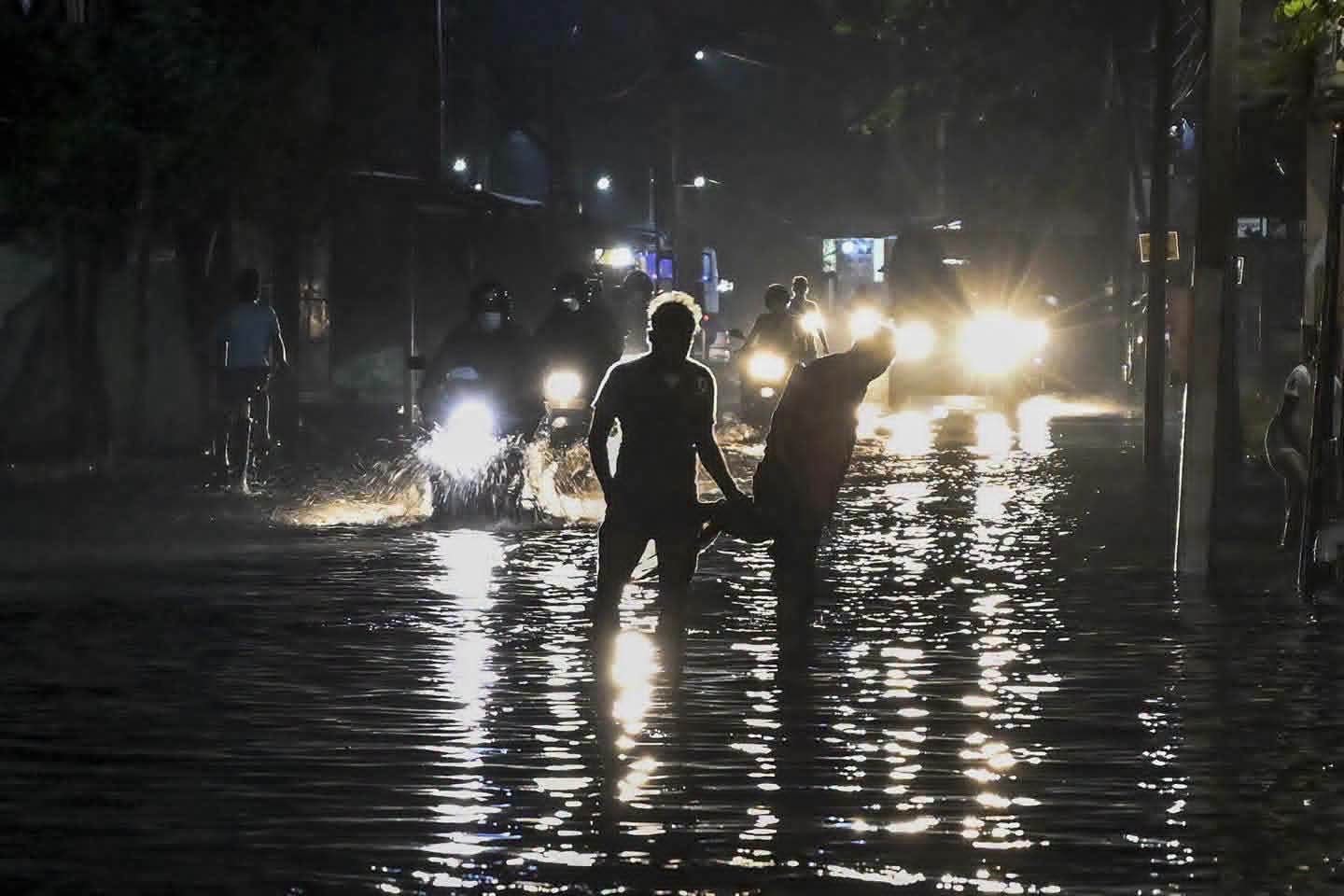
Several areas of Colombo, Sri Lanka’s commercial capital, were inundated following a high intensity downpour on Nov. 6, opening discussions on the city’s vulnerability to flash flooding.Sri Lanka is constrained by the lack of technology such as an operational Doppler weather radar system and hence cannot release accurate forecasts in time, according to weather officials.Despite being a RAMSAR-accredited wetland city, the water retention capacity of most wetlands in Colombo have declined due to urbanization, poor waste disposal and spread of invasive species.Economists suggest creating a dedicated financial reserve akin to an adaptation and resilience fund to enable local authorities to build resilient infrastructure. COLOMBO — On Nov. 6, a 129-millimeter (5-inch) downpour flooded parts of Sri Lanka’s commercial capital within minutes, stranding commuters and submerging a large number of vehicles. Siva Sivasagunthan, a three-wheeler driver working at a local ride-hailing app, told Mongabay that the water levels quickly increased and his vehicle was partially submerged in water. It took him around two hours to reach a location that would have usually taken 30 minutes to reach on a normal day. The downpour left many Colombo residents panicking. According to Ajith Wijemanna, director of Sri Lanka’s Department of Meteorology, there have been a few instances over the decades when Colombo has experienced rainfall exceeding 400 mm (15.7 in). In June 1992, the city experienced a rainfall of 493.7 mm (19.4 in). In November 2010, a 440.2 mm (17.3 in) rainfall was recorded in 24 hours. Wijemanna told Mongabay that the intensity of the rainfall — the speed of rainfall received in an hour — is extremely important. According to meteorological department readings, the rainfall intensity on Nov. 6 was more than 120 mm (4.7 in) per hour. The rain gauge reading at another location in Colombo indicated more than 135 mm (5.3 in) of rainfall per hour. “We believe that the main cause of flooding was the high intensity during a short period of time, such as an hour, which was similar to a gushing downpour,” Wijemanna said. He noted that Sri Lanka currently lacked technology such as a Doppler radar system to support better forecasts with good lead time. Once the system is made fully operational, the agency will have the capacity to issue forecasts and predict rainfall with a lead time. Pressure on an ancient drainage system The flash flood occurred soon after Sri Lanka’s prime minister Harini Amarasuriya instructed officials in local authorities, including the department of irrigation and divisional secretariats, to clean canals and drainage systems in Colombo to ensure proper flow of rainwater. Following the flash flood, several authorities deployed workers to clean drains and canals and identified 60 key locations with blocked drains and waterways obstructing the flow of flood water. Dark clouds hovering over Colombo is now a cause for worry for some urban dwellers. Image by Thuwan Mansoor. According to Deepika Wijethilake, deputy director engineering of drainage design at the Colombo Municipal Council (CMC), the sewer and storm water systems in Colombo are about a century old and have been designed to function separately. She told Mongabay that the storm water system has been designed to withhold a capacity of 30 mm (1.18 in) of rainfall per hour. “But on Nov. 6, there was a rainfall exceeding 100 mm [3.9 in] per hour. Since it rained heavily, there was extensive pressure on the system and it took some time for the water to recede,” she said, adding that the construction of more pavements also means less ability for rainwater absorption. Real estate boom impacting wetlands Besides grey infrastructure, Colombo’s wetlands also play a role in flood retention and mitigation. However, due to various development projects, Colombo’s wetlands are now under threat. A 2025 study by the Colombo-based nonprofit Centre for a Smart Future (CSF) looked at the emerging environmental pressures from the booming real estate development in Colombo’s suburbs, particularly around the Thalangama environment protection area, a picturesque Colombo suburb. According to the study, wetlands, rice fields and peri-urban landscapes are being positioned as exclusive residential enclaves and marketed as ‘green living.’ The study showed that the desirable features of the wetlands were being highlighted by property developers to increase demand. Interestingly, it also referred to areas such as Kaduwela, Malabe and Thalawathugoda — areas considered residential and all situated around wetlands — having witnessed an annual spike in property prices by about 30-40%. According to CSF co-founder and director Anushka Wijesinha, these property developers are doing very little to ensure what they market. “This is a very sensitive wetland complex. They are able to leverage on the wetland to create demand and price premia, but hardly ensure that their projects are nature-positive, which is problematic. The ecological value of the wetland is not reflected in the prices that are being charged or the fees paid to local councils or environmental authorities,” he told Mongabay. Clogged drains have become a burden for urban authorities in Sri Lanka. Image courtesy of the Ministry of Transport, Highways and Urban Development. Wijesinha said that most people see this green space idea narrowly and only from an aesthetic point of view. “But beyond that, it is a fundamental element of the city that makes the city resilient to various climate impacts. Over 45% of the country’s GDP is generated by the Western Province, of which Colombo is a major part. Then there’s a huge amount of logistics and international connectivity. There are supply chain risks when the city floods. Rather than concentrating on just the aesthetics, we need to look at it from a point of resilience, where these issues are a risk to the economic competitiveness of the city,” he said. He highlighted the importance of assessing the economic worth of a wetland. Citing a 2003 study of the Muthurajawela wetland, a coastal peat bog near Colombo, Wijesinha said how this wetland complex provides certain ecosystem services such as flood control. “Without these services, the country would have to spend billions to put up [human]-made solutions,” he said. Improving wetland connectivity Colombo lies in a low-lying area downstream of the Kelani river basin and is a RAMSAR-accredited wetland city. Chethika Gunasiri, an environmental scientist who focuses on urban wetlands and sustainability, noted that colonial cities are located in coastal or flood plain areas where floods are a natural phenomenon. “To mitigate these disasters, flood plain areas have natural infrastructure called wetlands. Their main function is to absorb rainwater, temporarily hold it and slowly release this water to the drainage system. Part of this water also goes through the soil and recharges the groundwater table,” she said. The Colombo Wetland Complex (CWC) comprises several urban and municipal council areas and not only the Colombo Municipal Council area. According to Gunasiri, 37% of rainwater that comes into Colombo is retained by this wetland complex. “But we now see how these wetlands are being filled and developed. The drainage system is not sufficient to manage high volumes of rainfall. There is no natural vegetation to retain or temporarily hold the water coming into the city,” she said. Land development authority workers clearing a waterway in Dematagoda, a densely populated area in Colombo. Image courtesy of the Ministry of Transport, Highways and Urban Development. According to her, around 20 square kilometers (7.7 square miles) of wetlands in the wetland complex remain, making it important to connect these wetlands to the Colombo flood management plan. “Most wetlands in Colombo are there as green patches, but their water retention capacity has decreased. Many wetlands have been invaded by pond apple [Annona glabra], [which has converted] them to terrestrial land where that water absorption capacity gets swiftly reduced. So we have to restore wetlands,” she said. Sustainable solutions Referring to Copenhagen’s Cloudburst Management Plan, Gunasiri said that it is important to develop sustainable solutions to withhold excess volumes of rainwater. “For instance, in Copenhagen, traditional roundabouts were converted into rain gardens to absorb rainwater. Small ponds have been created to retain rainwater. Bioswales have been introduced on the roads and sidewalks so that these vegetation patches collect rainwater from the road and is subsequently filtered to flow into the groundwater and the drainage system,” she explained. As for financing, Wijesinha of CSF said there is a need to create a dedicated financial reserve and said he advocates for an “adaptation and resilience fund” for the city. He said that some specialized funding is required to help local authorities fund resilient infrastructure, and plan for future needs. “Then the local authorities could look at redoing drainage systems, climate-resilient road infrastructure, improving wetland management and related issues. The biggest risk we have now is the fiscal risk because [of] lack of funds to pay for these investments when needed,” he said. He added that this fund could be a blended finance mechanism with a mix of government money, bilateral grants, multilateral development bank funds, philanthropic money, and an earmarked portion of local authority taxes or fees charged to property developers. Wijethilake of CMC also said that CMC is planning to design new drainage systems to withhold a capacity of more than 100 mm (3.9 in) rainfall per hour. “In the short term, we have to begin by cleaning canals and drains. In some canals there is an undergrowth and it needs to be removed. We are also removing silt deposits and garbage along these drains and canals,” she said. Caption: People wading through the waters in Colombo following the flash flood on Nov. 7. Image via Facebook. Citations: Igoor, M., & Abeyanayake, S. (2025). Shifting grounds: Unpacking the tensions between real estate development and nature in Colombo. Centre for a Smart Future. Retrieved from:https://www.csf-asia.org/wp-content/uploads/2026/01/CSF-Report_Shifting-Grounds_Dec2025.pdf Emerton, L., & Kekulandala, L. D. C. B. (2003). Assessment of the economic value of Muthurajawela wetland. IUCN. Retrieved from: https://portals.iucn.org/library/sites/library/files/documents/2003-005.pdf Credits Topics
Extreme rainfalls flood Sri Lanka’s coastal city as wetlands, drains vanish
Full Article
Original Source
Read the full article at News →KhanList aggregates and links to publicly available news content. We do not host full articles from third-party sources. Always verify important information with original sources.