
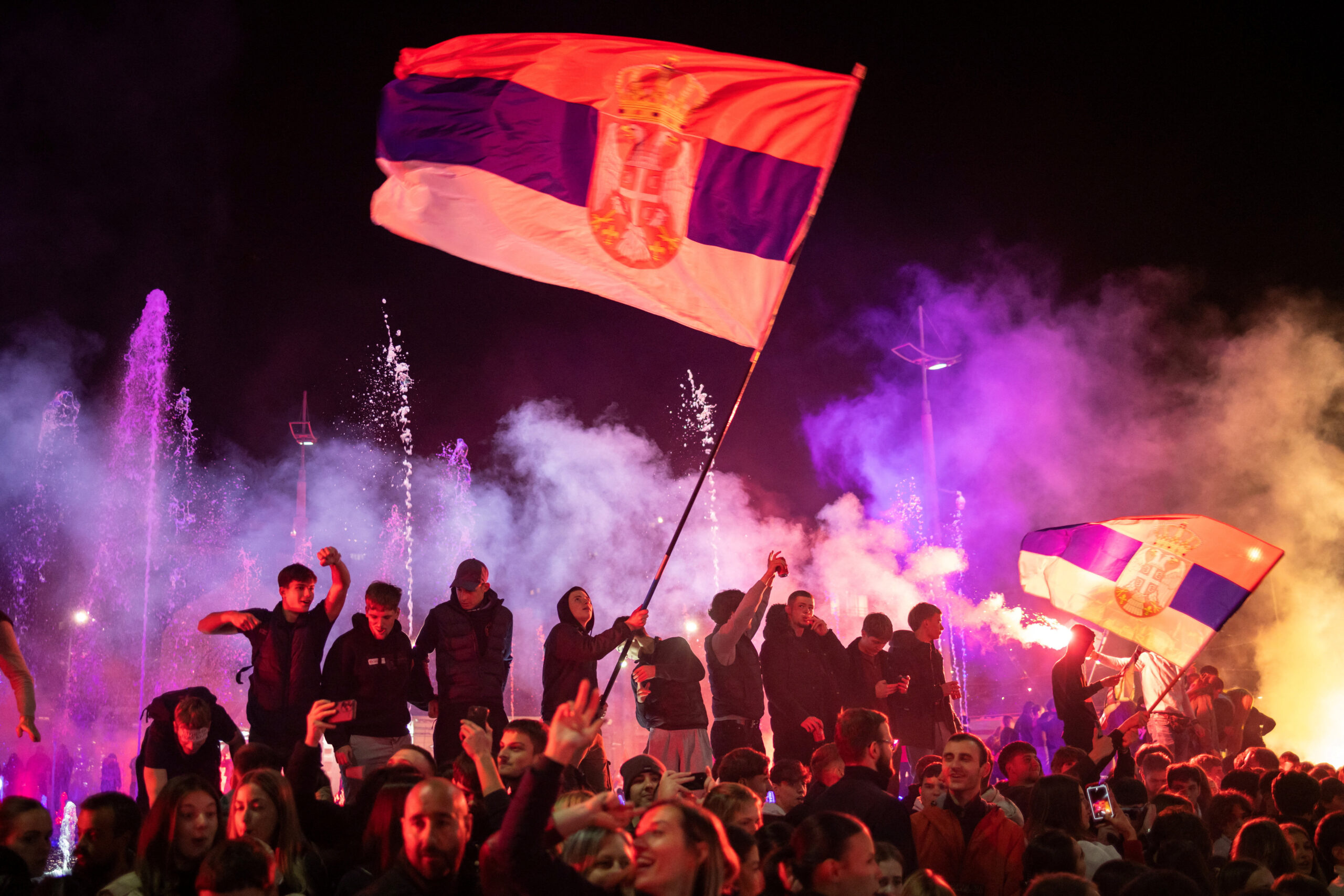
Class is in session. On Sunday, Serbia’s student-led movement defeated Aleksandar Vučić and his right-wing Serbian Progressive Party in parliamentary elections. Vučić, who has dominated Serbian politics since 2014 as prime minister and then as president, had called the snap election in the hope of returning as prime minister. Instead, a broad-based list of student-backed candidates ran on an anti-corruption platform and won a majority of seats in parliament. Below, Atlantic Council experts school us on what the outcome means for Belgrade, as well as for Europe and beyond. Click to jump to an expert analysis Jörn Fleck: A victory for democratic principles, but governing will present new challenges Christopher R. Hill: Rebuilding the country’s political institutions will need help from partners Olivia Olson: Domestic reform could impact foreign relations Lisa Homel: A credible transfer of power is a start, but it is no EU accession fast-track Amanda Thorpe: Washington will be keeping an eye on business prospects and the rule of law Jörn Fleck is senior director with the Atlantic Council’s Europe Center. A victory for democratic principles, but governing will present new challenges The decisive victory of the Student List over Serbia’s long-time leader was in the making for almost two years and surprised few inside the country. Too big was the groundswell of civic engagement and frustration with the ruling party. What started as a genuine grassroots movement against the ruling party’s corruption, state capture, and lack of democratic governance among students from Niš to Belgrade quickly transcended traditional opposition politics and mobilized broad swaths of Serbian society. The positive energy and determination that carried student protestors through two years of intense regime pressure and won cross-societal, cross-generational support was also apparent on election day as Serbian citizens turned out in large numbers and waited in long lines for hours to cast their votes. The Student List’s defeat of Vučić’s formidable political machine—despite a playing field heavily tilted against it in the media and state institutions—was not only an impressive grassroots-driven victory for democratic principles in Europe. It also achieved a powerful repudiation of a model of strongman politics that seemed to stand unchallenged until recently across the wider Balkans region. But whether Sunday’s election result is a lasting blow to that model will depend on what happens next. The students, those on the list, and many of their supporters know all too well that the real work only starts now. Government formation will require yet another transformation of the energy and shared purpose behind the list into an effective parliamentary coalition with ministerial appointments, a functioning leadership, and a hierarchy the students have avoided until now (for good reasons). The broad movement behind this success will have to translate the electoral platform that critics see as a combination of lowest common denominators on many issues into a more detailed policy agenda. The focus of that agenda will be a domestic push to restore the rule of law and reverse the capture of the state, media, and parts of the economy. Any such complex reforms will have to overcome resistance from entrenched interests in these institutions. All the while, Serbia’s new government will have to navigate a challenging geopolitical and economic environment. US pressure to remove Russian influence from the country’s energy sector may only soften temporarily. International markets will watch closely how the new team in Belgrade will handle the economy. The country’s growth model has depended to no small degree on manufacturing and infrastructure investments from European but also Chinese and Gulf investors, and it had already begun to sputter under pressure from both corruption and political uncertainty. Despite the enormous challenges facing the next democratic government of Serbia, the optimism, energy, and determination demonstrated by Serbia’s students over nearly two years of peaceful protests for change offer genuine grounds for hope. Whatever challenges lie ahead, their movement has opened up a new space for democratic possibility in Serbia that few outside thought possible. It may also carry a wider message for the region. Christopher R. Hill a distinguished fellow with the Atlantic Council’s Europe Center and a former US ambassador to Serbia. Rebuilding the country’s political institutions will need help from partners The loss of Vučić’s ruling party to a student-led coalition has plunged Serbia into an uncertain political future that will test the optimism and energy so apparent during two years of student street demonstrations. The incoming government faces the daunting task of maintaining Serbia’s hard-earned economic successes while rebuilding the country’s political institutions and civil life. The “Student List–Students Win” was a stunning success. The energetic coalition enjoyed broad public support that extended beyond Belgrade and other large municipalities to include voters in the countryside. Serbia’s traditional opposition parties often ignored the rural areas. Now some of those traditional parties lie in ruins, failing to achieve even the threshold numbers to achieve any seats in parliament. As if to rub in their past failures, the Student List announced that it will not accept Vučić’s supporters or those who supported the traditional opposition into its government. Transforming the movement’s menu of anti-Vučić slogans into governmental policies and programs that represent the interests of its broad-based coalition will be a challenge. While the overall thrust of the movement is to move closer to European views, this orientation cannot be taken for granted given the many nooks and crannies of the formation. Hearty perennials of Serbian politics, including Kosovo as the emotional third rail of the country’s state affairs and Vučić’s own balancing game between the East and the West, will probably remain in some form. No doubt, however, all Serbs can take great pride in the smooth running of the elections with apparently very few examples of the fraud and irregularities that were broadly predicted just days before by Student List supporters. And Vučić’s own concession speech—short, clear, and on point—was a welcome development to those who worried about a long period of unrest. Serbia will need help in this delicate transformation, and the eyes of many Serbs will turn to the EU in the hope that it will pick up the pace of its integration efforts. A Serbia integrated and anchored in the EU will benefit the entire region. Olivia Olson is a project assistant with the Atlantic Council’s Europe Center. Domestic reform could impact foreign relations Serbia’s foreign policy standing was not a defining issue for Serbian voters. Vučić has long pursued strategic ambiguity, balancing among Washington, Brussels, Moscow, and Beijing, a method that provided his party domestic legitimacy through investment and political engagement from many sides. The Student List–led government will inherit Serbia’s foreign policy balancing and it has already indicated that some foreign policy positions will remain unchanged. But the Student List’s goal to advance democratic reforms can translate into changes in how the country manages its external relationships. Serbia is the only EU candidate country in the region that has not imposed sanctions on Russia. The Student List has stated that it would hold the position against sanctioning Russia, citing Serbia’s own history with sanctions. However, because its platform is focused on fighting corruption and strengthening democracy at home, a Student List–led government might be less inclined to use foreign policy to bolster its domestic political standing than before. While Serbia’s formal position on Russia may remain unchanged, improvements in media freedom, rule of law, and civil society could broaden scrutiny and debate over the country’s relationship with Moscow. On China, the Student List platform calls for deepening cooperation in high-level tech investment, while also insisting on compliance with domestic regulations for all projects. Serbia is China’s main foray into the region: It received €10.3 billion of the €32 billion in Chinese investment across the Western Balkans between 2009 and 2021. The Student List’s domestic reform agenda in this could reshape how Serbia does business with foreign investors. Government-to-government agreements and “lex specialis” exemptions are not limited to Chinese infrastructure projects, as Serbia also uses such agreements with some EU member states, the United States, Turkey, and other partners. The Student List’s goal of increased transparency in this area could reshape the nature of infrastructure deals with many foreign partners, subjecting them to greater scrutiny. Lisa Homel is an associate director with the Atlantic Council’s Europe Center. A credible transfer of power is a start, but it is no EU accession fast-track The response to Serbia’s election from Brussels was swift: EU Enlargement Commissioner Marta Kos wrote, “A new chapter can begin for Serbia. The door to the EU is open, and we are ready to move forward together.” European Commission President Ursula von der Leyen and Council President António Costa offered their support for “reforms on the rule of law, media freedom the fight against corruption and strong democratic institutions.” Still, the election is not a fast track to the EU: Serbia’s next government will inherit the EU’s demands for greater Common Foreign and Security Policy (CFSP) alignment and normalization of relations with Kosovo. Although the student movement has largely avoided EU symbols at its protests, its priorities of anti-corruption, public procurement, and judicial independence correspond directly to the “fundamentals” chapters of the EU accession negotiations. This gives the new government a real opportunity to deliver progress where previous Serbian governments have stalled. Yet, to date, the Student List has not articulated a clear vision for EU accession. Moreover, in some areas the Student List has adopted positions similar to those of Vučić’s party, including its refusal to sanction Russia and in its memorandum reaffirming Kosovo as a part of Serbia rather than its own independent country. The new government will also inherit a stalled process to normalize relations between Serbia and Kosovo. The EU-facilitated Belgrade-Pristina dialogue, for example, has been largely frozen since 2023. Member states have blocked the opening of Serbia’s next negotiating cluster over its lack of CFSP alignment—which is the lowest among the EU candidate countries—and rule-of-law concerns. While Montenegro and Albania continue to advance in their accession negotiations, Serbia, the largest economy in the Western Balkans, has remained stuck. A credible transfer of power was necessary for Serbia’s EU path, but it is not sufficient on its own. The Commission’s annual enlargement package, expected shortly, will offer Brussels’ first formal assessment of what has changed and what the country needs to prioritize in its EU path. Amanda Thorpe is a nonresident senior fellow with the Atlantic Council’s Europe Center. Washington will be keeping an eye on business prospects and the rule of law Both Democrats and Republicans in Washington will be watching what happens next, too. As is customary, the bilateral relationship with Washington will be primarily driven by the executive branch, which launched the US-Serbia strategic dialogue in July, and has expressed interest in Serbia’s EXPO 2027. These partnerships and interests will likely continue, assuming a smooth transition of power. However, Congress has consistently maintained interest in democratic accountability and the rule of law in Serbia, as was seen with the introduction two months ago of the “Supporting the Rule of law, Building Institutional Justice, and Accountability Act,” known as the SRBIJA act. The bill cites democratic backsliding, repression, and Serbia’s ties with Russia, China, and Iran to call for US support for democracy accountability and sanctions against those who are threatening peace and security in the Western Balkans. The bipartisan, bicameral measure and related policy items will be worth watching in this post-election period. Serbia’s government transition will also impact its relationship with Washington. Peaceful transitions of power will encourage productive dialogue with the executive branch and smooth unease within the Congress.
Experts react: Serbia’s Vučić is out and the student-led movement is in. What comes next?
Full Article
Original Source
Read the full article at Atlanticcouncil →KhanList aggregates and links to publicly available news content. We do not host full articles from third-party sources. Always verify important information with original sources.