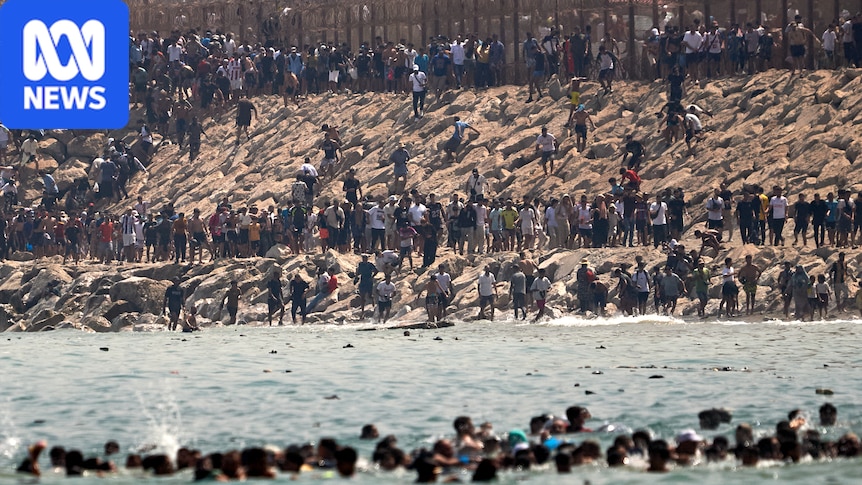
Italy has temporarily suspended the Schengen Agreement and reintroduced border controls with Spain after a surge of migrants entered the Spanish North African enclave of Ceuta.The move follows an apparent breakdown of border controls between Morocco and the tiny Spanish territory on Thursday, local time, allowing an estimated 50,000 people to cross into Ceuta amid chaotic scenes.The number of arrivals was equivalent to more than half of Ceuta's usual population, with Spanish authorities saying the influx might have stemmed from a legal ruling that migrants arriving by sea could not be immediately returned.The Spanish government's representative in Ceuta said 57 bodies had been recovered on the Spanish side of the border, with fears the death toll could be higher because there may also be casualties in Morocco.Authorities said some people drowned while others were crushed trying to climb the breakwater supporting the border fence.Spanish Prime Minister Pedro Sánchez vowed his government is working with Moroccan and international authorities "to restore normalcy as soon as possible".Here's how Ceuta has become a migration hotspot and why the crisis has prompted parts of Europe to tighten its borders.What is the Schengen Agreement?The Schengen Area allows people to travel between 29 European countries without routine passport checks at internal borders.While border controls are normally abolished, member states can temporarily reinstate them if they believe there is a serious threat to public order or internal security.Authorities say some people drowned while others were crushed trying to climb the breakwater supporting border fences. (AP Photo: Antonio Sempere)Italy does not share a land border with Spain, so the decision to reintroduce border controls for a month will impact people travelling by plane or boat between the two countries.The Italian government said the checks would target non-EU nationals arriving from Spain and would not affect Spanish or other EU citizens travelling to Italy."This is an extraordinary measure, adopted to safeguard national security and prevent possible repercussions for our nation," Prime Minister Giorgia Meloni wrote on X."The measure will be kept in force only for the time necessary, with particular attention to limiting any impact on summer tourist flows."Where is Ceuta?Ceuta is an autonomous Spanish city on the northern coast of Africa that borders Morocco.Spain also controls the nearby city of Melilla. Together, the two enclaves form the European Union's only land borders with Africa.Roughly the size of inner Sydney, Ceuta has a population of just over 83,000, according to Spain's Instituto Nacional de Estadistica.It is home to Christian and Muslim communities, including Spanish and Moroccan residents and cross-border workers.Why is it a migration flashpoint?For decades, Ceuta has been one of Europe's main migration gateways because it offers a direct route into the European Union.Many people fleeing conflict, persecution or poverty travel through Morocco hoping to reach the enclave.According to Spain's Interior Ministry, Ceuta recorded 2,582 migrant arrivals by land during the first six months of 2026, up from 978 during the same period of 2025.That 164 per cent increase contrasts with the broader trend across Spain, where migrant arrivals fell from 17,990 in the first half of 2025 to 12,138 over the same period this year.Many of the migrants who arrive in Ceuta are immediately turned back, while others are held in migrant shelters and can apply for asylum in Spain. (AP Photo: Antonio Sempere)Unlike the often dangerous Mediterranean sea crossing, Ceuta can be reached by land or by swimming around its coastal barriers, but the journey is still risky.The International Organization for Migration (IOM) says migrants face violence, illness and dangerous conditions at the border.Migrants have previously tried to enter Ceuta by climbing or cutting through border fences, swimming around sea barriers or hiding inside vehicles crossing the border.Many of those who arrive are immediately turned back, while others held in migrant shelters are processed and can apply for asylum in Spain.Migrants trying to cross from Morocco into the Spanish enclave of Ceuta on Friday. (AP Photo: Antonio Sempere)Spain has strengthened security over the year with double fences, surveillance technology and additional patrols, but attempted crossings have continued.The IOM has recorded over 35,000 migrant deaths and disappearances in the Mediterranean since 2014, including more than 5,000 along the western Mediterranean route, which includes Ceuta.Why has there been such a large surge?It is not year clear what triggered the sudden surge, though Spanish authorities suggested a legal ruling in early July may have fuelled misinformation about migrants' chances of remaining in Spain.Spain's Interior Ministry said about 50,000 people crossed into Ceuta from Thursday morning, but that 48,300 had already returned to Morocco by Friday evening, with hundreds more returning each hour.Territorial Policy Minister, Angel Victor Torres said the Supreme Court ruling, which barred authorities from summarily returning migrants who arrived by sea without due process, may have encouraged more people to attempt the crossing.While the decision does not guarantee migrants the right to stay, Spanish broadcaster RTVE reported the ruling spread widely on Moroccan social media.Prime Minister Sánchez blamed people smugglers for exploiting the legal ruling.The Supreme Court's ruling "spread like wildfire over the past few hours through the networks of human trafficking organisations," he said."They deceive so many young people and ultimately lead many of them to their deaths."What has the response been?Spain has described the mass crossing as "a violation of territorial integrity" and deployed hundreds of additional police and military personnel to Ceuta.Authorities have rapidly returned tens of thousands of migrants to Morocco under existing bilateral agreements.Italy went further by temporarily restoring border checks for arrivals from Spain under emergency provisions of the Schengen Agreement.A member of the Moroccan security forces stands guard as people attempt to cross from Morocco's northern town of Fnideq. (AP Photo)France, which already maintains some temporary border controls under its own Schengen exemption, said it would also strengthen checks on its border with Spain.Italy's Interior Ministry said it had separately agreed with Paris to tighten controls along the Franco-Italian border.Morocco's ambassador to Spain, Karima Benyaich, said the events in Ceuta were not what Morocco wanted."We have always prioritised legal, orderly and safe migration for all," she said, without commenting on what prompted the mass crossing.Migrants seen returning to Morocco from Ceuta on Friday. (AP Photo: Antonio Sempere)Rights groups said Moroccan police used water cannons and fired warning shots into the air to stop more people from entering Ceuta.The European Commission president Ursula von der Leyen backed Spain's response, saying the "images coming from Ceuta are unacceptable"."We cannot allow anyone to come to our Union without abiding by our rules," she said."Dangerous crossings must stop immediately. Smuggling networks must be dismantled. And returns must be swift, as our rules allow."
Europe tightens its borders after Ceuta migrant surge
Full Article
Original Source
Read the full article at Abc →KhanList aggregates and links to publicly available news content. We do not host full articles from third-party sources. Always verify important information with original sources.