
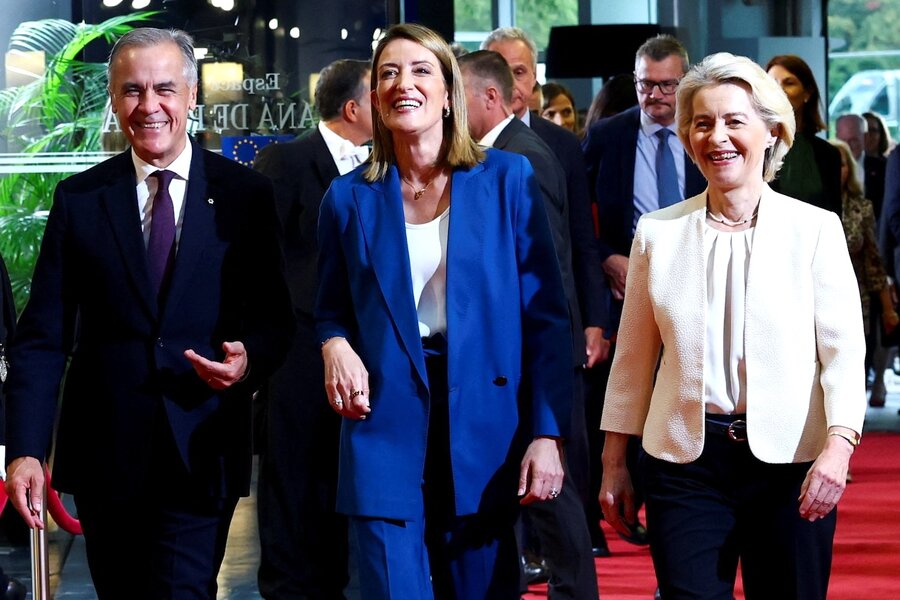
Canada clearly has no intention of allowing itself to become the United States’ 51st state. But it might be willing to consider becoming the 28th state to join the European Union. Sort of.On Wednesday, Ursula von der Leyen, head of the European Commission, invited the U.S.’s northern neighbor to join the 27-nation bloc – the world’s third-largest economy – as an “associate member.” Her reasoning?“We share one ocean, one set of values, one way of seeing the world,” Ms. von der Leyen declared. “We believe that power does not belong to the strongest, the richest or the loudest – but to all of us. That democracies have the freedom to choose with whom to work.” Such a partnership, she was careful to note, is “not against anyone else, but for our common strength.” On Thursday, Canada’s Prime Minister Mark Carney addresses the European Parliament, and is likely to express similar sentiments and support for closer ties.This week’s events mark ongoing geopolitical shifts that Mr. Carney himself put into top gear in January. Speaking at the annual World Economic Forum in Davos, Switzerland, he declared that the long-standing world order was ruptured, and urged “middle powers” to step up and build new coalitions.As these formerly close U.S. allies seek to untether themselves from decades of dependence and redefine sovereignty, they are finding it’s important to reaffirm bedrock social and political traditions they hold in common. Articulating democratic values at this time can help reshape regional trade and defense, as well as views of national identity and international responsibility. Canada “is an underrated military power,” according to the European Council on Foreign Relations, pointing to its experience in Arctic military strategy. And Canada’s plans to increase defense spending could mean potential business for European military contractors. Earlier this week, Mr. Carney welcomed international asset managers to a summit in Toronto, where his government showcased more than 160 multibillion-dollar investment opportunities in mining, energy, ports, manufacturing, and technology.The EU, too, appears to be adopting more expansive views of its role. “By creating a tailor-made title just for Canada,” according to Bloomberg News, “the EU is sending a powerful signal as a trading bloc that it can expand beyond its borders and reinvent itself.” Deepen your worldviewwith Monitor Highlights.Politics with respectGet political stories with respectful analysis.There's a world of new ideas in everyBooks newsletter.There's more to life, enrich yours withCulture & Learning weekly.Follow humanity's discoveries withScience & Nature stories in your inbox.Gain a spiritual perspectivefrom the stories in your inbox.Want to understand the deeper impact of critical events? Learn the Monitor's insight.Already a subscriber? Log in to hide ads. Beyond pragmatism or realpolitik, analysts believe that the collaborative, respectful approach to partnership that the EU and Canada are pursuing could have broader, global resonance.“The European project emerged from the ruins of the second world war,” Fabian Zuleeg, head of the European Policy Centre, wrote in The Guardian Monday. “Now, in a very different geopolitical context, we need ambitious mechanisms for bringing like-minded democracies together.” ALREADY A SUBSCRIBER? LoginReal news can be honest, hopeful, credible, constructive.The Christian Science Monitor was founded in 1908 to lift the standard of journalism and uplift humanity. We aim to “speak the truth in love.” Our goal is not to tell you what to think, but to give you the essential knowledge and understanding to come to your own intelligent conclusions. Join us in this mission by subscribing.
EU and Canada pursue a values-based alliance
Full Article
Original Source
Read the full article at Csmonitor →KhanList aggregates and links to publicly available news content. We do not host full articles from third-party sources. Always verify important information with original sources.