
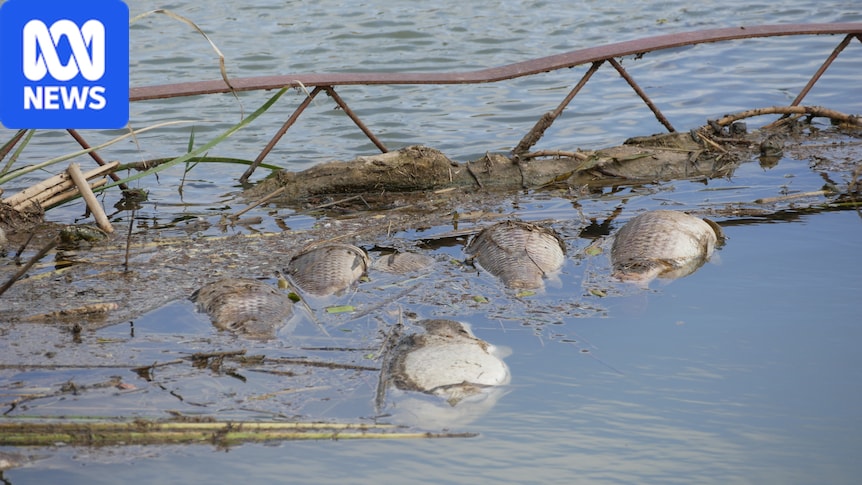
The NSW Environment Protection Authority (EPA) is investigating Murrumbidgee Irrigation over a possible breach of the Pesticides Act after 2,800 fish were found dead in Leeton Shire channels over the past week.The discovery came after Murrumbidgee Irrigation conducted weed spraying along the area's channel systems between the Riverina towns of Leeton, Stanbridge and Wamoon to improve flow rates for irrigators. The EPA has released a statement, confirming it was informed about the situation last week."The EPA is investigating to see whether there has been a breach of the Pesticides Act," a spokesperson said,"Murrumbidgee Irrigation are [sic] working to clean up the channel, and we have directed them to undertake further sampling."We are advised an estimated 2,800 fish are deceased, predominantly European Carp, with some native fish also impacted." The Leeton Shire Council said there were no concerns for residential drinking water, but some residents remained concerned about the impact on native species.In a statement, Murrumbidgee Irrigation said 95 per cent of the fish killed were European carp.But Leeton resident and avid fisherman Josh Higgins has disputed that. Josh Higgins feels more could be done to protect the channel's ecosystems. (ABC Riverina: Nicola Ceccato)"I've not ever seen fish dead like this before," he said. "There were certainly hundreds of Murray cod there and ranging from all sizes."Some quite small, but there was quite a few that were upwards of that 60 and 70-centimetre mark up to that metre and over the metre mark, which is pretty devastating."Murrumbidgee Irrigation says the majority of fish affected in the recent fish kill were European carp. (ABC Riverina: Nicola Ceccato)Mr Higgins said he was worried that the weed treatment happened at a time when Murray cod were breeding."Your average recreational fisherman is unable to go and target a Murray cod this time of the year because it's their breeding time," he said."There's no denying there is quite a bit of weed through that area and it would affect flow rates for the farmers and obviously they need to get water."So that's completely understood, but there has to be better ways to go about it."Yabbies and other crustaceans were also impacted in the recent fish kill. (Supplied)Chemical concernsThe product used by Murrumbidgee Irrigation in its spraying program is called Magnacide H, which has a general biocide called Acrolein as its active ingredient.It is used to treat submerged aquatic weeds like pondweed and ribbon weed. Magnacide H is currently the only product approved by the Australian Pesticide and Veterinary Medicines Authority to treat weeds in irrigation channels. On Murrumbidgee Irrigation's website, the company states that it expects all fish in the channels where Magnacide H is used will die, but previous cases showed it was mainly European carp impacted.Director of the University of NSW Centre for Ecosystem Science Richard Kingsford said to understand the full impact on the channel's ecosystem, every species killed by the chemical should be tracked. Richard Kingsford says Acrolein is a very toxic chemical for aquatic species. (Supplied: Richard Kingsford)"Even though this chemical doesn't hang around for very long, if it kills a lot of things like yabbies and shrimps," Professor Kingsford said."It can have impacts longer term on the whole food web that's dependent on that system."Professor Kingsford said finding a solution to the weed problem could be difficult, with no other approved APVMA treatment for irrigation weeds and the high cost and effort of manually clearing long stretches of channel. "It could also be about how do you make sure your timing of using herbicides doesn't coincide with when native fish are migrating and in big numbers in those channels," he said. "The problem with herbicides and pesticides … there are also chronic effects where [they] can build up in the tissues and affect the way these animals survive and breed."Murrumbidgee Irrigation says only 5 per cent of the fish kill were native fish. (Supplied)In a statement, Murrumbidgee Irrigation said weeds needed to be treated at different times of the year depending on growing cycles. "Our channels are private infrastructure used to deliver irrigation water and for reasons of safety, at all times of the year we recommend that people do not use our channels for recreational purposes, including fishing," it said.The company said the recent spraying was a "controlled and purposeful activity" and said it was working with the EPA to "identify any lessons that can inform future weed management activities".
EPA investigates after thousands of fish found dead in irrigation channels
Full Article
Original Source
Read the full article at Abc →KhanList aggregates and links to publicly available news content. We do not host full articles from third-party sources. Always verify important information with original sources.