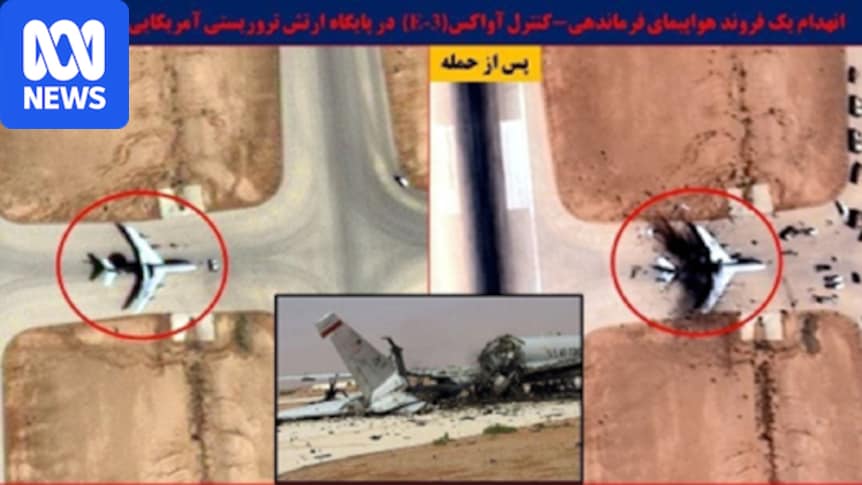
Five months into a war Donald Trump said would last only weeks, the Iran conflict has so far cost the United States tens of billions of dollars and brought about "the end of an era" in American military strategy.After a short-lived ceasefire, heavy bombings resumed earlier this month, with the US hitting Iranian targets and retaliatory strikes causing chaos across the Gulf.The war has so far cost the US $US37.5 billion ($53.6 billion), according to the Pentagon's figures, and US politicians have approved even more funding.An unprecedented $US1.15 trillion military spending package that will help fund the war this week advanced through the House of Representatives despite fierce pushback from Democrats concerned about spiralling costs. The bill now goes to the Senate.And if the US is planning for a wider war, as the Washington Post reports, there could be more severe losses to US equipment and munition stocks to come.Over the last five months, the US defence force has suffered heavy blows to its personnel, military bases and hardware, and analysts warn American war strategy long-term has been weakened.This is what it's lost and what the impacts could be.The damage on US basesThe US military footprint in the Middle East has sustained heavy damage during the war, as Iran struck US bases and outposts across the Gulf.There are at least 19 US military facilities across the Middle East, according to the Council on Foreign Relations.Early in the war, sustained attacks on US bases in Saudi Arabia, Kuwait and Jordan left some of those bases "all but uninhabitable", the New York Times reported.Among them was Camp Buehring, a post in north-western Kuwait. In March, two Iranian F-5 planes dropped eight bombs on the facility, striking the dining area, gym and garage, according to an analysis of Iran-released images by Mark Cancian and Chris Park of the Center for Strategic and International Studies (CSIS).US military base Camp Buehring in Kuwait was attacked during the opening days of the war. (Supplied: Center for Strategic and International Studies/ABC News)At a Jordanian base, in the opening days of the war, a powerful missile defence radar, which is part of the Terminal High-Altitude Area Defense (THAAD) system, was destroyed by Iran. It costs just shy of $US500,000.In the latest escalation, the same base was targeted by a barrage of strikes, killing three American soldiers.The US Ali Al Salem base in Kuwait has been repeatedly hit by Iran, including again this week. At least 20 American personnel have been injured in the attacks.A naval base in Bahrain was also struck in late February, reportedly destroying two satellite communication terminals and other buildings. It was hit again in June.Satellite images show Iranian attacks on warehouses (lower left) and headquarters (centre) at the Naval Support Activity (NSA) naval base in Bahrain. (Supplied: Center for Strategic and International Studies)It could cost between $US4 billion and $US9 billion to rebuild these damaged bases, according to Mr Cancian.But the attacks will have a deeper impact than just physical destruction, says Kelly Grieco, a defence policy expert at the Stimson Center."US bases … were to a large extent, sanctuaries," she said."The fact that this has been exposed as such a vulnerability and that the adversary is able to reach far deeper and to attack the bases has a psychological impact."Certainly, it marks … an end of an era. An era when the United States was just so dominant relative to others in controlling airspace."A satellite view from March shows the Ali Al Salem Base in Kuwait after Iranian strikes. (Reuters: Planet Labs)Along with well-known locations of US assets, Iranians have reportedly been targeting covert outposts as well.The regime recently struck CIA facilities in the Gulf. One was located in the US embassy in Riyadh and another located in eastern Iraq, Reuters reported. The hits, according to the news service, prompted US intelligence analysts to investigate whether Russia assisted by providing targeting information or advanced drone technology.Mr Cancian, a senior defence advisor at the CSIS, said Iranian strikes on US infrastructure had been "precise"."There were no random craters … some of them were aimed at military facilities, but others were clearly intended to cause casualties [such as] attacks on barracks and dining facilities and gyms."Loss of personnelThe greatest cost to the US so far, though, has been in the military personnel lost to this war.All up, the Pentagon has said 18 service members have been killed since the war began.Four died in the latest phase of the war, according to the Pentagon, including one killed in northern Iraq while carrying out a controlled detonation of unexploded ordnance from a downed Iranian drone.Six soldiers were killed in Kuwait during the first few days of the war, with another dying from injuries from a missile attack on Prince Sultan Air Base in Saudi Arabia.Another six service members were killed in March when a KC-135 refuelling aircraft supporting operations against Iran crashed in Iraq.Separately, the US military said a navy pilot died after a helicopter crashed into the Arabian Sea earlier this month during what it described as an emergency landing not caused by hostile action.The Pentagon has been accused of withholding information about US casualties, with officials telling the New York Times that dozens of military personnel had been injured in the latest wave of Iranian attacks against US forces.Dr Grieco said she was concerned the number of US casualties would rise."[People are] questioning why we are still fighting this war and are those lives worth it to be lost."Weapons depletedThe US has worn down its weapons supply in a way that defence experts had not anticipated.In Dr Grieco's words, the military has been "eating up" munitions at a rate it cannot afford."Things like missile defence systems, long-range strike weapons, Tomahawk missiles. We've been going through these at a high expenditure rate," she said.She said the military had also used a large proportion of its "high-value critical systems", or military assets that it did not have in large numbers.One example is the THAAD mobile system, which is specifically designed for ballistic missile defence and can hit targets at ranges of 150 to 200 kilometres."We were already in a hole before this war started … and now, because of this war, we've dug ourselves a much bigger hole that we need to get out of," Dr Grieco said."It's going to take years for us to be able to recover the numbers that we've lost."A report to the US Congress in May found at least 42 American aircraft, including F-15 and F-35 fighter jets, 24 MQ-9 Reaper drones and an A-10 attack plane, had been destroyed or damaged since February.Despite US Central Command claiming attacks on more than 10,000 targets, Iran had still retained roughly 70 per cent of its pre-war missile stockpile, according to a New York Times report in May.The US has not made the current state of its military stockpile known, but Dr Grieco said that in recent months it had likely gotten worse. Meanwhile, she said, the Iranians' weapons supply may have grown.The Iranian military may have used the ceasefire to excavate and reopen buried underground "missile cities" that had their entrances blocked by US and Israeli attacks, she added.In contrast, half of America's stockpile of hard-to-make air defence interceptors had been depleted, while up to a third of expensive missiles had been used, a Center for Strategic and International Studies report said.Compared to Iran, Dr Grieco said the US was in a "lopsided" position."[The] math already favoured Iran at the start of the war. It now looks worse," she said.Some weapons could take five to six years to replace, which will weaken the US's deterrence capabilities, analysts say."There's going to be this gap, this window of vulnerability, until they can rebuild those inventories," Mr Cancian said."It's a problem for the Western Pacific. If a conflict were to break out with China, we would be way below where most analysts and the war planners want the inventories to be."Learning military lessons the 'hard way'Despite the persistent fighting words from Washington, analysts say there are signs the US is shifting its strategy in the Middle East.One of them is that the US this month relocated dozens of aircraft to Ben Gurion Airport and Ramon Air Base in Israel, signalling Washington knows it has a problem, according to the Council on Foreign Relations.The war has made the realities of the geography much more apparent as Iran has exploited the fact US military assets sit well within striking distance.Dr Grieco said this conflict and Iran's role in it had cast a shadow across the future of US military presence in the Gulf."I don't know if we'll see these kinds of basing changes happening overnight," she said. "But I think long-term there's good reasons for these Gulf countries to really re-think whether they want these bases."The dwindling stockpiles of weapons also mean the US is constrained in its ability to help its allies.Charles Kupchan, a professor at Georgetown University and senior fellow at the Council on Foreign Relations, pointed to Ukraine's desperate need for Patriot missiles."They're not able to get what they want from the United States, in part, because we don't have enough to give them," he said.He said while the US still enjoyed vast military superiority over Iran, the regime's ability to launch drones and missiles remained "robust"."As the US has found out the hard way — in Afghanistan, in Iraq, in Libya, in Syria — superior military capability does not always translate into a successful strategic outcome," he said.
'End of an era': How the Iran war may change US military strategy
Full Article
Original Source
Read the full article at Abc →KhanList aggregates and links to publicly available news content. We do not host full articles from third-party sources. Always verify important information with original sources.