
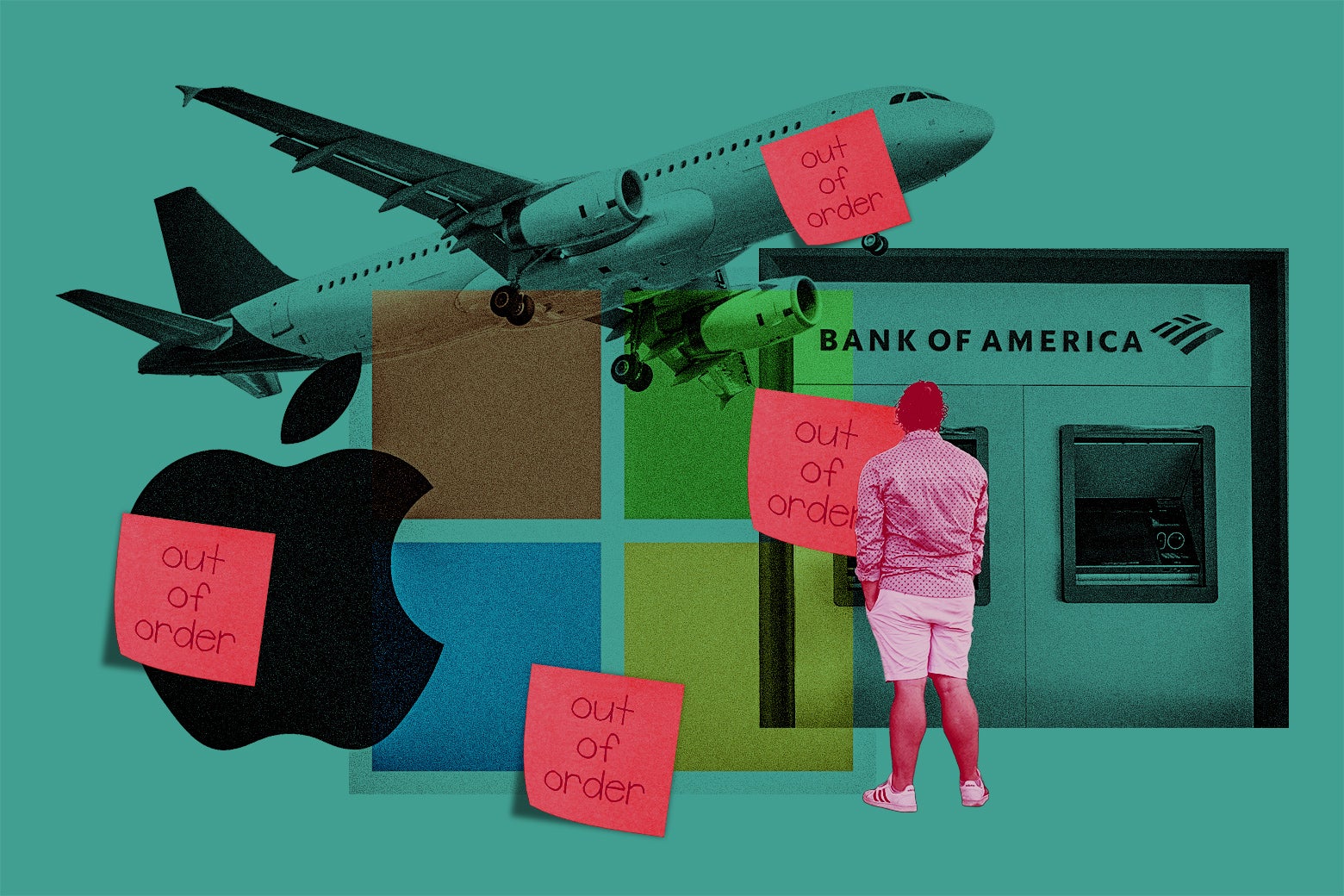
The Slatest The system is glitching. Photo illustration by Slate. Photos by Joe Raedle/Getty Images and Getty Images Plus. This story is adapted from the Slatest newsletter. You can sign up here to get it in your inbox every day. With apologies to Chinua Achebe, things really do seem to be falling apart. In less than a week, technical glitches have disrupted air travel, online banking, email, and other services across the country and the world. And while the timing may just be a coincidence, the problems collectively point to major vulnerabilities lurking beneath our thin veneer of civilization. Let’s briefly explore each one. Microsoft: A global outage prevented users—including healthcare providers, businesses, and governments—from accessing Outlook emails, Teams, and other services starting Thursday.The Federal Aviation Administration: On Friday evening, a technical issue prompted a nearly five-hour nationwide ground stop, the longest since 9/11. Passengers remained stranded into this week—but don’t worry: Our swole Homeland Security secretary, Markwayne Mullin, managed to take a government plane to the LSU–Texas game on Saturday.Banks: A glitch at JPMorgan Chase prevented thousands of customers from accessing their online accounts and the payment service Zelle on Monday.United Airlines: A 90-minute system issue apparently unrelated to last week’s air travel problems delayed departing flights on Monday.The National Security Agency: NSANet, an internal system that lets employees at one of the world’s most powerful spy agencies securely discuss top-secret information, was down on Tuesday.Apple: Thousands of users were unable to access Apple Music, the App Store, iCloud, Apple Pay, and other programs today.The National Weather Service: According to TMZ, some meteorologists are having trouble accessing weather.gov. What’s next, electricity and running water? I won’t blame you for asking, but temporary snafus don’t always signal deeper problems. Over the past few years, glitches at Amazon Web Services, the online infrastructure provider Cloudflare, and the cybersecurity firm CrowdStrike have tanked services ranging from email to Snapchat—only for those services to quickly get restored. And despite the feverish impulse to connect the dots between the latest outages, we may just be looking at extraordinarily bad luck. A newly installed router at an FAA outpost in Arkansas seems to have triggered the air travel fiasco, while an overdue software update appears to have taken down NSANet. The latest chaos is most likely pure happenstance—or simply the result of a collective impulse to turn outages that wouldn’t normally have netted much concern into national news. Even so, these kinds of disruptions really could become routine. The rush to blame a new artificial intelligence system for the air travel debacle appears to be in error, as my colleague Nitish Pahwa explains, but sophisticated A.I. agents are already exploiting security flaws to target companies, banks, and cryptocurrencies. Even when the systems in question are analog, they’re often aging and exposed. Targeted attacks, rising seas, and even accidents threaten to disrupt telecommunications cables, the power grid, and the other physical infrastructure that undergirds modern life. So while it may seem as if things are falling apart, the scarier possibility is that we haven’t seen anything yet. Tolga Akdoğan OK, you’ve earned a break. Here’s what my colleagues think you should read, drink, and play to take your mind off the news—assuming the internet is still here, that is: Stay grounded: To carry over from the above, we’re still waiting for the whole story of what caused last weekend’s ground stop, but many Americans quickly blamed A.I. Even if they’re wrong, Slate’s Nitish Pahwa explains, the impulse to pin the responsibility on Silicon Valley is yet another sign that the techlash is in full swing. Sip on some whiskey from [redacted]: A handbook on curating spirits and making cocktails at home is an unlikely target for government censorship. But that’s exactly what the authors of The Bartender’s Library experienced when officials in China—where their book was being printed—objected to several passing references to Taiwanese whiskey. Jacob Grier recounts the transnational political saga, which left him both shaken and stirred. Solve the crossword: Slatest readers are primed to ace today’s grid, which includes timely clues such as “Scott Colom, in 2027” (seven letters), “Subject of a memorable Scott Colom campaign ad” (14 letters), and “Like the call for Mississippi, vis-à-vis all the Senate races in 2026” (11 letters). Play now! Take a field trip to the Big Apple: If you’re in New York this week, be sure to head to Times Square to check out the Slate podcast What Next on a billboard, featured with Amazon Music! You can listen to What Next, as well as all your other Slate favorites, on Amazon Music. OK, that’s it from me. Go forth and enjoy your evening!
Email. Air Travel. Banking. Why Does It Suddenly Seem as if Everything Is Falling Apart?
Full Article
Original Source
Read the full article at Slate →KhanList aggregates and links to publicly available news content. We do not host full articles from third-party sources. Always verify important information with original sources.