
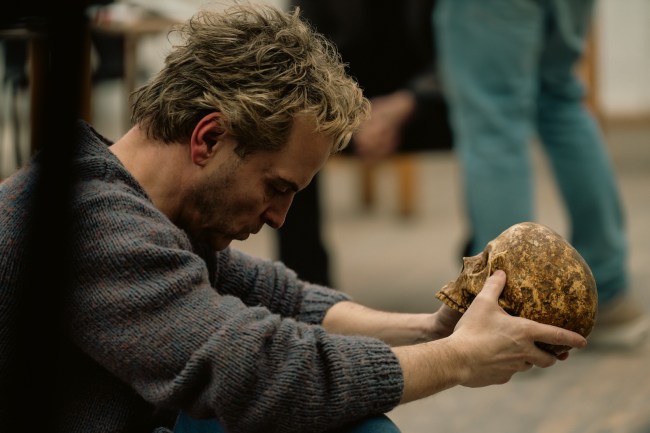
There’s no question Andrew Scott, the 49-year-old Irish actor, has earned his position as one of the finest contemporary actors going. He’s in demand, but choosing wisely, and in roles that slyly play off his own status as an out gay man (a rare thing indeed) but with something off-center beneath, often a secret. He played Tom Ripley, one even more sociopathic than Matt Damon’s own iconically calculating Adonis, to devastating effect in the sinister Netflix series “Ripley,” there more explicitly grappling with the Patricia Highsmith character’s ambiguous (but was it?) sexuality. He played the Hot Priest who turned down a chance at heterosexual, secular love in “Fleabag,” of course, and starred in “All of Us Strangers” as a lonely adult orphan living in a glittering tower, bracing himself for romantic intimacy with Paul Mescal. I also saw him playing up to nine roles in Anton Chekhov’s “Vanya” onstage in New York City last year as men and women of all sorts, showing an actor who can shimmy between genders and across ranges. He has the unmistakable warmth of someone you should trust, but with intrigue behind the curtain of many of his performances to suggest that maybe you shouldn’t. He’s that good. Scott has now taken on what will, to this point, I suppose, go down as “the role of a lifetime” in director Simon Stone’s rueful, pained, and unremarkable new film drama “Elsinore” as Scottish actor Ian Charleson, who died of HIV/AIDS complications while portraying Hamlet at the National Theatre in London in 1990. Charleson’s story is unlikely to be one most are familiar with. Even the most public of deaths among the most publicly gay of people often still remain in hiding, though Charleson wasn’t out himself. He resisted pressures from his inner circle to announce his disease amid a stage run that miraculously lasted 24 performances. Actors then were afraid of damaging their reputations. It’s not that different now, even as many advancements have made HIV/AIDS feel locally like a plague of the past. A blond-headed Scott throws himself valiantly into the role of Charleson with the urgency and commitment of any of his best work, but the problem isn’t his: It’s that the movie surrounding him dulls the greatness of his performance with its conventional storytelling, and over-complication in post. “Elsinore” is one of those movies where you can feel the filmmaker — here, Stone, known for both stage and screen — actively laboring to “open up the play” with the opportunities of film. But “Elsinore” was never a play. Instead, it’s a movie where every emotional beat worth lingering on, especially Charleson’s swan-song performances as Hamlet, is churned into a frenzied montage of editing that won’t let the material take a breath. Or the audience sink in. Charleson played an Olympian athlete in the Best Picture-winning 1981 film “Chariots of Fire,” and an Anglican priest in the next year’s Best Picture topper, “Gandhi.” That was after playing an outré bisexual in the 1978 film “Jubilee,” directed by his former lover, the very openly gay director Derek Jarman, who died of AIDS in 1994. Aside from a handful of film credits, including one alluded to in “Elsinore” as Dario Argento’s giallo “Opera,” Charleson otherwise kept to the stage. Scott’s Charleson at one point in this film opines about how much more satisfying stage work is for an actor without an editor there to chop you up to pieces. Stone, working from a screenplay by Stephen Beresford (himself a playwright), does not follow his protagonist’s lead. Every thoughtful consideration of Kaposi’s sarcoma lesions, or the retching of blood into buckets under the care of dutiful practitioner Dr. Margaret Johnson (Olivia Colman) to show the terrible realities of the disease, is whipped into what feels like a feature-length series of jump cuts. The best scenes out of the “Hamlet” production detailed here are tossed into a rushed montage near the movie’s end that gives us no sense of what we are promised is a performance of enormity. (The play in 1990 was directed by Richard Eyre, later the filmmaker behind features like the campy diva battle “Notes on a Scandal.” He’s played in “Elsinore” by Johnny Flynn.) A couple of things are going on: “Elsinore” triggers in a watchful gay viewer’s senses the signifiers of what would be the AIDS awards-bait movie of serious gravitas. Tom Hanks’ Oscar-winning performance in “Philadelphia.” Ed Harris in “The Hours.” Everyone who came out of the cringey “Dallas Buyers Club” with Academy Awards in 2014. There are others, though more lost to time. We become suspicious of this device, especially when paired with great acting. Is HIV/AIDS being exploited in the package of a would-be Oscar hit? Or are we showing young queer audiences how it was, how we got to where we are, and how where that is still isn’t perfect? It can be both, but the structure of “Elsinore” tips toward the former. Then, there’s a veritable, cheeky who’s-who of British gay literati and luminaries lingering about “Elsinore’s” 1989 London milieu that’s irresistible in theory, but often drab in execution. There’s Eyre, of course, and Jarman (David Dawson, as excellent and tender and wounded here as he was in his screen breakthrough “My Policeman”). The afterburn of his relationship with Charleson lingers affectingly, though. After some drinks, he invites Charleson home, but they instead part with one of those tacit kisses shared by people who once loved each other but can’t make it work anymore. There’s too much history here. The lingering scorches of Charleson’s secret affairs and friendships with various (and out) men make for the best parts of “Elsinore,” but there’s no life to the telling. (Joe Locke plays a young man also ailing in Johnson’s AIDS clinic alongside Charleson.) The pallid grayness of Mike Eley’s cinematography is probably supposed to mimic the finality of HIV/AIDS taking hold, but there’s no passion aesthetically to counterbalance what becomes absolute misery onscreen to watch. I’m not in the business of comparing one gay social drama to another, but Robin Campillo’s 2017 Cannes-winning French drama “Beats Per Minute” imbued an albeit more activist-oriented story of ACT UP fighting against AIDS suppression in Paris with such heat and spectacle. Watching someone die of AIDS in a room becomes a bore unless anyone is given a reason to keep on living. That reason is, of course, supposed to be Charleson’s performance in “Hamlet,” which is relegated to a whirlwind sequence at the movie’s end after many pained rehearsals where he refused to drop out (and where Johnson encouraged him to). Scott has a mesmerizing hold on his scenes, and he’s compelling to watch in his repartee with Colman as Johnson, who treated the disease at a time when it was most stigmatized. She named her groundbreaking HIV testing clinic after him; that’s how much he impacted her. We are told how much Charleson mattered to people, but never shown it. Which unfortunately shuffles off “Elsinore,” named after the Danish town where “Hamlet” was set and where its main character died, off to the realm of HIV/AIDS movies seeking prestige over deep feeling. Grade: C “Elsinore” premiered at the 2026 Telluride Film Festival. Focus Features releases it starting November 20.
‘Elsinore’ Review: Andrew Scott’s Towering Performance as a Dying Actor Can’t Overcome AIDS-Movie Awards Bait Clichés
Full Article
Original Source
Read the full article at Indiewire →KhanList aggregates and links to publicly available news content. We do not host full articles from third-party sources. Always verify important information with original sources.