
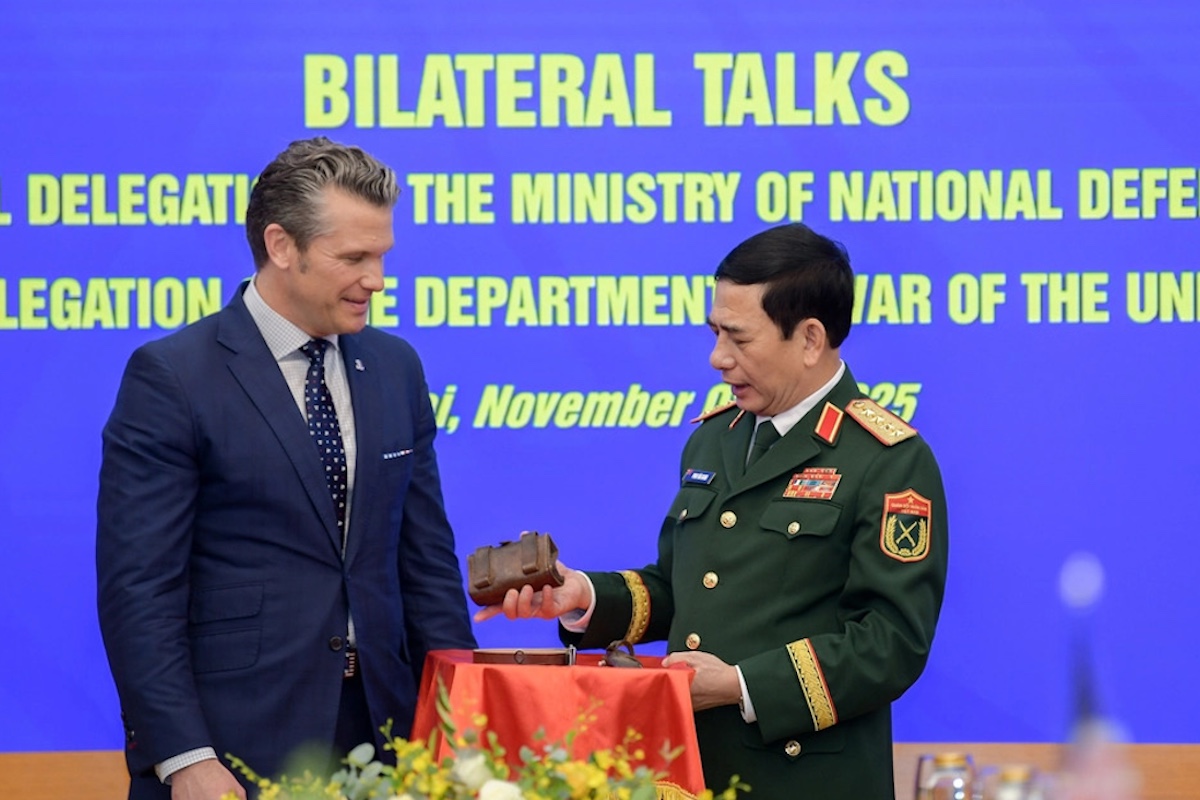
The June 2026 defense dialogues in Hanoi — underscored by the concurrent deployment of US Navy and Army cooperation missions to Central Vietnam — signal that the US-Vietnam security dynamic has transcended symbolic diplomacy. What began as careful tactical engagement is now a vital anchor for regional stability under the Comprehensive Strategic Partnership. Yet as the Ministry of National Defense accelerates preparations for the Third Vietnam International Defense Expo in Hanoi this December, policymakers in both capitals should answer a key question: how do we translate this political momentum into durable, structured capabilities? Real partnerships survive on an ongoing capacity to adapt, demanding Hanoi and Washington to broaden their defense architecture while respecting the strategic boundaries that define Vietnam’s foreign policy. Doing so requires anchoring the future in the exceptional trust capital born of war legacy remediation. Over the past decades, sweeping joint initiatives — from the Bien Hoa dioxin cleanup to unexploded ordnance clearance in provinces like Quang Tri — have served as the bedrock of the relationship. This cooperation is reciprocal. Vietnam’s decades-long dedication to accounting for missing US personnel is met by expanded Washington assistance in deploying advanced DNA analysis to identify fallen Vietnamese soldiers. As this historic post-war reconciliation nears completion, it should no longer be treated as a standalone achievement and instead be leveraged as a launchpad for modern security cooperation. To catalyze this next strategic phase, Washington and Hanoi should prioritize four decisive steps. First, they should deepen maritime security and domain awareness. The volatile security environment in the East Sea demands that maritime cooperation transcend basic hardware handovers. While past transfers of Hamilton-class cutters enhanced patrolling, the priority should shift toward real-time intelligence integration and secure, shared data networks. Elevating Hanoi’s capacity to counter gray-zone threats and monitor its exclusive economic zone secures Vietnamese waters and empowers the Vietnam Coast Guard to act as a resilient provider of humanitarian assistance, disaster relief, and search-and-rescue operations across critical international sea lanes. Second, Washington and Hanoi should catalyze defense industry cooperation and tech transfer via supply chain integration and statutory reform. December’s Defense Expo in Hanoi provides the prime catalyst for US defense firms to pivot from a traditional vendor-purchaser model toward genuine industrial partnerships. Establishing maintenance, repair, and overhaul facilities on Vietnamese soil and co-producing dual-use technologies will accelerate Vietnam’s goal of forging a self-reliant defense industry. Realizing this vision, however, requires Washington to dismantle lingering bureaucratic impediments, most notably by streamlining International Traffic in Arms Regulations export controls and creating flexible statutory waivers under the Countering America’s Adversaries Through Sanctions Act for legacy Russian hardware transitions, alongside a reevaluation of Vietnam’s market economy status and the relaxation of outdated export controls. Crucially, such co-development unlocks a vital bilateral loop: US technology expands local capabilities, while Hanoi helps Washington secure and diversify critical technology supply chains through its expanding semiconductor and critical mineral sectors. Third, Washington and Hanoi should engage regional actors and anchor their cooperation within multilateral frameworks. Bilateral defense ties are most resilient when they reinforce, rather than bypass, regional architecture. Consequently, US-Vietnam defense initiatives should lock step with mechanisms from the Association of Southeast Asian Nations (ASEAN), particularly the Defense Ministers’ Meeting Plus. At the same time, Washington and Hanoi should harmonize capacity-building efforts with shared regional partners like Japan and Australia. Focusing on functional coordination — such as joint coast guard training and maritime law enforcement seminars — advances a free, open, and lawful Indo-Pacific without forcing rigid bloc politics or feeding zero-sum rivalries with Beijing. Fourth, Washington and Hanoi should invest in next-generation thinkers and doers to ensure institutional continuity. Because strategic partnerships live and die by human networks, both capitals should insulate the relationship. Doing so means formalizing strategic dialogues designed for rising scholars and young military officers. Furthermore, both capitals should scale up joint training and logistical funding for United Nations Peacekeeping Operations, an area where Vietnam’s recently enacted Law on Participation in UN Peacekeeping Operations underscores Hanoi’s desire to act as a responsible global security contributor outside the friction of major-power rivalries. Concurrently, expanding military education exchanges—such as sending more Vietnamese officers to US staff colleges—and building joint research pipelines for emerging tech talent will forge the resilient institutional tissue required to sustain cooperation over the long term. This multifaceted expansion of defense cooperation is aligned with Vietnam’s independent foreign policy. Adhering to the sovereign “Four No’s” doctrine—which rules out military alliances, backing one country against another, hosting foreign bases, or using force in international relations—is not a barrier to engagement. Rather, it is what makes the relationship sustainable. Diversifying defense procurement, securing high-tech supply chains, and cultivating a capable generation of strategic thinkers strengthens Vietnam’s strategic autonomy. A robust, self-reliant, and prosperous Vietnam is in the US national interest, as Washington reaffirms continuously. The evolution of the US-Vietnam relationship demonstrates that former adversaries can anchor a profound peace when guided by mutual respect and aligned interests. By implementing these structural, regional, and generational recommendations, Washington and Hanoi will ensure that their shared strategic horizon remains anchored in mutual trust, industrial resilience and enduring stability. David Santoro is president and CEO of the Hawaii-based Pacific Forum, which runs the annual Honolulu Defense Forum (HDF), an event that facilitates dialogue between public and private-sector actors to advance regional stability and cooperation across the Indo-Pacific.
Elevating US-Vietnam defense ties for regional stability
Full Article
Original Source
Read the full article at Asiatimes →KhanList aggregates and links to publicly available news content. We do not host full articles from third-party sources. Always verify important information with original sources.