
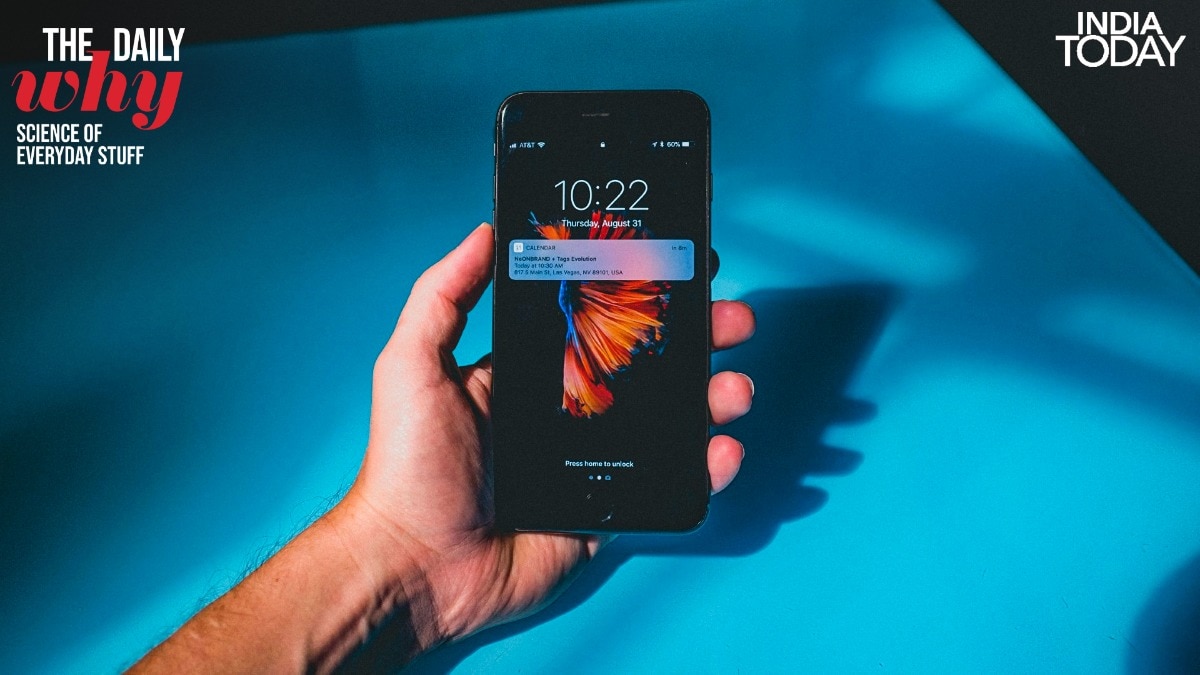
Time makes no sound. It leaves no footprints and asks for no attention. Yet every morning, more than a billion screens across India wake up and agree on it, to the very second.Your phone says 12:35 pm. So does your laptop, the departure board at the railway station, the bank’s server and a friend’s phone in another city. No hand set them. No one compared them. And still, they never disagree.That quiet harmony begins in a cool, hushed room in New Delhi. There, atomic clocks stand in rows like sentinels, counting the trembling of atoms billions of times every second, and keeping a nation in step.WHY DO ALL PHONES SHOW THE SAME TIME?Every phone and laptop compares its clock with a more reliable clock elsewhere, and corrects itself automatically. Those reliable clocks, in turn, trace their time back to atomic clocks. In India, the keeper of official time is the CSIR National Physical Laboratory (NPL) in New Delhi. Indian Standard Time (IST) is simply world time, called Coordinated Universal Time (UTC), plus five hours and 30 minutes. NPL generates India's version of it.WHO DECIDES INDIAN STANDARD TIME?NPL does. Inside its clock room sit hydrogen masers and caesium clocks, two kinds of atomic clock, all compared with one another every second. Software then blends their readings into a single, steady time for the country. Indian Standard Time is world time plus five hours and 30 minutes, generated by CSIR-NPL in New Delhi. (Photo: Radifah Kabir/India Today) Why so many clocks? No two clocks tick exactly alike. Hydrogen masers are remarkably steady over minutes, while caesium clocks stay reliable over weeks. Together, they cover each other's weaknesses. If one clock starts misbehaving, it is quietly left out, and the rest carry on.HOW DOES AN ATOMIC CLOCK WORK?Every clock needs something that beats at a steady rhythm. "Any clock has an oscillator at its heart," Dr Poonam Arora, Scientist G at CSIR-NPL, and Head of the Time & Frequency Metrology Division, told India Today Digital. An oscillator is anything that repeats a motion at a steady pace, like a swinging pendulum, a vibrating quartz crystal in your watch, or even the spinning Earth.An atomic clock uses atoms as its pendulum. A caesium atom responds to one exact frequency of microwaves, and that frequency never changes. When it has vibrated 9,192,631,770 times, exactly one second has passed. That is how the world has defined the second since 1967.The clock then turns this into a single electrical tick, sent out once every second, which every other machine in the lab follows.Strangely, scientists do not measure time itself. "We cannot measure time. We can only measure time intervals," Dr Bharath Vattikonda, Principal Scientist (Scientist E) in the Time and Frequency Standards / Indian Standard Time (IST) Division at CSIR-NPL, told India Today Digital. Nobody knows when time began, so what we measure precisely is the gap between one moment and the next.HOW ACCURATE IS INDIAN STANDARD TIME?The Indian Standard Time is astonishingly accurate. Every day, NPL compares India's time with world time using satellites, and sends the results to the International Bureau of Weights and Measures (BIPM) near Paris, which keeps world time.For about five years, India's time has stayed within plus or minus three nanoseconds of world time, Dr Vattikonda said. A nanosecond is a billionth of a second. In three nanoseconds, light travels less than a metre.HOW DOES YOUR PHONE GET THE CORRECT TIME?Your phone usually takes its time from your mobile network. Telecom companies, in turn, often rely on satellite signals for their timing, and NPL is working with them to synchronise their networks to Indian time.Laptops and computers, meanwhile, ask for the time over the internet using the Network Time Protocol (NTP), a simple system that lets a computer check the time with a server. It is accurate to thousandths of a second. India's time has stayed within three nanoseconds of world time for about five years. (Representative image: Unsplash) NPL runs about 20 such time servers, and each can answer 10,000 requests every second. The exact traffic is kept confidential, because the system is treated as critical national infrastructure.But there is plenty of room to spare. "We are at maybe less than 20 per cent of the load," Dr Vattikonda said.HOW TO SYNC YOUR LAPTOP WITH INDIAN STANDARD TIME?Most Windows laptops take their time from Microsoft's server by default, but you can switch to India's own clock in about a minute. As NPL's official guide explains, right-click the clock on your taskbar and open the date and time settings.Under the Internet Time tab, choose to change the settings, replace the server name with time.nplindia.org, and click Update Now. From then on, your laptop will set its clock by the atomic clocks in New Delhi. On office laptops managed by an IT team, this option may be hidden, as the time is set by the company’s own server.WHAT ARE THE NEW INDIAN STANDARD TIME RULES?This matters more than ever. On August 27, the government notified the Legal Metrology (Indian Standard Time) Rules, 2026, part of the One Nation One Time initiative. They take effect 180 days after publication.Under the rules, government offices, telecom companies, banks, power grids and data centres must set their systems by IST, using authorised sources traceable to NPL. Critical sectors must also keep backup timing systems.The reason is simple. When banks, trains and power grids run on slightly different clocks, transactions clash, records disagree and faults become harder to trace.So the next time your phone and laptop agree to the second, remember the hum of atomic clocks in a Delhi lab, quietly keeping the nation on time.- Ends
Why do your phones and laptops show the same time? The answer ticks in a Delhi lab
Full Article
Original Source
Read the full article at Indiatoday →KhanList aggregates and links to publicly available news content. We do not host full articles from third-party sources. Always verify important information with original sources.