
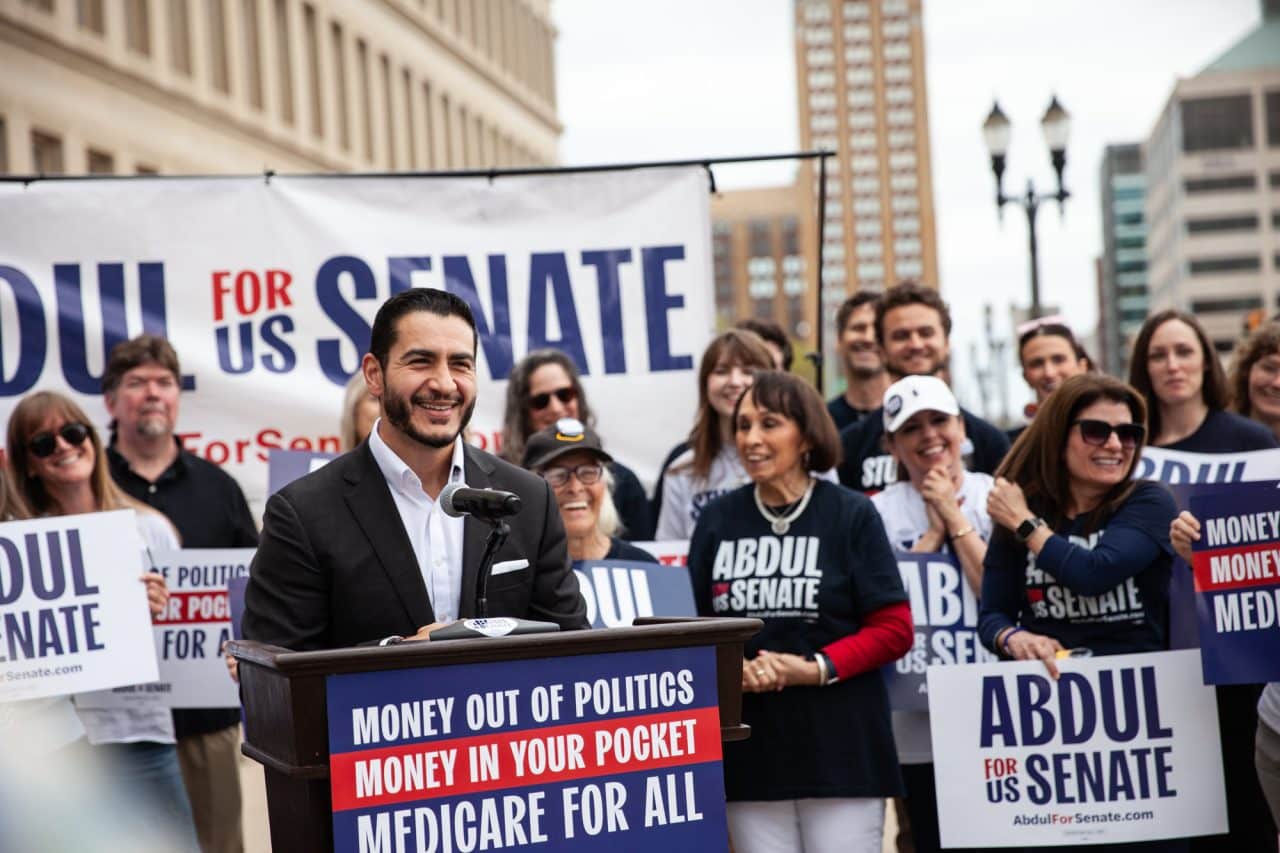
Democrat Abdul El-Sayed’s victory over GOP candidate Mike Rogers laid waste to a dubious media narrative that dominated the Michigan Senate race. The story was that El-Sayed’s candidacy had “divided” the Democratic Party because he’s a critic of the U.S./Israel military relationship. In the weeks leading up to the election, the mainstream press ran multiple pieces on the topic, nearly all following a similar formula. A couple of local pro-Israel Democrats were quoted; the public trepidation of a pro-Israel local lawmaker was cited; El-Sayed’s connection to left-wing Twitch streamer Hasan Piker was referenced; and declarations of disarray were made. “Democrats are still struggling to unite behind El-Sayed after the primary exposed deep disagreements over Israel,” claimed one PBS article. A cursory look at the data quickly reveals that, insofar as such disagreements exist, they certainly aren’t deep, as El-Sayed’s position on Israel is consistent with the vast majority of Democratic voters. A March 2026 Pew Research Center poll found that 80 percent of Democrats and Democratic-leaning independents have a negative view of Israel, up from 69 percent in 2025 and 53 percent in 2022. Days before the election, a Marist poll found that despite claims of a split party, 95% of Michigan Democrats planned to vote for El-Sayed. In the end, only 4% of Democrats voted for Rogers. 5% of Michigan Republicans actually voted for El-Sayed, but you’d be hard-pressed to find a single article imagining that the Republican Party was “divided” in Michigan. The phony narrative around El-Sayed may have died, but the assumptions that fueled it remain. As a Muslim of Arab descent, his criticisms of Israel are viewed as more suspicious than those of the average progressive, with a frequent implication in the media that they may point to deep-rooted antisemitism. In an appearance on MS Now, the morning after the election, Morning Joe co-anchor Willie Geist asked El-Sayed what he would do to protect Jewish voters who might be uneasy about his views. “I’m committed to Jewish safety, and we are united against discrimination,” explained El-Sayed in his response. “The U.S. spends billions to carry out genocide and apartheid against Palestinians. The genocide in Gaza with our complicity is continuing right now. Nobody wants to talk about that.” El-Sayed’s answer went viral, and he was commended across social media for it, but the original question was curious, given that he had consistently said as much on the campaign trail. The Geist question also came after the anchor had pressed El-Sayed on why he supports cutting off military aid to Israel, thus equating continued support for the country with the issue of Jewish safety. El-Sayed faced a similar line of questioning on The View, where co-host Sara Haines took him to task for comments he made about the March 2026 attack on a Michigan synagogue. El-Sayed had immediately condemned the attack, while pointing out that multiple members of the assailant’s family had been killed in an Israeli airstrike on Lebanon. “Hurt people hurt people,” said the Senator-elect. In response to backlash over the comment, El-Sayed apologized, but this wasn’t enough for Haines, who somehow connected the remarks to his religion. “Do you think that leaders have a responsibility to challenge the extremist views in their own religion, especially considering you’re the first Muslim senator of the United States?” she asked. After Democrat James Talarico was declared the winner of the Texas Senate race, CNN asked him whether he would “stand up” to members of his party like El-Sayed. Why is El-Sayed, who just prevailed in a swing state running on a program of affordability and health care access, being grilled on Jewish safety, called out over the actions of “extremist” Muslims, and allegedly posing such a threat to the country that fellow members of his party must stand up to him? The media’s pro-Israel bias is undoubtedly a factor here, but it’s also important to remember that El-Sayed’s primary win over Haley Stevens triggered a wave of Islamophobia across social media. One Washington Post study found that almost 1 in 3 posts about El-Sayed from right-wing figures mentioned Islam, Muslims, or Sharia Law within two weeks of his August victory. In a recent Zeteo piece, reporter Prem Thakker points out that these two media threads are very much connected and that El-Sayed is being held to a different set of rules than his colleagues. “We are seeing a type of double, perhaps even triple, standard that is genuinely devoid of any logic or sensibility, other than the media’s final attempts to harden the conflation of Israel with Jewish people, and discipline the ascendant left by any means necessary,” Thakker writes. Back in reality, a supermajority of Jewish Americans now believe that AIPAC and Israel are increasing antisemitism in the United States. When Hasan Piker made the same claim, he was denounced by many as a dangerous antisemite whom El-Sayed needed to denounce in order to have any chance of winning. That analysis turned out to be wildly off, but such setbacks haven’t shifted the mainstream media’s coverage of the first Muslim U.S. Senator.
El-Sayed coverage shows how the media is out of step with the public on Israel
Full Article
Original Source
Read the full article at Mondoweiss →KhanList aggregates and links to publicly available news content. We do not host full articles from third-party sources. Always verify important information with original sources.