
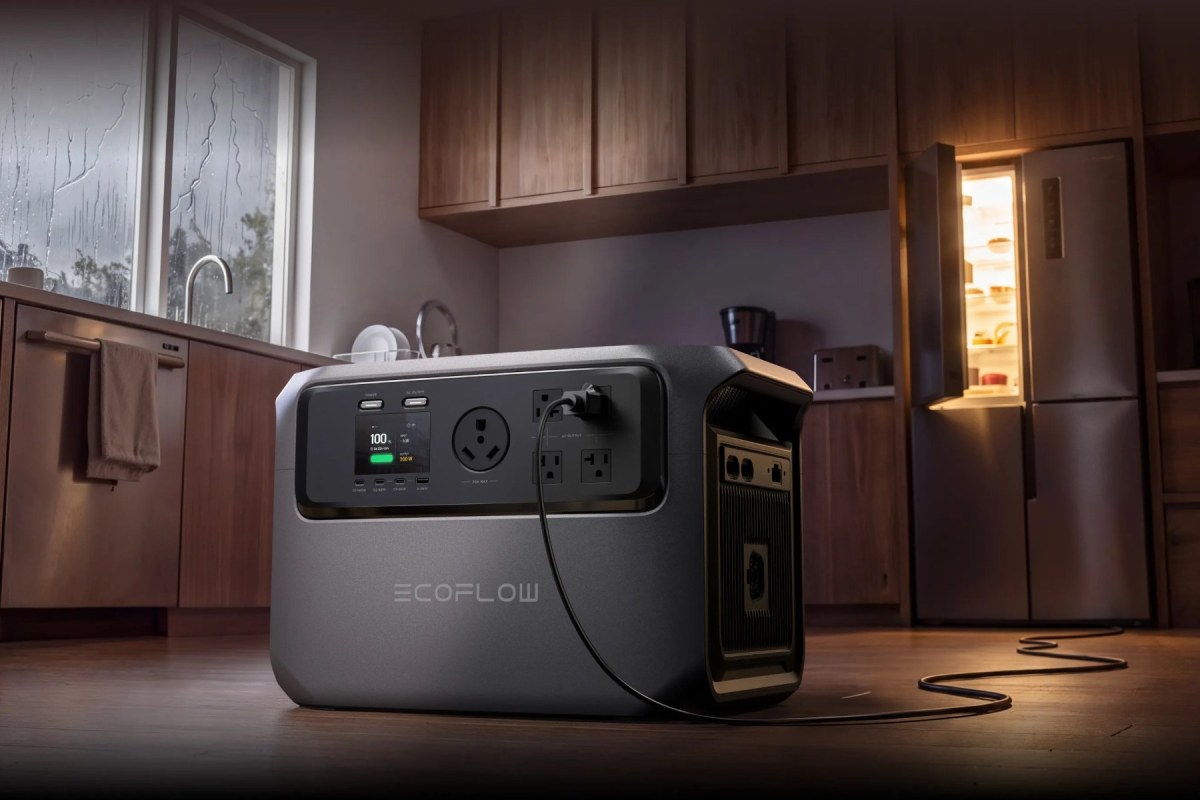
EF EcoFlow We may earn revenue from the products available on this page and participate in affiliate programs. Learn more › If you’ve ever driven with white knuckles to a gas station while your car’s range read “0 miles,” you’ll appreciate a new feature on this portable power station. EcoFlow is building a similar cushion into its new DELTA Gen4 portable power stations. A feature called Emergency Power Mode holds back a small reserve for charging phones after the screen hits 0 percent. Two models are on sale today through EcoFlow’s website: the DELTA 3000 Gen4 at an early-bird $1,299 and the DELTA 3800 Gen4 at $1,699, against list prices of $1,699 and $2,199. Both put out 3,600 watts in chassis EcoFlow says are smaller and lighter than its DELTA 3 Ultra models, which include the DELTA 3 Ultra Plus we tried last year. They arrive a month after EcoFlow’s TITAN home batteries targeted whole-home backup. Why the DELTA Gen4’s idle draw matters in a long outage A router and a lamp barely register, but the inverter’s own draw adds up over a long outage. EcoFlow EF EcoFlow A power station spends some charge just keeping its inverter awake. EcoFlow rates both DELTA Gen4 models at 14 watts with the AC outlets switched on and nothing plugged in, and 3 watts in standby. At 14 watts, a full day of idling uses 336 watt-hours, about 11 percent of the DELTA 3000 Gen4’s 3,072Wh battery. The 3-watt standby number is what lets EcoFlow claim a fully charged DELTA 3800 Gen4 can sit for about 52 days before it drains, which matters for one parked in a closet waiting for an outage. EcoFlow pairs the lower overhead with a mode called Fridge Runtime Boost and rates the DELTA 3000 Gen4 for up to 58 hours of refrigerator runtime. The DELTA 3800 Gen4 gets more than 70 hours. Those fridge numbers come from EcoFlow’s own tests with an empty 654-liter Samsung refrigerator, and the company notes that food load, room temperature, and door openings all change the result. The mode also supports one compressor-based appliance, such as a fridge or freezer, at a time, and EcoFlow says not to run other AC loads alongside it. We haven’t tested either DELTA Gen4 model yet, so these performance figures are EcoFlow’s. Emergency Power Mode covers what’s left after the battery runs down. You turn it on from the unit or the EcoFlow app, and EcoFlow says the reserve can give an iPhone 17 nearly a full extra charge. 3,600 watts in a smaller DELTA chassis EcoFlow staged the DELTA 3800 Gen4 in front of three bigger boxes to make its size point. EcoFlow EF EcoFlow Both DELTA Gen4 models share a 16.8 x 11.4-inch footprint, and both are rated for 3,600 watts continuous and 7,200 watts of surge from their 120V outlets. That’s enough to run a 1,500-watt space heater and a refrigerator at the same time with room to spare. EcoFlow’s original DELTA Pro weighed about 99 pounds to hit the same 3,600-watt rating. The DELTA 3800 Gen4 fits 691 extra watt-hours and about 10 more pounds into the same footprint, for 3,763Wh at 67.5 pounds. EcoFlow says that’s roughly 33 pounds lighter than the DELTA Pro, and it holds slightly more energy. The DELTA 3000 Gen4 holds 3,072Wh at 57.3 pounds, and EcoFlow puts it at about 20 percent lighter than the DELTA 3 Ultra, with the same capacity. The bigger model also has more ways to grow. The DELTA 3800 Gen4 takes up to 2,000 watts of solar across two inputs and has an expansion port for up to two extra batteries, including the DELTA Pro 3 Smart Extra Battery, for about 12kWh total. The DELTA 3000 Gen4 has one 1,000-watt solar input, and its spec sheet lists no battery port. EcoFlow says the DELTA 3000 Gen4 refills from a wall outlet in under two hours and the DELTA 3800 Gen4 in under 2.5 hours. The 3kWh, 3,600-watt class is crowded, with Anker’s SOLIX F3000 and Jackery’s Explorer 3000 v2 at the same capacity and output. Our guide to the best portable power stations covers the field. DELTA 3000 Gen4 and DELTA 3800 Gen4 prices and shipping The DELTA 3000 Gen4 and DELTA 3800 Gen4 are listed for preorder. As of November 4, EcoFlow shows the DELTA 3800 Gen4 shipping in late November and the DELTA 3000 Gen4 in early December. EcoFlow’s early-bird pricing runs through December 7. That puts the DELTA 3800 Gen4 at $1,699, 23 percent off its $2,199 list, and the DELTA 3000 Gen4 at $1,299, which is $400 below its $1,699 list. EcoFlow DELTA 3000 Gen4 $1,299 EcoFlow DELTA 3000 Gen4 $1,299 See It For a house that needs a fridge, a router, and a few lamps through a weekend outage, this is the DELTA to look at first. It has the same 3,600-watt output as its bigger sibling and weighs about 10 pounds less. The savings come out of expandability, since it gets one 1,000-watt solar input, four charging methods, and no listed battery expansion. Capacity: 3,072Wh lithium iron phosphate (LFP) Output: 3,600W continuous, 7,200W surge (120V) Weight: 57.3 lb Self-consumption: 14W with AC on, 3W standby (EcoFlow rating) Fridge runtime: Up to 58 hours (EcoFlow test, empty refrigerator) Solar input: 1,000W, one input Outlets: Five AC (one 30A), three USB-C up to 140W, one USB-A Cycle life: 6,000 cycles to 70% capacity (EcoFlow rating) Warranty: 3 years, 5 with app registration EcoFlow DELTA 3800 Gen4 $1,699 EcoFlow DELTA 3800 Gen4 $1,699 See It At early-bird prices, $400 more buys 691 extra watt-hours, a second 1,000-watt solar input, and an expansion port that takes the system to about 12kWh with add-on batteries. That port is the reason to step up if you plan to expand a home-backup system later. EcoFlow rates it for more than 70 hours on a refrigerator and lists six ways to charge it. Capacity: 3,763Wh lithium iron phosphate (LFP), expandable to about 12kWh Output: 3,600W continuous, 7,200W surge (120V) Weight: 67.5 lb Self-consumption: 14W with AC on, 3W standby (EcoFlow rating) Fridge runtime: 70+ hours (EcoFlow test, empty refrigerator) Solar input: 2,000W across two inputs Outlets: Five AC (one 30A), three USB-C up to 140W, one USB-A Cycle life: 6,000 cycles to 70% capacity (EcoFlow rating) Warranty: 3 years, 5 with app registration 2026 Popular Science Home of the Future Awards 39 products that will improve your everyday life.
EcoFlow’s new DELTA Gen4 portable power stations keep a reserve of extra power for emergencies
Full Article
Original Source
Read the full article at Popsci →KhanList aggregates and links to publicly available news content. We do not host full articles from third-party sources. Always verify important information with original sources.