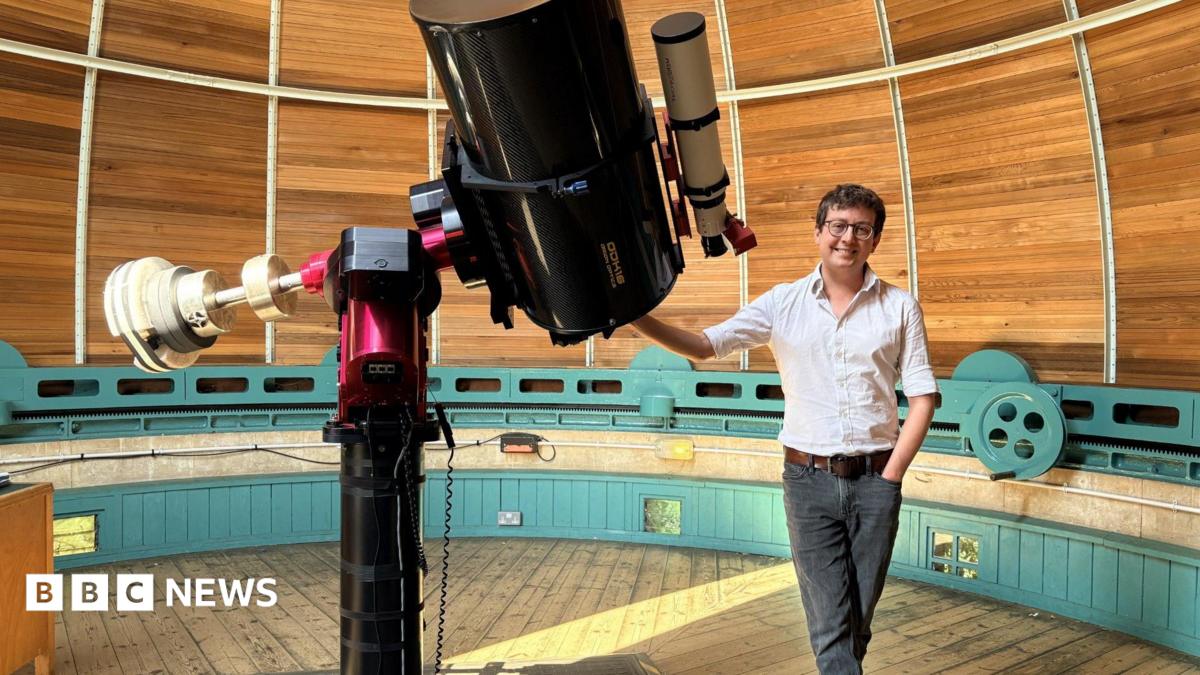
East's astronomers plan for solar eclipseImage source, MATT BOTHWELLImage caption, Dr Matt Bothwell plans to experience the solar eclipse from northern Spain ByJoanna Taylor and Katy PrickettCambridge has been facing an "astronomer exodus" this summer as they have travelled abroad to see Wednesday evening's total solar eclipse, according to an astrophysicist.Dr Matt Bothwell, from Cambridge University's Institute of Astronomy, is among many stargazers heading to northern Spain, which is due to experience the full blackout on Wednesday evening.Meanwhile, Jonathan Clough, vice chairman of the Cambridge Astronomical Association, is heading north on a cruise to the Faroe Islands in the hope of seeing the total eclipse, the Northern Lights and the Perseid meteor shower all at once.Watch parties take place across the East of England, which will experience a partial eclipse, but one which will have the greatest coverage of the Sun since 1999. Image source, Lyndsay SmithImage caption, More than 90% of the Sun will be covered when seen from Northamptonshire, but it is still incredibly dangerous to look at it without eye protection, warned AstonAston is hosting a watch party for many of his neighbours in a dark corner of his housing estate in Northampton.The 14-year-old is a junior ambassador for the charity UK Astronomy, to which he donates the proceeds from his book All About Space."I'm going to take two telescopes, some equipment and offer experiences for all ages. UK Astronomy has donated loads of solar glasses," he said. While he has seen three previous eclipses "every single one is different, especially this one as it is the biggest solar eclipse to hit the UK until 2090," he added."And just after the sun sets, the Perseid meteor shower will peak and the sky will be incredibly dark with 50 to 100 meteors every hour."Where can you watch it?Members of Peterborough Astronomical Society will be watching from Ferry Meadows country park.Luton Astronomical Society has an event taking place at Stopsley Common in Bedfordshire and the Bedford Astronomical Society is hosting another at the Piazzi Smyth Observatory at Bedford School.West Stow Country Park in Suffolk will be hosting a pre-booked eclipse event from 17:45, while Dash Astronomical Society has moved its planned event at fire-hit Dunwich Heath to nearby Darsham Village Hall.In Essex, people can watch the partial eclipse from Southend-on-Sea pier, Munnings Museum in Dedham hosts an event and Loughton Astronomical Society is holding another at Theydon Bois village green.North Norfolk Astronomy Society will have special solar telescopes on site at Binham Village Hall, near Fakenham, for its watch party and Ingham Village Hall has also organised a viewing event.The Lumo housing development in Eddington, external, Cambridge, is also holding an event – although Bothwell and Clough admit there are fewer events around featuring astronomers than you might expect, because so many of them will be in Spain or Iceland where the Sun will be 100% covered.In Hertfordshire, Hertford Astronomy Group will be at Bramfield Village Hall, while in Buckinghamshire, people are invited to bring their own eclipse glasses or pinhole projector (more on this below) to the Town Hall Green in Beaconsfield.If you want to watch the total eclipse from the UK, the European Space Agency is due to livestream the event, external on YouTube.A solar eclipse happens when the Moon blocks out the Sun.The Moon is about 400 times smaller than the sun, but also about 400 times closer to the Earth, meaning they always appear the same size from Earth, and when they line up they create what Bothwell calls an "extraordinary cosmic coincidence".This means complete darkness lasting between 10 seconds and seven and a half minutes, which results in a drop in temperature on Earth and stronger winds.Stars and planets will become visible and birds may stop singing, as if it were night-time.If you are not somewhere on Earth where the Sun and Moon completely line up from your point of view, you will experience a partial solar eclipse.This will result in a slight dimming of the Sun's light and a drop in temperature. Where is it? Parts of Spain, Portugal, Iceland and Greenland will experience the total solar eclipse on Wednesday. Much of the rest of Europe, including the UK, will experience a partial solar eclipse. The best place to watch it from in England is the South West.During this eclipse, around 90% of the Sun will be covered by the Moon for people viewing it in the East of England.Bothwell said the eclipse is forecast to begin at 18:15 BST in Cambridge and will reach its peak at 19:12, before concluding at about 20:00. Depending on where you are in the UK, it will peak between 19:02 and 19:16.How and when to see the solar eclipseWhat should I do?The partial eclipse can be experienced from anywhere in the East of England, provided the skies are clear, although cloud is forecast. Both Bothwell and Clough stressed that you must avoid looking directly at the Sun with the naked eye even when it is mostly blocked, as this can cause permanent damage. Clouds and sunglasses will not prevent this and it is not always immediately obvious that the retinas have been harmed as it is not painful to look at the Sun during an eclipse.You must only look directly at the Sun if you are wearing eclipse glasses. The UK Health Security Agency recommends checking the ones you purchase meet international safety standards, external. Image source, JONATHAN CLOUGHImage caption, Jonathan Clough recommends taking a colander outside during the partial solar eclipse to create crescent-shaped sunspots There are other ways to experience the partial eclipse. Bothwell recommends standing near a tree as the eclipse can create dozens of crescent-shaped images on the ground as light shines through the gaps between the leaves — an effect similar to... ... a pinhole camera which is "cheap and easy" to make and it projects the eclipse on to a surface such as paper or cardboard.If you have not got a handy, leafy tree or a pinhole camera, Clough recommends taking a kitchen colander outside to create the same effect.Image source, Getty ImagesImage caption, If you stand under a tree and look down during the eclipse, you might see crescent-shaped images as the light shines through its leavesHow rare is it? In 1999, most of the UK experienced a partial solar eclipse, while Cornwall and Devon experienced a total solar eclipse. There was another partial eclipse in the UK on 29 March 2025.Britons will have to wait another 64 years, until 2090, to experience another complete blackout in the UK.A total eclipse occurs somewhere on Earth about once every 18 months, but the gap between them being at the same spot tends to be about 400 years.A partial eclipse happens about twice a year, to varying degrees. The upcoming eclipse will offer better coverage of the Sun than any other in the UK for the last 27 years.'Life-changing' Bothwell, who is in his 40s, said he had never seen a total eclipse as there had "never really been one remotely near in my lifetime"."It can be once in a lifetime," he said. "People who have seen totality, that experience of the Moon completely covering the Sun, say it is a genuinely life-changingly amazing experience."I can't pass up the chance to see something so exciting."Clough, meanwhile, has travelled to the Faroe Islands once before to see a solar eclipse, in 2015. But cloud coverage meant that he did not experience totality, he said. Do you have a story suggestion for Cambridgeshire? Contact us below.Get in touchRelated topicsAstronomyPeterboroughDarshamWest StowNorthamptonBedfordLutonFakenhamBinhamTheydon BoisSouthend-on-SeaHertfordCambridgeBeaconsfieldEclipsesRelated internet links
East's astronomers plan for solar eclipse
Full Article
Original Source
Read the full article at Bbc →KhanList aggregates and links to publicly available news content. We do not host full articles from third-party sources. Always verify important information with original sources.