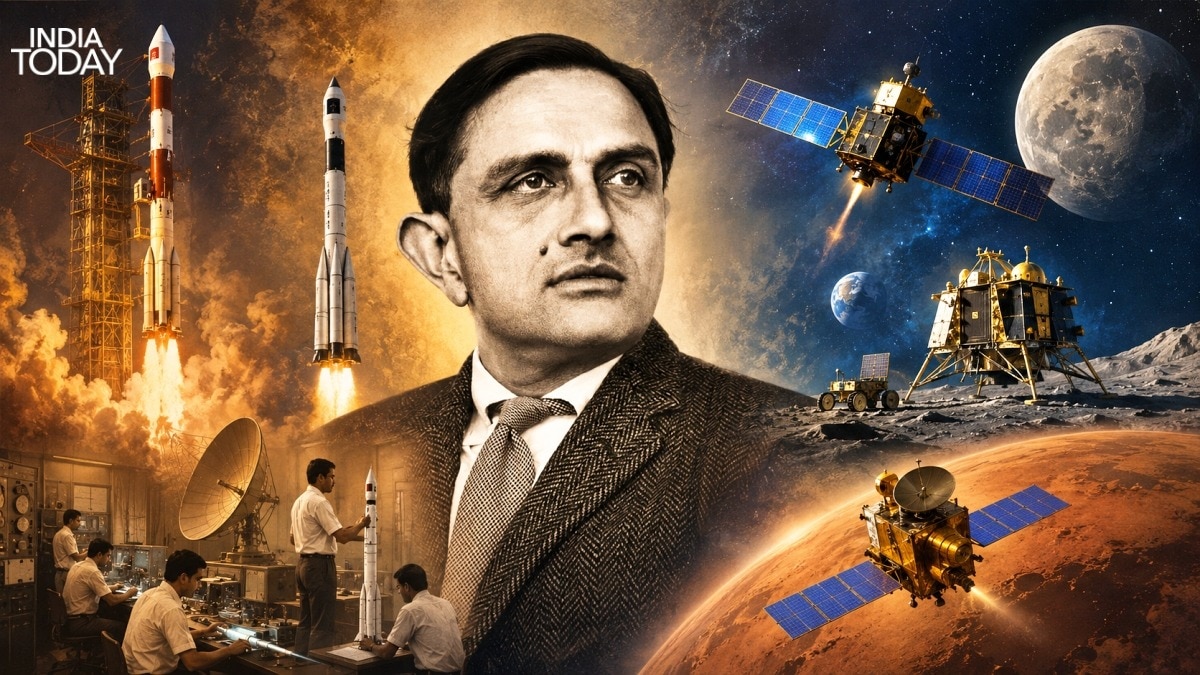
On Vikram Sarabhai's birth anniversary, his role in shaping India's space programme is back in focus. His vision placed satellites and science at the service of development, not prestige.His conversations with Nasa helped lay the groundwork for the Satellite Instructional Television Experiment (SITE). (Photo: Generative AI by India Today)What does a country struggling with poverty, food security, education and basic infrastructure need with a space programme?That was the question Vikram Sarabhai confronted in the early years of independent India. Born on August 12, 1919, in Ahmedabad, Sarabhai went on to become the founding father of India's space programme and the man who convinced the country that space technology was not a luxury, but a tool for development.Sarabhai himself acknowledged the apparent contradiction. In a speech on the value of space activity for developing countries, he noted that India was a country with extremely low per-capita income and enormous challenges involving food, clothing, housing, education and social services. Vikram Sarabhai was born on 12 August 1919 in Ahmedabad. (Photo: Isro) Yet he asked what space research could offer such a nation. His answer was radically different from the space race being pursued by the United States and Soviet Union.India did not need to compete with economically advanced nations simply to reach the Moon or send humans into space, Sarabhai argued. Instead, it needed to become “second to none” in applying advanced technologies to the real problems of people and society. That philosophy became the DNA of India's space programme.The organisation that began as INCOSPAR in 1962, under Sarabhai's vision, eventually became Isro in 1969. The programme at Thumba began with sounding rockets, but Sarabhai was already thinking much bigger: satellite communication, education, weather forecasting and management of natural resources. Vikram Sarabhai laid the foundation for India's space program. (Photo: Isro) His conversations with Nasa helped lay the groundwork for the Satellite Instructional Television Experiment (SITE), which later used satellite technology to deliver educational programming to rural India.In other words, Sarabhai did not sell India a dream of escaping Earth. He sold it a dream of using space to transform life on Earth.He died in 1971, aged just 52, long before India launched its first satellite or reached the Moon. Yet the institution he helped create continued to grow in 2026.Today, India's space programme spans communication, navigation, meteorology, Earth observation and planetary exploration.Nasa has just invited India to be part of its Moon base programme and help it steer the plans to ensure a sustained human presence on the surface of the Moon and then push on to Mars.A private company successfully launched India's first private rocket named after him, Vikram-1 to space, adding to his stellar legacy and contribition to India's space dreams.And perhaps that is Sarabhai's greatest legacy: he imagined India's space future at a time when that future barely existed, and then built the institution capable of achieving it.- EndsPublished By: Sibu Kumar TripathiPublished On: Aug 12, 2026 13:44 IST
Before India reached space, one man gave 50 million Indians a space dream
Full Article
Original Source
Read the full article at Indiatoday →KhanList aggregates and links to publicly available news content. We do not host full articles from third-party sources. Always verify important information with original sources.