
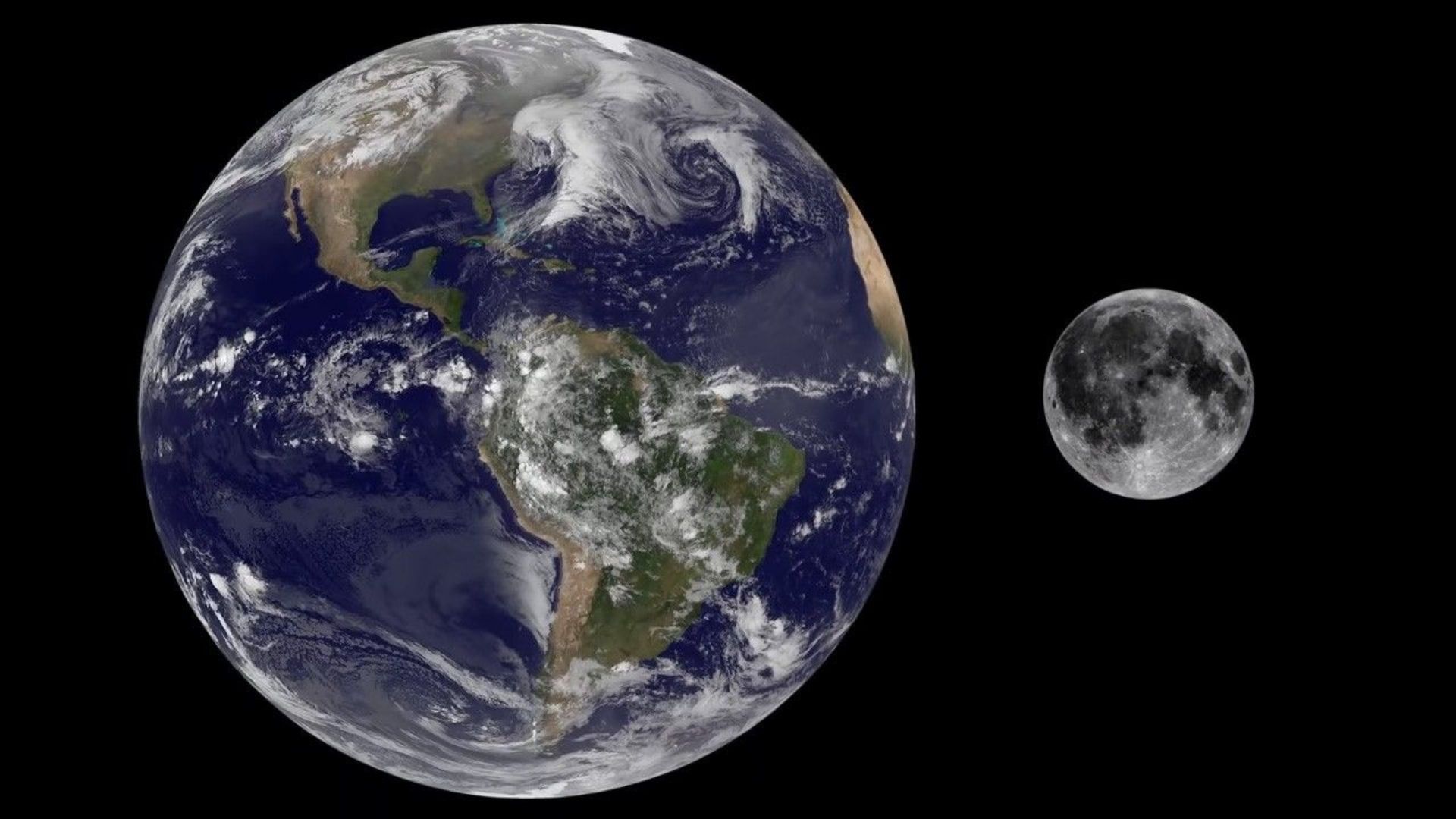
Human deep-space exploration has a brand-new, ultra-fast pipeline to home. In a new interplanetary optics development, Chinese scientists have officially bridged the 400,000-kilometer (248, 548 miles) abyss between Earth and the Moon with high-speed lasers. Reportedly, researchers at the Technology and Engineering Center for Space Utilization (CSU) under the Chinese Academy of Sciences have tested a two-way laser communication link between Earth and orbit across this vast distance. Precise beam alignment Space missions typically use microwave radio signals to dial back home. But as humanity prepares to build permanent lunar bases and send astronauts back to the moon, radio bandwidth may not serve all the needs. High-resolution observation maps, gigabytes of scientific readings, and live HD footage demand far more than standard frequencies can handle. Laser beams have shown potential to solve these issues. CSU announced that they have completed over a year of rigorous in-orbit testing. And the result is a fully operational, two-way laser network extending straight into deep space. It was anything but easy. “Earth-moon communication is like threading a needle from a thousand miles away,” Yang Lei, head of the CSU laser test team, told CGTN. At a distance of 400,000 kilometers, even a microscopic wobble from the spacecraft or a brief shimmer in Earth’s atmosphere can bounce a laser beam miles off target. To fix this, the team engineered a real-time tracking system that constantly calculates orbital movement, optical delays, and atmospheric distortion to lock the beams in place. Data transmission rates But this was not it, and then came the light problem. By the time a laser signal finishes its journey across space, it weakens to a mere whisper of light. Earth-based receivers often catch just a handful of individual photons per second amidst a chaotic wash of moonlight, starlight, and city glare. To slice through that noise, scientists deployed ultra-sensitive, superconducting single-photon detectors. Paired with high-bandwidth processing and custom noise-resistant coding, the ground stations successfully unlocked data speeds reaching 1.25 Mbps on the uplink and a blazing 100 Mbps on the downlink. Eventually, it can shrink hardware size, enhance connection security, and dramatically expand data bandwidth. As crewed lunar landings draw near, this newly forged Earth-moon “information highway” ensures that our return to the moon could be streamed in real time. China and its partners plan to build a permanent robotic and human base at the lunar south pole by the 2030s. Optical links are central to handling the massive data footprint of this project, managing the data generated by lunar habitats, high-definition mapping, and continuous scientific monitoring. Globally, optical space communication has moved from concept to reality. NASA laid the groundwork in near-Earth space with its Laser Communications Relay Demonstration (LCRD) in geostationary orbit before breaking deep-space records with the Deep Space Optical Communications (DSOC) experiment aboard the Psyche spacecraft NASA’s DSOC demonstrated peak downlink speeds up to 267 Mbps over tens of millions of kilometers to prove laser viability for future Mars missions; in contrast, China’s recent 400,000 km test establishes a dedicated, high-speed cislunar bridge.These parallel achievements usher in a new era of laser-driven space communications, moving past radio bandwidth limits to enable real-time streaming across deep space.Get the latest in engineering, tech, space & science - delivered daily to your inbox.Mrigakshi is a science journalist who enjoys writing about space exploration, biology, and technological innovations. Her work has been featured in well-known publications including Nature India, Supercluster, The Weather Channel and Astronomy magazine. If you have pitches in mind, please do not hesitate to email her.
Earth-moon space laser communication verified at 248,000-mile distance
Full Article
Original Source
Read the full article at Interestingengineering →KhanList aggregates and links to publicly available news content. We do not host full articles from third-party sources. Always verify important information with original sources.