
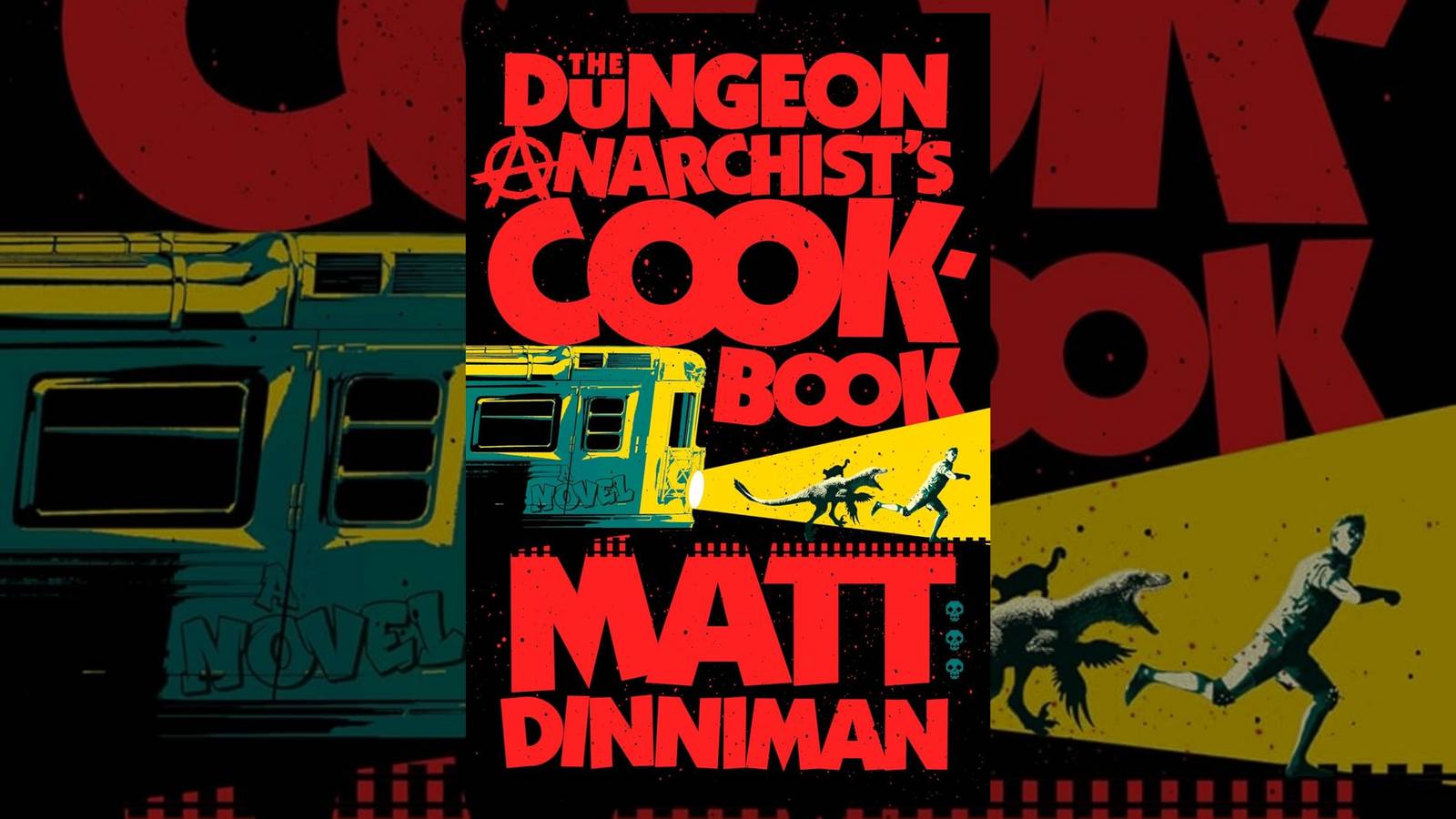
Published Nov 26, 2026, 5:00 PM EST Nicholas Becher is a gaming journalist with an MFA in Creative Writing from FAU. With extensive experience playing video games, he covers all forms of gaming content at Screen Rant, from breaking news to the latest fan theories. Most-played games range from Clair Obscur to Civ to Elden Ring to Halo 2 and beyond. Dungeon Crawler Carl starts off with a relatively simple premise, with Carl and Donut entering the World Dungeon and setting the stage for an epic adventure on an alien TV show. While the first couple books are relatively straightforward in terms of "floor mechanics," serving as tutorial floors for our beloved protagonists, by the time we reach Book 3, The Dungeon Anarchist's Cookbook, things get a little bit more complex. The Iron Tangle is often discussed as one of the more complicated floors in the World Dungeon, and rightfully so. While the premise itself isn't all that hard to grasp, it's the larger layout and structure of the floor that readers often get tripped up on. Specifically, understanding how the various trains, stations, and railway lines connect to one another can feel a bit like riding the Nightmare Express itself, especially as Carl begins to unravel the floor's underlying mechanics. However, breaking down the Iron Tangle into its fundamental components makes it much easier to understand how the floor operates, how Carl ultimately figures it out, and why it's such a pivotal chapter in Dungeon Crawler Carl. What Is The Iron Tangle In Dungeon Crawler Carl? The Iron Tangle is the fourth floor of the World Dungeon in Dungeon Crawler Carl, and it serves as the main setting of The Dungeon Anarchist's Cookbook. Unlike the traditional dungeon corridors of the first two floors or the more open-world design of the third floor, the Iron Tangle is essentially an enormous rail system designed to function as a giant, intentionally overcomplicated puzzle. Carl, Donut, Mongo, and Katia start off on the fourth floor aboard a moving subway train, with very little indication of where they're headed. The floor itself consists of an elaborate, three-dimensional network of interconnected railway lines, underground tunnels, and numbered stations. The tracks run along the walls, ceilings, and floors of the tunnels, with gravity apparently shifting depending on which surface you're closest to, making the physical layout somewhat difficult to visualize in your mind's eye. According to the book, a total of roughly 380,000 crawlers enter the Iron Tangle, and there are only 9,000 or so stairwells leading to the fifth floor. However, there's also a unique stipulation on the fourth floor, which is that crawlers cannot descend early. Crawlers are given ten days to complete the Iron Tangle, but the stairwells will only become accessible in the final six hours before the floor collapses. How The Iron Tangle Works The Iron Tangle has two main types of trains: colored subway lines, such as the Red Line and Yellow Line, and named trains, such as the Nightmare Express and Dismemberment Limited. The colored lines travel in one direction toward higher-numbered stations, while the named trains operate on more complicated looping routes and travel way faster. The stations themselves follow a specific number pattern. Prime-numbered transfer stations have saferooms, while stations numbered in multiples of five feature exit-only caverns that monsters use to move throughout the dungeon. Transfer stations ending in one feature entrances to the Desperado Club, while those ending in nine feature Club Vanquisher entrances. The colored trains originate in various trainyards designated by letters, where mind-wiped NPC employees such as Vernon perform routine maintenance and prepare trains for their next journey. Station 435 serves as the final stop for employees, while Station 436 leads to the Abyss, which is an enormous pit where trains and other wreckage are discarded. If that wasn't complicated enough, however, the stairwells leading to the fifth floor are located at Stations 12, 24, 36, 48, and 72. Every crawler enters the Iron Tangle past these stations, meaning the standard subway lines are effectively carrying them farther away from their exit. As such, crawlers have to figure out how to travel backwards through a transportation system that is basically designed to move them forward. How Carl Solves The Iron Tangle In Book 3, Carl's success in navigating the Iron Tangle really comes down to piecing together information from other crawlers, questioning NPCs and experimenting with the various trains and transportation systems to get a sense of what's going on. With Mordecai's help, Carl eventually discovers that the seemingly nonsensical layout of the Iron Tangle is apparently a scaled-down model of the galaxy itself and the Syndicate's network of wormholes. Probably the biggest breakthrough, however, is Carl's realization of how the portals that transport trains between stations and trainyards actually operate. By hijacking various pieces of railway equipment and repurposing them in ways the dungeon designers never intended, in true Carl fashion, he effectively circumvents many of the floor's established rules. Without spoiling too much of the book's incredible climax, solving the Iron Tangle ultimately becomes a collaborative effort between hundreds of crawlers. Knowing where the stairwells are located is only half the battle, and Carl's efforts to save as many crawlers as possible result in absolute chaos and destruction. !!! SPOILER WARNING: DO NOT READ PAST THIS POINT IF YOU HAVEN'T FINISHED BOOK 3 !!! Why The Iron Tangle Is So Important In Dungeon Crawler Carl The Iron Tangle is a major turning point in Dungeon Crawler Carl for several reasons, the most obvious being Carl getting his hands on the titular Dungeon Anarchist's Cookbook. The book contains generations of knowledge from previous crawlers, including everything from crafting recipes and exploits to personal journal entries of their experiences in previous crawls. It ends up being one of Carl's most valuable resources throughout the entire series. The fourth floor is also integral to Katia's character development, who ends up being a major player throughout the story thereafter. After being betrayed by Hekla and accidentally killing her, Katia officially becomes a permanent member of the Royal Court, and her shapeshifting abilities prove both hilarious and invaluable. The Iron Tangle also introduces several important mechanics that become relevant on later floors, including Personal Spaces, the leaderboard, and the bounty system. Most important, however, is that the Iron Tangle shows what Carl and the crew are capable of when they work together. Carl puts it all on the line to save thousands of other crawlers, which is a defining aspect of his character going forward. We also start to see the potential for an organized rebellion against the dungeon's creators, laying the groundwork for some of the most important events in the series, particularly the ninth floor's Faction Wars. While the Iron Tangle has a complicated structure and layout, the premise itself is actually not all that complex if you focus in on Carl and Donut's experience alone. There are certainly tricky aspects to the railway numbering system, with the colored lines and numbering, and it's understandable that readers might not grasp that right away. However, it's important not to get lost in the weeds here, as Dungeon Crawler Carl's story is really about the characters themselves and how they deal with the mechanics of each floor. Dungeon Crawler Carl Publisher(s) Penguin Random House Publication Date September 21, 2020 Number of Pages 444 ISBN# 979-8688591507
Dungeon Crawler Carl: The Iron Tangle Explained (How The Fourth Floor Actually Works)
Full Article
Original Source
Read the full article at Screenrant →KhanList aggregates and links to publicly available news content. We do not host full articles from third-party sources. Always verify important information with original sources.