
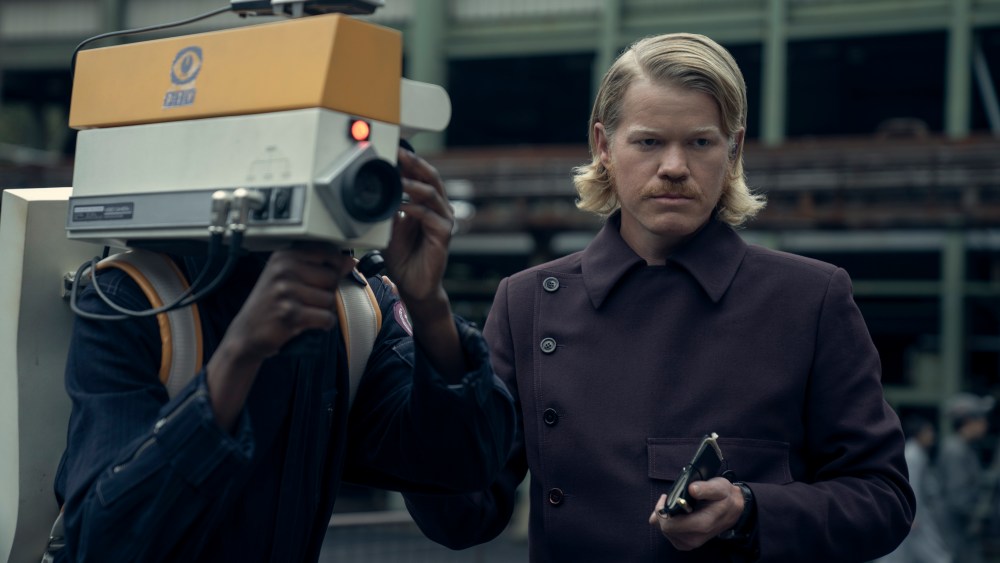
“The Hunger Games: Sunrise on the Reaping” might be Haymitch Abernathy’s prequel movie, but Oscar nominee Jesse Plemons was the first person cast in the film. Plemons plays Plutarch Heavensbee, a Capitol insider, who becomes a key figure in the rebellion that sparks in the latter half of Suzanne Collins’ original trilogy of dystopian novels. In the second book, “Catching Fire,” and its 2013 film adaptation, Plutarch is introduced as the Head Gamemaker, tasked with creating the brutal trials in the Hunger Games. (The late Philip Seymour Hoffman originated the role.) At the end of that story, Katniss Everdeen (Jennifer Lawrence) learns that Plutarch was really scheming from inside the establishment to help support the rebels. But “Sunrise on the Reaping” takes place 25 years before those events, so casting the younger Plutarch was key. “I’m a huge fan of Jesse’s,” franchise director Francis Lawrence tells Variety. “Had never worked with him before, and had always wanted to, and thought he would be perfect.” Plemons, of course, is one of the blockbuster movie’s most accomplished stars — one of the star-studded ensemble’s seven Oscar nominees: Jennifer Lawrence and Kieran Culkin are winners, with Glenn Close receiving an honorary Oscar earlier this month. “We had a lot of fun casting all these people fans are familiar with for this movie. But with [Plutarch] specifically, there was a lot more development,” Lawrence adds, sharing that he and “Hunger Games” producer Nina Jacobson spent considerable time working with Collins on Plutarch’s arc. “He’s an infiltrator,” Lawrence explains. “He’s the guy at the beginning of the formation of the resistance, and at the same time, has to get to the place where by ‘Catching Fire’ he’s at Snow’s side and so trusted. So, it was on us to figure out how to portray Plutarch in a way that is believable. And that was fun because we were adding scenes that weren’t in the book.” Francis Lawrence directs Jesse Plemons in “The Hunger Games: Sunrise on the Reaping.” Murray Close/Lionsgate Philip Seymour Hoffman and Woody Harrelson in the 2013 “Hunger Games: Catching Fire” Murray Close/Lionsgate Book readers might’ve noticed a new Plutarch scene in the “Sunrise on the Reaping” movie — where Plemons appears bruised and bloodied after being brutally interrogated by President Snow (Ralph Fiennes), who’s learned of a secret plot to sabotage the 50th Hunger Games. “That was a keystone scene for us, and we went over and over and over different approaches of it,” Lawrence says. “How can we have him be active on these two distinct paths: one is, ‘How can I keep this resistance alive, but a secret?’ And ‘How can I seem utterly loyal and faithful to Snow, who is very, very smart?’ It’s become one of my favorite scenes in the movie.” Lawrence kicked off conversations with Plemons by sending Collins’ unpublished manuscript. The actor cracked open the book, but because he was also working on “Digger,” he hadn’t made it to the final pages before the finished script came in. “I read the script, and then finished the book, and was surprised by how engaging it was and how complex the character was,” Plemons tells Variety over the phone from his home in Texas. “And I was really blown away by the script and the book.” Indeed, Plutarch is a meaty character. But he also had to consider that the role was originated by Hoffman, one of his favorite actors of all time, who’d also played his father in 2012’s “The Master.” As such, Plemons knew saying yes would come with plenty of questions from reporters about how it felt to continue the late Hoffman’s “legacy” after the actor’s unexpected death in 2014. Even after filming the part, Plemons hasn’t quite ironed out how to articulate his feelings on such a lofty question. “That’s a tough one to answer,” Plemons replies, thoughtfully, when I ask how he feels about all of that. “I’m definitely honored to have the opportunity to play this character. I wish I had a better answer for you, but it’s complicated.” Less complicated are his feelings about the “Hunger Games” franchise’s larger message, which was a key factor in his decision to take the part. “I find it a big accomplishment when a film or a book that has such a wide appeal is able to tackle real-world themes and issues everyone feels and relates to, that connect to all of our lives,” Plemons says. Read on as Plemons explains how he approached Plutarch’s prequel arc, including what he garnered from Hoffman’s performance, and why he and Lawrence debated over the complex character’s true motivations. In the original trilogy, we find out that Plutarch is secretly a revolutionary. And in this story, we realize he’s had to play this role for 25 years. What struck you about that? Many things. One, just the nature of doing a prequel like this. It was interesting knowing where the character ends up and how all these relationships progress, and then realizing there was actually more space to play and create ourselves. To fill in this very large blank over the course of 25 years. And there was something, just in the scope of the amount of time that he has been fighting and infiltrating the capital, there’s a sort of double agent aspect. There’s a sort of philosopher side to him. There’s most definitely an importance on knowledge that he’s trying to instill in Haymitch. And at the same time, what I was most interested in was his very pragmatic sense of hope, which is not at all shrouded in any sort of rose-colored idealism. It’s very rooted in the reality of how difficult and almost impossible it’s going to be, and I was just really intrigued by that on a personal level. The other interesting aspect is that he winds up being with the good guys, the resistance. But even still, in his relationship with Haymitch, I feel like I was constantly questioning — and I feel like the audience probably will too — just how expendable he feels Haymitch is for the greater good. All the while, he’s at least, to me, growing pretty fond of him as the story goes on. So there were just a lot of complexities that I really enjoyed. Jesse Plemons (as Plutarch Heavensbee), Joseph Zada (as Haymitch Abernathy) and Glenn Close (as Drusill Sickle) in “The Hunger Games: Sunrise on the Reaping.” Murray Close/Lionsgate One of Plutarch’s main functions is helping feed the propaganda machine. During the Reaping, for example, we see how Plutarch recognizes the bigger picture of how to tell a great story. It’s kind of cool to watch him as a director and producer, and he brings a bit of levity, too, to a very tough scene. That was the first sequence I shot, which was great. It’s obvious he’s incredibly intelligent. He’s able to sort of play this role. And I really loved that sequence with Glenn [Close]. I’m assuming they’ve known each other practically all of Plutarch’s life; she’s probably like a crazy aunt in some way. And it was really fun to play with maniuplating Drusilla without her knowing it. It’s interesting. Obviously, his agenda is to prove himself to Snow and everyone in the Capitol. And at the same time, there must be something kind of alluring about pulling this [rebellion] off. It was really interesting, and Francis definitely allowed for some space, especially in the sequence where we’re filming Haymitch saying goodbye. We brought in a little more of the book there and a little more of Plutarch handling the camera operator, being a little more hands-on than was in the scene. Francis is known for adding scenes that are missing from the books. In this case, he expanded the scene after Snow interrogates Plutarch. Tell me a little bit about adding that scene, and what it shows about what that character endured to keep up this ruse. That scene, because it was a new addition that wasn’t in the book, was something that I could definitely see the need for — to see where Plutarch was in all of this. Aside from seeing in the library earlier on, it’s the only time you get to see Plutarch with Snow, and it was just an absolute thrill getting to work with Ralph. It’s such a game of intellect between the two. Plutarch is trying to gauge how much Snow knows, whether he knows that he’s involved and who he knows is involved. At the same time, he’s trying to double down and act as if he’s truly working in the interest of the Capitol. We played around a lot with that scene. You and Francis sometimes disagreed about Plutarch’s motivations. What was your perspective on it? I don’t think there’s like a black-or-white, or cut-and-dry, easy way of categorizing Plutarch or his motivations. The main debate Francis and I were in was whether or not his motivations were rooted in some sort of self-centeredness. A kind of wanting to be the hero, or just wanting to stick it to the Capitol and his family, that I’m sure, as a child, he had very conflicted feelings about. I felt his intentions were pure. The fact that he would like to stick it to the Capitol, that’s most definitely part of it. He’s most definitely entitled and privileged. But I think everyone’s given a choice, and at some point, Plutarch decided that knowledge is of the utmost importance, and I think, morally, he is very much on the side of what is right and he sees the injustice. I believe his intentions are pure. I just don’t know why you would make it all that time if your motivations were about your own self-interest. You’d get tired at a certain point. It wouldn’t be enough to fuel you for 25 years. Yeah. Jesse Plemons (as Plutarch Heavensbee) in “The Hunger Games: Sunrise on the Reaping.” Murray Close/Lionsgate You had the unique circumstance of having worked with Philip Seymour Hoffman. How did you approach creating the prequel version of Plutarch? Did you watch his performance in the earlier films? Or did you call on things you observed from working together? I had a lot of conversations with some of the other actors that were playing characters that were established in the other films, and we all had our own unique challenges and thoughts about how best to capture that essence, while at the same time taking some freedom in the fact that 24-25 years is a long time. The thing that jumped out at me in the film that he was in [Hoffman first appeared in 2013’s “Catching Fire”] was that they were still most definitely fully committed to the cause, but you could see the time. You could see the weariness of all those characters. There were little things that I was conscious of and tried to connect to his performance, but for the most part, I felt like this is a very different Plutarch. He’s beginning his journey and is incredibly ambitious, and the whole energy of his pursuit just felt very different, and all the relationships, like his relationship with Snow, are just beginning. So, it wound up feeling like there was quite a bit of room. The whole idea is Suzanne writes the book, and that determines where there’ll be more movies. But because there is so much more of Plutarch’s story to potentially tell, would you be interested in signing on again if that opportunity came? Most definitely. I can’t imagine where her mind will go next — no one can. But, personally, selfishly, what I would love to see is Plutarch’s teenage years. I thought a lot about that while we were shooting, but I don’t think I could play that part. I don’t know. There are prosthetic ways or de-aging ways we could make this happen. [Laughs.] Like “The Irishman.” This interview has been edited and condensed for length and clarity.
Jesse Plemons on the ‘Honor’ of Playing Plutarch in ‘The Hunger Games’ After Philip Seymour Hoffman and Debating Director Francis Lawrence Over the Character’s Motivations
Full Article
Original Source
Read the full article at Variety →KhanList aggregates and links to publicly available news content. We do not host full articles from third-party sources. Always verify important information with original sources.