
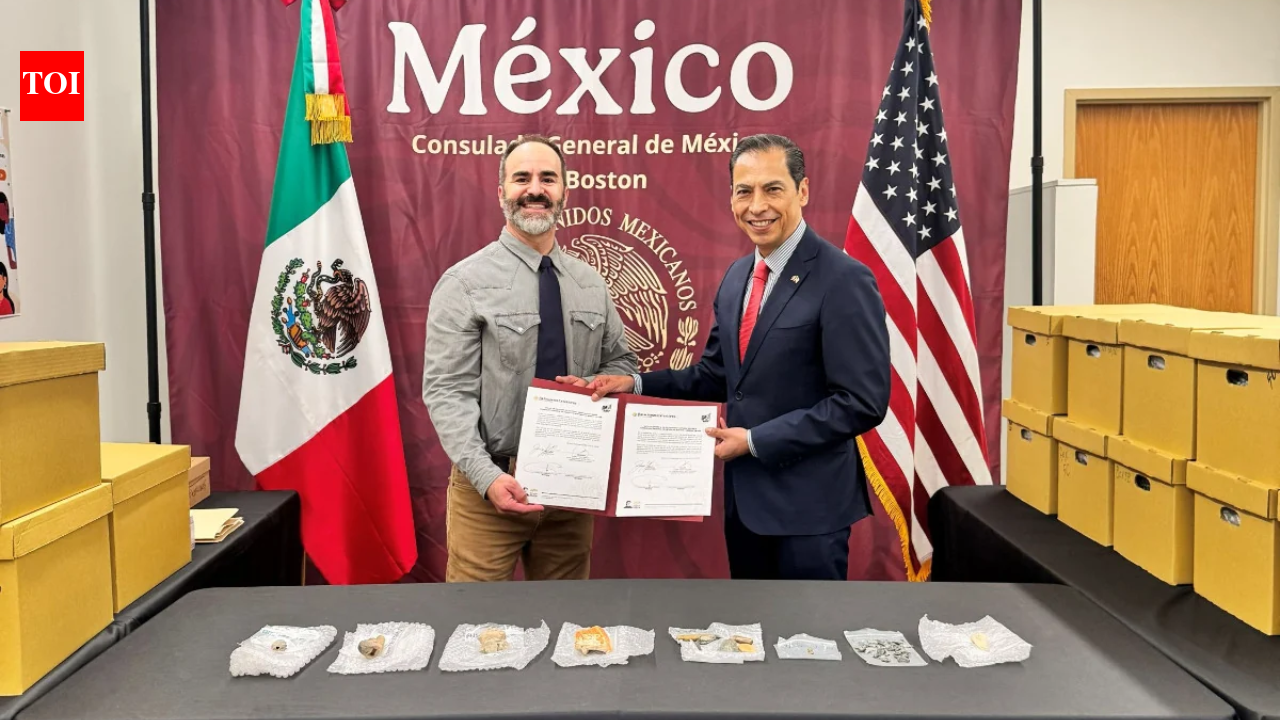
A routine house clearance in western Massachusetts nearly sent more than 1,100 pieces of Mexico's pre-Hispanic history to a landfill. Instead, a man's decision to investigate unusual objects in a dumpster set off an unlikely rescue operation involving an archaeologist and more than 40 high school students in Connecticut. According to a joint announcement by Mexico's Foreign Affairs and Culture ministries on August 17, 2026, all 1,132 objects were eventually returned to the Mexican Consulate in Boston after nearly two years of work to clean, classify, catalogue and document them.The discovery began around two-and-a-half years before the handover, when Matthew Pioggia was helping clear an old house in western Massachusetts. Among the discarded belongings in a dumpster, he noticed objects that appeared unusual. Knowing that his relative by marriage, Jeremy Pilver, was an archaeologist, Pioggia photographed some of the items and sent him the pictures, hoping he could identify them.Pilver, who teaches archaeology at Farmington High School in Connecticut, immediately recognised that the objects appeared to be genuine archaeological material. Although he could not initially determine their precise cultural origin or age, he realised they needed to be rescued before the dumpster was emptied. He urged Pioggia to retrieve as many as possible.In an interview with NPR, Pilver recalled that Pioggia climbed into the dumpster and spent about four hours digging through the discarded material. The objects were mixed with personal belongings, household debris and other waste. Pioggia eventually brought Pilver around 50 box tops filled with recovered material. The collection was in poor condition, with dust and debris covering the objects and their containers. Pilver also noticed evidence that mice and other animals had been around them.What followed was a painstaking project that turned a high school classroom into an archaeological workspace. Pilver enlisted his students to help examine and document the collection. Over nearly two years, more than 40 students participated in cleaning the surfaces of the objects, sorting and classifying them, creating a digital inventory and database, taking photographs, documenting individual pieces and preparing them for professional packing.Archaeological collections also carry information through their materials, designs, condition and associations. Recording those details systematically helps researchers study and compare objects, particularly when their original excavation context is not fully known. Pilver told NPR that the students worked through the collection using a shared spreadsheet and were deeply engaged in the project. He described the experience as an opportunity to show them the less glamorous but essential laboratory work behind archaeology.As the students worked through the boxes, they also uncovered an important clue to the collection's history. Pioggia had rescued paperwork along with the objects. According to Pilver, the documents indicated that the artefacts had been loaned from Mexico City's National Museum of Archaeology to a researcher connected with a US university around 55 years earlier. The paperwork provided a link to their Mexican origins, although it did not establish exactly how the collection eventually ended up in the Massachusetts house or why it was discarded.The inventory was subsequently assessed by specialists from Mexico's National Institute of Anthropology and History (INAH). Their examination identified the collection as pre-Hispanic archaeological material originating in southeastern Mexico. It included objects from different periods, meaning their precise dates and cultural associations still need further investigation. The documentation supplied by Pilver is expected to help specialists establish more details about the collection's provenance and chronology.The largest category consisted of 1,053 ceramic fragments, many of them believed to have been used for domestic purposes. The pieces included smoothed, moulded, painted and incised pottery. The collection also contained two complete spindle whorls, objects traditionally used in textile production, and 18 fragments of figurines. Other recovered material included nine flakes of obsidian, a volcanic glass commonly used by ancient communities to make tools, and 11 flint flakes. The inventory also recorded three wood fragments, three stone polishers, an incomplete slab of metamorphic rock, a fragment of another stone slab and 36 shark teeth associated with the archaeological material.The objects were not all elaborate or immediately recognisable as historical treasures. Some were fragments of everyday pottery, while others included small decorative pieces. In his NPR interview, Pilver described a small bird-shaped pendant that may have been worn on a necklace and an object he believed could have been an ear ornament. Their significance lay not only in their appearance but also in what they could reveal about the people and communities that made and used them.For Pilver, identifying the objects was only one part of the responsibility. He believed they belonged to the people and culture from which they originated and that returning them was the ethical course of action. He coordinated with the Mexican Consulate General in Boston, the Foreign Affairs Ministry and INAH to arrange the voluntary handover. The students also helped photograph, document and professionally pack the collection for its journey back.In August 2026, the consulate formally received all 1,132 objects during a handover ceremony. Mexico's government described the collection as one of the largest archaeological groups received by the Boston consulate in recent years. The return was coordinated by the consulate in collaboration with INAH, the Foreign Affairs Ministry and academic institutions in the New England region.Speaking to NPR, Pilver described the handover as an enormous relief after more than two years of work. He recalled how consulate staff came out to receive the boxes one by one, saying he felt as though he had taken his first deep breath in about two-and-a-half years. He was particularly moved by the response of Mexican officials, who recognised the significance of the gesture.The project also gave the students an unusual opportunity to put archaeological ethics into practice. Instead of learning about cultural heritage and repatriation only through textbooks and classroom discussions, they were directly involved in documenting and returning objects to their country of origin. Their contribution extended beyond identifying and sorting the pieces to creating a record that can support future research.Mexico's Culture Ministry said the documentation provided by Pilver would be used to establish further dating and provenance information, potentially allowing the objects to serve as a comparative collection for academic study. The return also forms part of the country's wider efforts to recover archaeological and historical material held abroad.
Dumpster find saves 1,132 Mexican artefacts, students catalogue them
Full Article
Original Source
Read the full article at Timesofindia →KhanList aggregates and links to publicly available news content. We do not host full articles from third-party sources. Always verify important information with original sources.