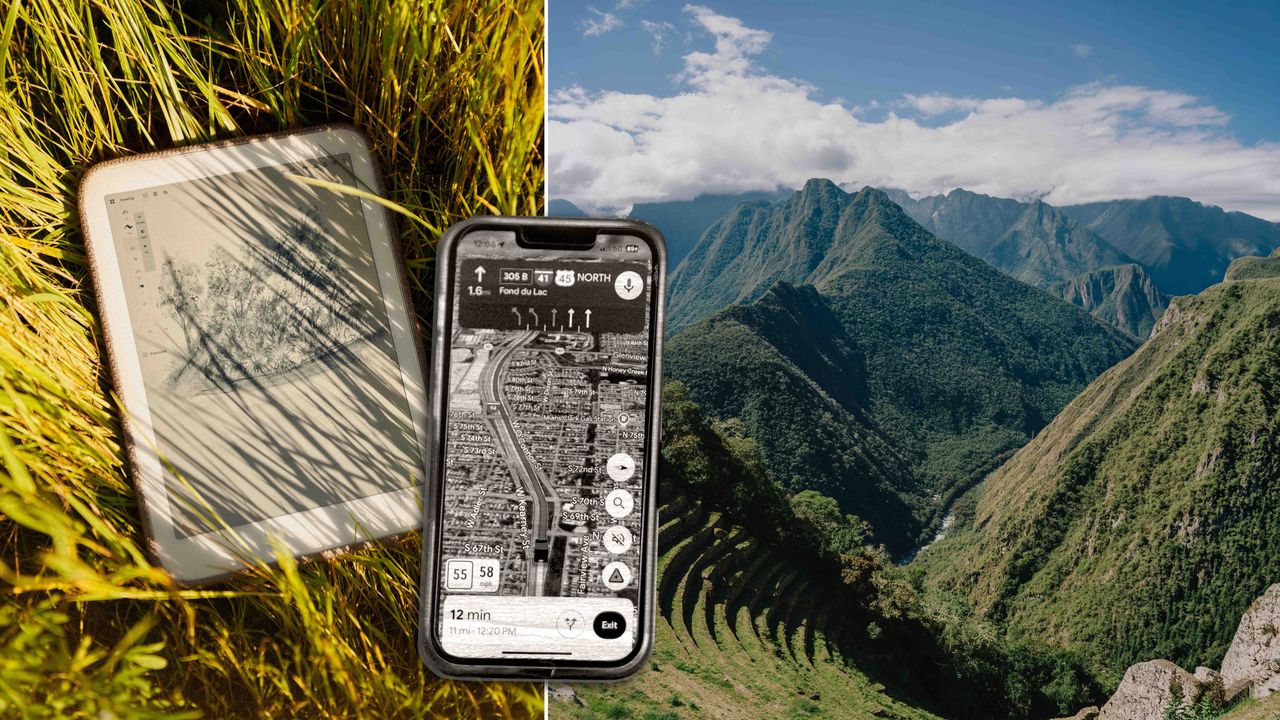
Not long ago, a group of anthropologists were climbing the Inca Trail, the legendary hike through the cloud forests of the Andes Mountains that concludes at Machu Picchu’s Sun Gate. Along the way, they swapped supposedly local stories about the region’s lore. Overhearing them, their trail guide was puzzled.Hikers trek the Inca trail Getty“[They] were telling each other these ancient tales, stories that I had never heard as a local,” says Miguel Angel Gongora Meza, founder and director of Evolution Treks Peru. A native Peruvian, he knows the region well as a professional guide for three decades. “So, I asked where they got those stories. They said, ‘AI!’ I tried to research them but couldn’t find anything about them. No wonder they sound so fabulous; they’re not true!”As survey after survey finds a sizable minority of travelers turning to chatbots for critical trip information, professional guides are finding themselves fact-checking a torrent of travel slop, from false facts about a place to fake places entirely. In September, for instance, Gongora Meza told the BBC about two tourists he’d stopped before they set off on a “perilous” trek to the “Sacred Canyon of Humantay,” a destination that doesn’t exist.If you similarly find yourself somewhere new, what travel tech can you actually trust to help you get to know a place? It’s a question travelers ask with greater frequency, as AI gets integrated into virtually every device and app you use on the go—like Gemini in Google Maps or an upgraded Siri “Visual Intelligence” feature coming to Apple’s iPhone camera with iOS 27, out this September. And a new wave of wearables makes clear Big Tech’s vision goes even further: cameras on glasses and cameras in future AirPods; glasses with augmented reality navigation; and real-time translation beamed into our ears.But as new AI features launch there’s a counter trend emerging that’s inspiring a more intentional, utility-first relationship with tech: think a new wave of “digital detox” devices—smarter than your average “dumbphone” capable only of texting and calling—and the resurgence of single-purpose gear that helps us log off and, well, connect. Below, we look at some of the ways technology is changing the way we travel.Planning: You can now chat with the map, but should you?The kind of misinformation guides like Gongora Meza find themselves increasingly needing to correct is par for the course with large language models, the kind of tech many people refer to when they say “AI” and “chatbots.” “Chatbot outputs are not based off of a database of facts. They are based on the next best guess of the words which come before it, based on existing training data, typically scraped from the web,” explains Alex Hanna, director of research at the Distributed AI Research Institute (DAIR).This can quickly get problematic when relied on for planning a trip to destinations underrepresented in the data. “If the training data set has 1,000 articles of ‘Best 10 things to do in New York,’ that will likely be more accurate than ‘What are 10 things which are off the beaten path in Peru,’” she explains. “Chatbots make things up and then they might happen to be correct.”Even so, tech companies are changing their apps and mobile operating systems around to nudge more travelers to use AI on our existing devices. “Whole interfaces have changed where it's designed around [AI]. It’s just everywhere,” says Julian Chokkattu, senior editor covering gear at Wired. “A lot of this is just largely changing the way we interact with our phones.”Earlier this year, for instance, Google Maps introduced Ask Maps, which integrates its Gemini large language models and Google promotes as a replacement for “research and sifting through reviews.” The company’s blog reads: “If you’re planning a trip, just ask, ‘I’m headed to the Grand Canyon, Horseshoe Bend, and Coral Dunes—any recommended stops along the way?’ You’ll get clear directions, ETAs, and insider tips from real people, like how to find a hidden hiking trail.”Sundar Pichai, chief executive officer of Alphabet Inc., presents on the new Ask Maps feature during the Google I/O Developers Conference in Mountain View, California. GettyBut while Google writes that this can “take the guesswork” out of a trip, Chokkattu advises travelers proceed with caution: “You spent so much money and saved up, and the last thing you want to do is leave the prep work to AI and realize on the day of that it’s not useful.”“If you are using it, double check your work—which is a little unfair in itself because we didn’t always have to do that. We had a time where we could trust Google searches and find information and relevant links.”Navigating: Big Tech wants you sporting their latest AI specsWhile Big Tech companies plug their latest AI products into every step of the planning process, they’re also investing heavily in trying to get travelers to wear AI devices on their faces.Meta positions its Ray-Ban glasses as the ultimate travel accessory; a recent billboard campaign featured South African model Nina Meyer asking her “AI glasses” for the best pizza in Brooklyn, with the headline reading “This is how Nina explores the city.”Two pairs of Ray-Ban Meta Smart Glasses, which have a small LED light meant to signal that they are being used to film. Getty“That’s going to become more of a thing later this year as Google is coming out with their own glasses,” says Chokkattu, who has followed the space for more than a decade. Google has partnered with eyewear brands Gentle Monster and Warby Parker for its forthcoming Android XR specs (XR being shorthand for the buzzword “extended reality”). Snap’s specs, unveiled in June, retail for $2,195. Meanwhile, Apple looks to late 2027 for the launch of its own competitive product.Chokkattu tracks lots of travel use cases the glass makers are promoting: “It's access to voice assistants in your ears to ask you to translate this sign just by looking at it rather than having to pull out your phone, or having real-time translations, or even just closed real-time captioning for people who are hard of hearing.”“But it comes with a lot of baggage and privacy implications,” he acknowledges. “Back when the original Google Glass launched [in 2013], we called them glassholes,” citing the pejorative used then for early adopters, before Google discontinued the product in 2015. “Now, it's coming back to that where, even though everyone has a camera in their pocket now, people are still very much wary of cameras on smart glasses,” with particular concern regarding men filming women without consent using Meta Ray-Bans. Reached for comment on the product and its potential misuses, a Meta Spokesperson told us, “The people who use them and those around them need to trust them. That's why we built privacy into our AI glasses from the ground up. For example, every pair has a capture LED that blinks when you take a photo or video that you can save or share, it can’t be turned off, and if someone covers or damages the LED, the camera is disabled. We will keep strengthening our protections as our glasses become even more capable.”Overcoming the social stigma remains the biggest challenge the tech firms face with wider adoption. Then there’s also the fact that most things you can do with smart glasses you can already do with smartphones.Logging off: The rise of digital minimalism beyond the “dumbphone”Travel tech often promotes a vision for exploration without friction. Ironically, though, it’s friction that some travelers are seeking out when they’re on the ground somewhere new.Consequently, there’s a resurgent interest in gadgets that aim to do one—or only a few—things well. And this rising counter-trend isn’t mere nostalgia for dumbphones. Rather, it looks like a surging growth in compact cameras (take the viral Fujifilm X Half and the X100VI, which has kept selling out). It’s the reinvigorated interest in e-readers and “hippie” tablets with monochrome screens. And then there’s a headline-grabbing crop of “digital detox phones” such as the retro-looking Commodore flip—which blocks Instagram but lets you use Spotify and call an Uber—and the Light Phone III’s minimal suite of tools, including GPS directions and a forthcoming open, user-developed tool library.“This moment is really similar to how we as a society changed our attitude towards smoking,” says Kaiwei Tang, co-founder and CEO of Light. (To stress the smoking metaphor, some London restaurants and bars are even banning smartphone use, as digital detoxing is en vogue.) “We’re so out of balance the last 20 years, with smartphones, AI goggles, and social media. People are pushing back.”Daylight ComputerDaylight DC-1The Light PhoneLight Phone IIIThat doesn’t mean giving up those other devices entirely. “It’s not black and white,” he admits, with “a lot of our users keeping a smartphone as a secondary device” they might use on a trip, Tang says. “You realize you don’t need this computer with you 24/7.”And Wired’s Chokkattu, who has reviewed many of these gadgets, says that’s exactly how many companies are pitching them as a “weekend phone.” “I think having something like a digital detox phone makes more sense in the travel mindset because you are actively trying to avoid all of those things.”Gongora Meza of Evolution Treks Peru says that’s what we need to prioritize with greater intention: engaging with the people and places around you. He’s not anti-tech; he cites hiking apps with downloadable maps, and others that help you identify rocks and stars, as examples. The difference is tools that help you engage with the world around you rather than retreat.“The struggle is not just with information [travelers] obtained from AI but helping them detox from technology, taking their attention from their phones to the places they’re visiting, from their screens to the immensity of the mountains, the colors of the forests,” Gongora Meza says. “To connect,” he emphasizes, “that’s something we need more than ever with all the events humanity is facing.”
Dumbphones, Smart Glasses, and More Tech Trends That Are Shaping the Way We Travel
Full Article
Original Source
Read the full article at Cntraveler →KhanList aggregates and links to publicly available news content. We do not host full articles from third-party sources. Always verify important information with original sources.