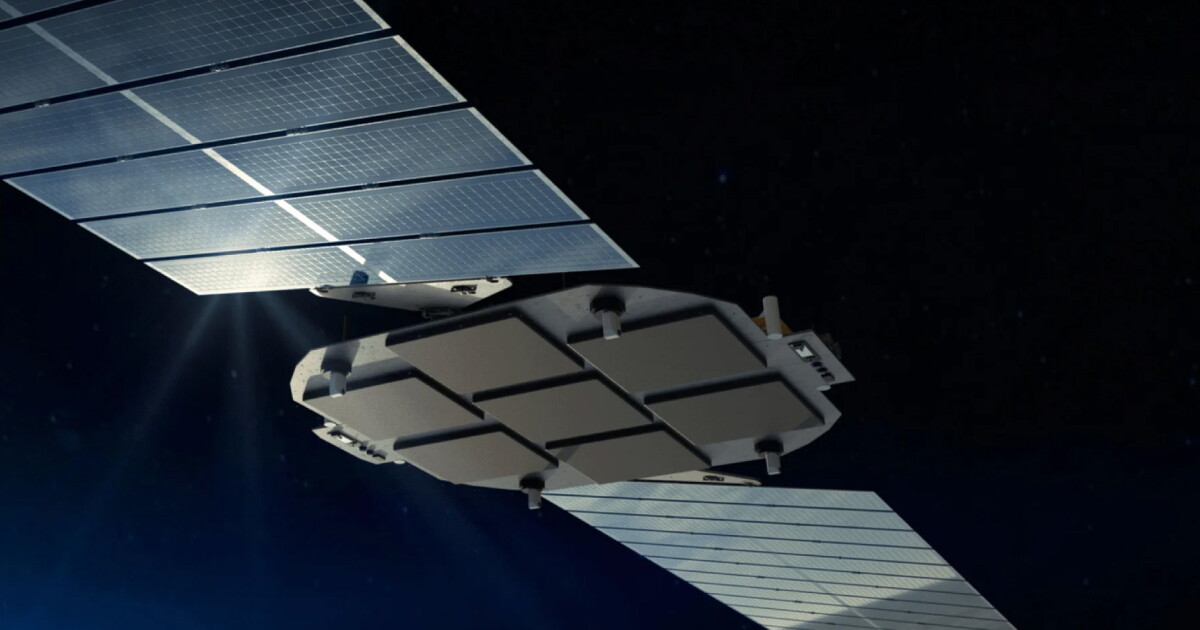
The US Space Force – the youngest branch of the country's armed forces – is investing billions of dollars in next-gen tech to expand its threat detection capabilities.Its Space-Based Airborne Moving Target Indicator (SB-AMTI) program is being developed to augment airborne and terrestrial military technologies that track moving targets in the air. The US Space Force (USSF) notes that these platforms presently face "unprecedented risks from increasingly sophisticated anti-access/area-denial systems."As part of this program, the USSF has inked a US$397 million deal with space systems firm Rocket Lab to deploy its 'flatellites' in low earth orbit (LEO) to track airborne threats.Another company, which the USSF hasn't named due to security concerns, has been awarded a $218 million contract to develop a system for the same purpose. SpaceX, meanwhile, has a $4.16 billion agreement to build out a satellite constellation for the SB-AMTI program. This should be operational by 2028. Artist impression of Rocket Lab's Flatellite spacecraft inside a Neutron launch vehicle fairingRocket Lab For its part, Long Beach, California-headquartered Rocket Lab's solution sounds ideal for the task at hand. Its flatellite is described as "a next-generation flat satellite design optimized for large constellations – with space-based sensors and low latency, high bandwidth communication links."This unique low-profile satellite design allows many of them to be stacked in a payload for efficient deployment. Propulsion, flight software, avionics, reaction wheels, star trackers, separation system, solar arrays, radios, composite structures, fuel tanks, and other components are all integrated into a compact frame. Rocket Lab says this allows it to produce large volumes quickly and consistently.The company also operates launch services, so it'll get the flatellites on board its own upcoming Neutron rocket. Standing 141 ft (43 m) tall, this is a reusable medium-lift rocket with a 13-ton payload capacity, specially designed for satellite constellation deployment and interplanetary missions. The upcoming Neutron is a reusable rocket designed to deploy satellite constellations with a 13-ton payload capacityRocket Lab Additionally, Rocket Lab says it'll operate these flatellites from secure facilities, providing data and track information to the USSF.The firm first announced its flatellites last February. The SB-AMTI program might well see the largest deployment of these yet. They aren't the first satellites to take this form, though: SpaceX's constellation of satellites for providing Starlink connectivity also have a flat-panel design.Source: Rocket Lab
Space Force invests millions in advanced threat detection 'flatellites'
Full Article
Original Source
Read the full article at Newatlas →KhanList aggregates and links to publicly available news content. We do not host full articles from third-party sources. Always verify important information with original sources.